- Quick Summary
- Is WHMIS Training Mandatory in Ontario?
- Who Must Receive WHMIS Training in Ontario?
- General WHMIS Education Versus Workplace-Specific Training
- What Must WHMIS Training Cover?
- Ontario Employer Responsibilities Under WHMIS
- Is Online WHMIS Training Enough in Ontario?
- How Often Is WHMIS Training Required?
- Does WHMIS Training Transfer to a New Employer?
- Do All Workplace Products Require WHMIS Training?
- Current 2026 WHMIS Compliance Note
- What WHMIS Training Records Should Employers Keep?
- Ontario WHMIS Compliance Checklist
- Frequently Asked Questions
- Arrange WHMIS Training for Your Ontario Workplace
WHMIS training is mandatory for Ontario workers who work with hazardous products or may be exposed to them through their work.
However, completing a generic course and receiving a certificate does not necessarily satisfy all of an employer’s WHMIS responsibilities.
A compliant workplace program has two connected training components:
- General WHMIS education that explains the hazard communication system
- Workplace-specific training based on the products, procedures and exposure risks at the worker’s actual job
Employers must also maintain labels, provide access to current safety data sheets, establish safe procedures, evaluate worker understanding and review the WHMIS program regularly.
This guide explains the WHMIS training requirements Ontario employers should address before allowing workers to use, handle, store or work near hazardous products.
Quick Summary
Ontario employers must provide WHMIS education and training to workers who use hazardous products or may be exposed to them during their duties.
Training must help workers understand:
- The hazardous products present in the workplace
- Supplier and workplace labels
- WHMIS pictograms and hazard statements
- Safety data sheets
- Safe handling, storage and disposal procedures
- Exposure controls and personal protective equipment
- Spill, leak and emergency procedures
- Where to obtain additional hazard information
A general online course can cover portable WHMIS knowledge. The employer must still provide training about the workplace’s products, exposure routes, controls and emergency procedures.
| Requirement | What the employer should provide |
|---|---|
| General WHMIS education | Hazard classes, pictograms, labels and SDS knowledge |
| Workplace-specific training | Product hazards, procedures, controls and emergencies |
| Hazard information | Supplier information and other hazards known to the employer |
| SDS access | Current information that workers can readily access |
| Labels | Supplier or workplace labels where required |
| Worker evaluation | A method of confirming that workers understand the training |
| Program review | Review at least annually and when conditions change |
| Refresher training | Training when products, hazards, procedures or worker knowledge change |
| Records | Evidence of training, evaluation, reviews and corrective action |
The central compliance principle is:
A certificate documents course completion. The employer must still confirm that the worker understands how to work safely with hazardous products in that workplace.
Is WHMIS Training Mandatory in Ontario?
Yes. WHMIS is part of Canada’s national hazard communication system and is implemented in Ontario through provincial occupational health and safety requirements.
Ontario employers must provide education and training when workers:
- Work directly with hazardous products
- Handle, store or dispose of hazardous products
- May be exposed during normal operations
- May be exposed while performing maintenance or cleaning
- Supervise workers who handle hazardous products
- Participate in emergency or spill response
- Work near processes that could release a hazardous substance
The training requirement is not limited to workers who pour, mix or apply chemicals.
A maintenance worker could be exposed while opening equipment. A cleaner may handle concentrated products. A warehouse worker may respond to damaged containers. A supervisor may need to direct workers during a leak or spill.
Each of these roles may require WHMIS education and workplace-specific instruction.
Employers should identify exposure, not rely only on job titles
A useful WHMIS training assessment examines tasks and exposure scenarios rather than relying on job titles.
For example, an office employee may not normally require extensive product-specific training. However, that could change if the employee stores cleaning chemicals, handles printing products or has emergency-response responsibilities.
Similarly, a contractor or temporary worker may need instruction when their work could expose them to hazardous products present at the site.
Employers should ask:
- Which products could this person encounter?
- How could exposure occur?
- What task could disturb or release the product?
- What protective measures must the person understand?
- What should the person do during an emergency?
Who Must Receive WHMIS Training in Ontario?
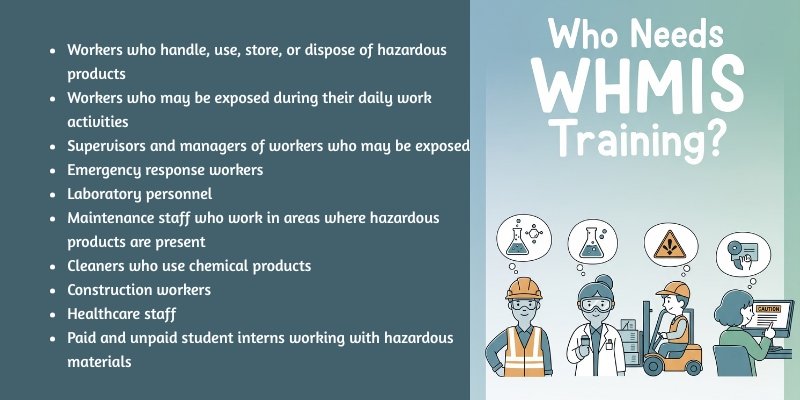
Workers should receive WHMIS education and training when they work with a hazardous product or may be exposed to one as part of their work.
This commonly includes:
- Production workers
- Warehouse employees
- Cleaners and custodial staff
- Maintenance personnel
- Laboratory workers
- Construction workers
- Automotive and mechanical workers
- Healthcare workers
- Agricultural workers
- Supervisors and managers
- Spill-response personnel
- Temporary and agency workers
- Contractors working around workplace chemicals
The scope of training should match the person’s duties.
A purchasing employee may need to understand procurement and SDS requirements. A forklift operator transporting drums may need spill and damaged-container procedures. A maintenance technician may need detailed information about isolation, ventilation and respiratory protection.
Workers do not necessarily need identical training. They need enough education and instruction to recognize hazards and perform their assigned work safely.
General WHMIS Education Versus Workplace-Specific Training
This is one of the most important distinctions in Ontario WHMIS compliance.
General WHMIS education
General education teaches workers how the WHMIS system communicates hazard information.
It normally covers:
- Worker, employer and supplier responsibilities
- Hazard groups, classes and categories
- WHMIS pictograms
- Signal words
- Hazard statements
- Precautionary statements
- Supplier labels
- Workplace labels
- Safety data sheet format
- How to locate information within an SDS
This knowledge is relatively portable. A worker can use it when reading labels and SDSs at another workplace.
Workplace-specific WHMIS training
Workplace training explains how hazardous products are used and controlled in the worker’s actual environment.
It should cover:
- The hazardous products used at the location
- Where the products are stored
- How workers may be exposed
- Required engineering controls
- Safe handling and dispensing procedures
- Required gloves, respirators and other PPE
- Storage incompatibilities
- Waste and disposal procedures
- Spill and leak response
- First aid and emergency procedures
- Workplace label procedures
- How to access the employer’s SDS system
A worker who understands pictograms may still be inadequately trained if they do not know which gloves to wear, where the eyewash station is located or how to respond to a spill.
Key distinction: Education teaches workers how WHMIS communicates hazards. Workplace-specific training teaches them how to control those hazards during real work.
Employers arranging [WHMIS training in Ontario] should confirm that the course covers general education and that workplace-specific instruction will also be completed.
What Must WHMIS Training Cover?
The exact content depends on the workplace and hazardous products involved. A complete program should address the following subjects.
1. Supplier labels
Workers should understand the information displayed on a supplier label, including:
- Product identifier
- Supplier identifier
- Pictograms
- Signal words
- Hazard statements
- Precautionary statements
- Supplemental information
Workers should also know not to use a product when the label is missing, damaged or unreadable.
2. Workplace labels
Training should explain when a workplace label is required.
This may include situations where:
- A hazardous product is transferred into another container
- A supplier label becomes damaged or unreadable
- A hazardous product is produced and used at the workplace
Workers should understand the employer’s labelling procedure and who is authorized to prepare replacement labels.
3. Safety data sheets
Workers should know how to access and interpret the SDS for each hazardous product they use.
Training should help workers locate information about:
- Product identification
- Hazard identification
- Ingredients
- First aid
- Firefighting
- Accidental release
- Handling and storage
- Exposure controls
- Personal protective equipment
- Stability and reactivity
- Toxicological information
- Disposal and transport considerations
Workers do not need to memorize every line. They should know where to find the information they need before work begins and during an emergency.
4. Safe use, handling and storage
Product-specific instruction should explain:
- How the product is received
- Where it is stored
- Which products must be separated
- How it is transferred or dispensed
- Which equipment is used
- How exposure is controlled
- Which work practices are prohibited
- How waste is collected and removed
5. Exposure prevention
Workers must understand how the employer protects them from inhalation, skin contact, eye contact, ingestion and other exposure routes.
Training may cover:
- Substitution
- Enclosures
- Local exhaust ventilation
- General ventilation
- Automated dispensing
- Restricted-access procedures
- Work scheduling
- Hygiene practices
- Personal protective equipment
PPE should not be presented as the only control when more effective engineering or administrative measures are available.
6. Emergency procedures
Workers should know what to do when:
- A container leaks
- A product spills
- A worker is exposed
- Vapours enter the air
- A fire occurs
- A label is missing
- The wrong products are mixed
- An alarm or evacuation is initiated
Training should also establish the limits of the worker’s role.
A worker who has basic WHMIS education should not assume they are qualified to clean every chemical spill.
Ontario Employer Responsibilities Under WHMIS
Training is only one part of an employer’s WHMIS program.
Ontario employers should also:
Maintain a hazardous-product inventory
The employer should know:
- Which products are present
- Where they are used and stored
- How much is kept
- Which departments use them
- Which employees may be exposed
- Whether current labels and SDSs are available
The inventory should be updated when products are purchased, removed or replaced.
Ensure products are properly labelled
Hazardous products must have the appropriate supplier or workplace identification.
Employers should have a process for:
- Inspecting labels
- Replacing damaged labels
- Labelling secondary containers
- Matching product names on labels and SDSs
- Preventing the use of unidentified products
Provide access to safety data sheets
Workers must be able to access SDS information when they need it.
A digital system may be used, but the employer should consider:
- Whether workers can access it during every shift
- Whether passwords or device restrictions create delays
- What happens during a power or network failure
- Whether workers know how to search the system
- Whether emergency responders can access the information
Establish safe work procedures
The employer should develop procedures for:
- Use and handling
- Storage
- Transfer and decanting
- Waste disposal
- Spill response
- Exposure response
- Products in pipes, tanks or process systems
- Maintenance and non-routine work
Provide effective education and training
The employer may deliver training internally or select a qualified external provider.
However, outsourcing the course does not transfer the employer’s legal responsibility.
The employer must ensure that the program matches:
- Worker duties
- Workplace products
- Exposure risks
- Safe procedures
- Emergency arrangements
- Worker language and learning needs
Consult the JHSC or health and safety representative
The joint health and safety committee or worker representative should be involved in developing, implementing and reviewing the WHMIS education and training program where applicable.
This can help identify:
- Missing products
- Weak procedures
- Training gaps
- Label problems
- SDS access issues
- Worker concerns
- Lessons from incidents and inspections
Evaluate worker understanding
Attendance alone does not show that training was effective.
Employers should confirm that workers understand the material through methods such as:
- Written or online knowledge tests
- Verbal questioning
- Workplace demonstrations
- Procedure walkthroughs
- Label and SDS exercises
- Observation during work
- Emergency drills
A worker should be able to answer four practical questions for each product they use:
- What are the hazards?
- How do I protect myself?
- What should I do in an emergency?
- Where can I find more information?
Is Online WHMIS Training Enough in Ontario?
Online training can be an effective way to deliver the general education component of WHMIS.
A well-designed online course can teach:
- Responsibilities
- Hazard classes
- Pictograms
- Labels
- Safety data sheets
- Basic control principles
However, an online course usually does not know:
- Which products the employer uses
- How those products are stored
- The workplace ventilation system
- Which PPE has been selected
- Where spill kits are located
- The employer’s emergency procedure
- How products are transferred or disposed of
Online-only completion should therefore not automatically be treated as the entire WHMIS program.
A stronger training process includes:
- General classroom or online education
- Workplace-specific product instruction
- Review of relevant labels and SDSs
- Demonstration of controls and PPE
- Emergency-procedure instruction
- Confirmation of worker understanding
- Documented authorization to perform assigned work
How Often Is WHMIS Training Required?
Ontario’s WHMIS education and training program should be reviewed at least annually.
This does not automatically mean every worker must repeat the same full course every year.
The annual review should determine whether:
- New products were introduced
- Products or classifications changed
- Labels or SDSs were updated
- Procedures changed
- New exposure risks were identified
- Controls or PPE changed
- Incidents revealed knowledge gaps
- Workers still understand the required procedures
Refresher training should be provided when the review or workplace conditions show that it is necessary.
For a detailed discussion of certificate dates and refresher triggers WHMIS Training Expiry in Ontario: Validity, Annual Review & Refresher Rules]
Does WHMIS Training Transfer to a New Employer?
General WHMIS knowledge may transfer between employers. Workplace-specific training does not fully transfer.
A worker may already understand:
- Pictograms
- Labels
- Hazard classes
- Safety data sheets
The new employer must still explain:
- The products used at the new workplace
- Site-specific exposure risks
- Storage locations
- Required control measures
- PPE requirements
- Spill procedures
- Emergency arrangements
- SDS access
The new employer may accept evidence of previous general education, provide a knowledge assessment or require the worker to repeat the course.
The employer remains responsible for determining whether the worker is adequately trained.
Do All Workplace Products Require WHMIS Training?
WHMIS applies to hazardous products that meet the applicable classification criteria.
Certain product categories may be excluded from some WHMIS supplier label and SDS requirements because they are regulated under other legislation. Examples can include:
- Consumer products
- Cosmetics, drugs and food
- Pest-control products
- Explosives
- Radioactive nuclear substances
- Tobacco products
- Manufactured articles
- Wood and wood products
- Hazardous waste in specified circumstances
An exclusion from WHMIS labelling or SDS requirements does not mean the product is harmless.
Employers may still need to provide instruction about:
- Health effects
- Safe use
- Storage
- Personal protective equipment
- Exposure controls
- Emergency procedures
For example, a cleaning product purchased from a retail store may be considered a consumer product. Workers using it frequently or differently from normal household use may still face workplace exposure risks.
Current 2026 WHMIS Compliance Note
Federal Hazardous Products Regulations were amended in December 2022. Suppliers received a three-year transition period ending in December 2025 to update affected classifications, labels and safety data sheets.
Ontario employers should now confirm that their hazardous-product inventory reflects current supplier information.
A practical 2026 review should include:
- Checking whether updated SDSs have been received
- Comparing current labels with SDS product identifiers
- Reviewing revised hazard classifications
- Updating training when new hazard information appears
- Removing superseded documents from active systems
- Confirming workers understand any changed precautions
This is especially important for employers that have not completed a full WHMIS inventory and program review since the transition ended.
What WHMIS Training Records Should Employers Keep?
Training records help demonstrate due diligence and make refresher planning easier.
A useful record should include:
- Worker’s name
- Job title or department
- Course title
- General education completion date
- Workplace-specific training date
- Products or product groups covered
- Training provider or instructor
- Assessment result
- Practical demonstration results
- Retraining or corrective action
- Review date
- Worker and instructor acknowledgement
Employers should also retain:
- Course materials
- Product inventory
- Current SDS records
- Label inspection records
- Annual program reviews
- JHSC consultation records
- Incident-related retraining records
- Revised procedures
The training matrix should distinguish between general WHMIS education and workplace-specific product instruction.
Ontario WHMIS Compliance Checklist
Before considering a worker ready to handle hazardous products, confirm that:
- A current hazardous-product inventory exists
- Required supplier labels are present
- Workplace labels are used where required
- Current SDSs are readily accessible
- General WHMIS education has been completed
- Product-specific hazards have been explained
- Safe procedures have been demonstrated
- Required controls and PPE are available
- Emergency procedures have been reviewed
- Worker understanding has been evaluated
- Training records have been completed
- The WHMIS program has an annual review date
A [workplace safety audit] can help identify gaps between certificate records and the WHMIS controls actually used on the floor.
Frequently Asked Questions
Is WHMIS mandatory for every employee in Ontario?
Not every employee automatically requires identical training. Workers who work with hazardous products or may be exposed through their duties must receive appropriate education and training.
Does a worker need WHMIS training before starting work?
Training should be completed before the worker is expected to use hazardous products or face exposure without adequate instruction and supervision.
Is a WHMIS certificate enough for compliance?
No. The certificate may document general course completion. Employers must also provide workplace-specific instruction and confirm worker understanding.
Is annual WHMIS training mandatory?
The WHMIS program should be reviewed at least annually. Full annual retraining is not automatically required for every worker, but refresher training must be provided when products, hazards, procedures or worker knowledge change.
Can an employer provide its own WHMIS training?
Yes. The employer may provide training internally or use a qualified external provider. The employer remains responsible for ensuring that the program is adequate.
Do supervisors need WHMIS training?
Supervisors who oversee workers using hazardous products or who may need to respond to exposure situations should receive training appropriate to their responsibilities.
Can WHMIS training be completed online?
The general education component can be delivered online. Workplace-specific training must still address the employer’s products, procedures and controls.
Do contractors need WHMIS training?
Contractors may require WHMIS information and site-specific instruction when their work could expose them to hazardous products. Responsibilities should be clarified before work begins.
Is there a mandatory WHMIS test score?
The central requirement is that workers understand the hazards and safe procedures. Employers should use written tests, demonstrations, questioning or other suitable methods to evaluate that understanding.
Arrange WHMIS Training for Your Ontario Workplace
WHMIS compliance involves more than issuing online certificates.
Workers need general hazard education, product-specific instruction and a clear understanding of the controls used at their workplace.
Achieve Safety helps Ontario employers build practical workplace safety trainings that connects WHMIS labels and safety data sheets to the products and procedures workers use every day.
For WHMIS training or help reviewing your workplace safety program, contact Achieve Safety at (647) 523-7554.
NOTES:
- General education covers WHMIS concepts and hazard classes, while training covers workplace procedures for use, storage, spills, disposal and emergencies.
- CCOHS identifies workers who use, store, handle or dispose of hazardous products, workers who may be exposed, supervisors and emergency responders as groups requiring education and training. It also states that employers remain legally responsible even when an outside provider delivers the course.
- The annual-review and refresher framework is based on CCOHS guidance that programs should be reviewed at least annually, with retraining triggered by new products, changed conditions, new hazards or updated safe-use information. Employers should also evaluate worker knowledge through tests, demonstrations or other suitable methods.
- The current-compliance section reflects the December 2022 Hazardous Products Regulations amendments and the transition period that ended December 15, 2025.
- Health Canada confirms that employers are responsible for worker education, product labels, workplace labels or SDSs when necessary, and appropriate protective controls.