- Boom Lift Course Details
- What Is Boom Lift Training?
- Core Components of Boom Lift Operator Training
- Is Boom Lift Training Required in Ontario?
- Boom Lift Operator Training Ontario Requirements Checklist
- How to Select a Qualified Training Provider
- New Ontario EWP Training Rules Begin January 1, 2027
- Who Should Take Boom Lift Training?
- Articulating and Telescopic Boom Lifts
- What Does Boom Lift Training Cover?
- Boom Lift Training Vs Scissor Lift Training
- Boom-Lift Hazards Operators Must Understand
- Pre-Use Boom Lift Inspection
- Pre-Use Boom Lift Inspection
- Ontario’s 2027 Boom Lift Training Requirements
- Practical Training and Operator Evaluation
- Equipment-Specific Familiarization
- Online Theory and In-Person Boom Lift Training
- Fall-Protection Training Prerequisite
- Boom Lift Record of Training
- Does Boom Lift Certification Expire in Ontario?
- Boom Lift Training Frequently Asked Questions
- Book Boom Lift Training in Ontario
- Call: (647) 523-7554
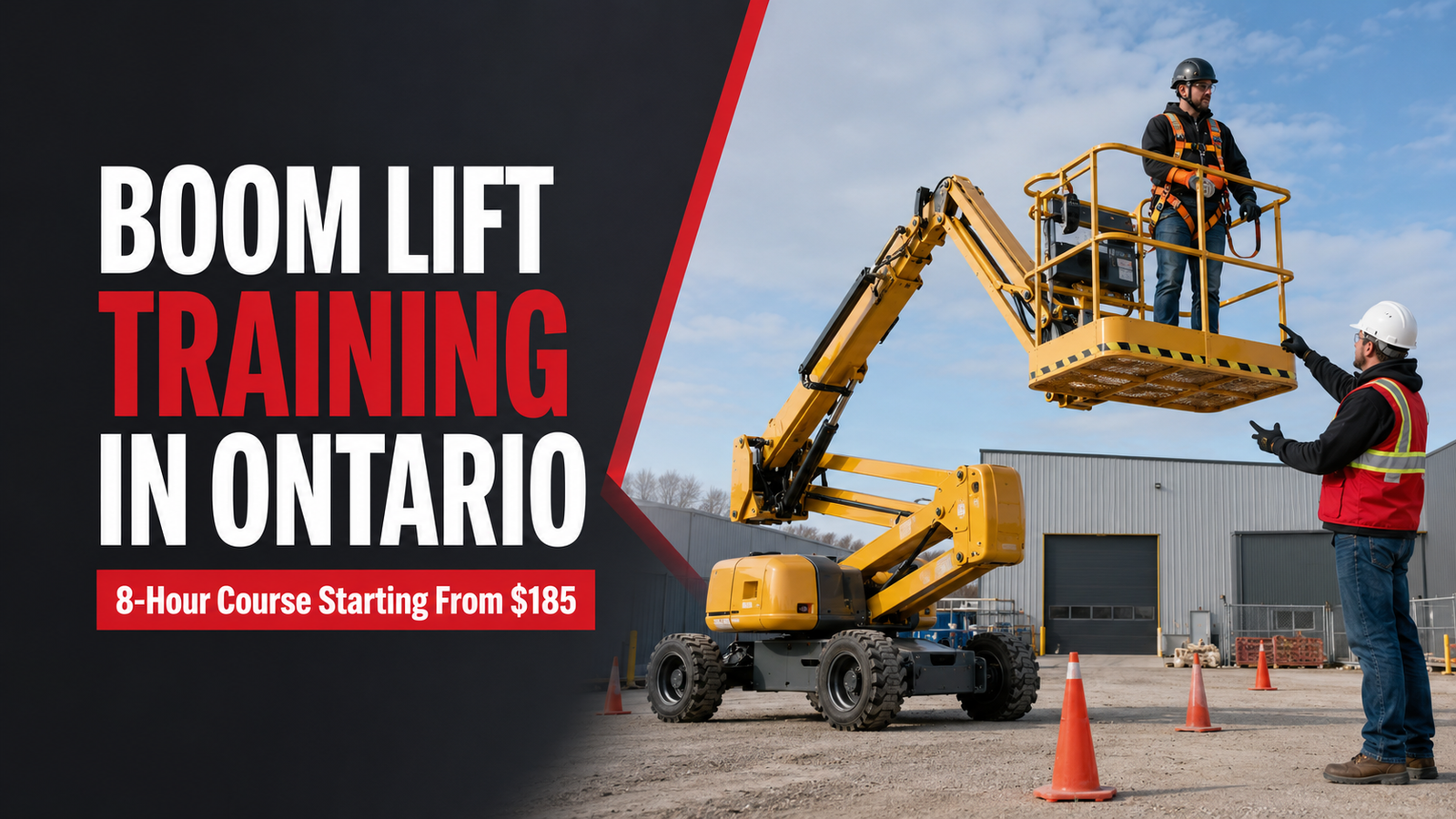
Boom lift training teaches workers how to inspect, position and operate boom-supported elevating work platforms safely.
Achieve Safety’s Boom Lift Training course is a part of EWP training that starts from $185. Participants complete theory instruction, hands-on training and a practical operator evaluation. Successful participants receive an Achieve Safety Record of Training.
The course focuses on the risks that make boom lifts different from scissor lifts, including horizontal outreach, tail swing, platform movement, ejection, entrapment and changing ground pressure.
Ready to get your team certified? Register Online
Boom Lift Course Details
| Course detail | Information |
|---|---|
| Course | Boom Lift Operator Training |
| Duration | Eight hours |
| Price | Starting from $185 |
| Training format | Theory and hands-on instruction |
| Assessment | Knowledge assessment and practical evaluation |
| Equipment focus | Boom-supported elevating work platforms |
| Standard alignment | CSA B354 series |
| Certificate | Achieve Safety Record of Training |
| Refresher training | Available |
| Fall-protection prerequisite | Working at Heights or applicable industrial fall-arrest training |
Course pricing may vary based on location, class size, delivery format and access to suitable equipment.
What Is Boom Lift Training?
Boom lift training is equipment-specific operator instruction for mobile elevating work platforms that can move a platform both vertically and horizontally.
Unlike a scissor lift, a boom lift can position its platform beyond the machine’s base. This extended operating envelope allows workers to reach over, around or above structures. It also changes the machine’s stability, movement and fall-risk characteristics.
Training prepares an operator to understand:
- How boom movement affects the platform
- How outreach changes stability and ground pressure
- How to inspect the machine before use
- How to identify overhead and electrical hazards
- How to avoid entrapment and crushing points
- How to manage tail swing
- How platform capacity affects operation
- How to use the approved fall-protection anchorage
- How to respond to equipment failure or an emergency
- When conditions require the operator to stop work
Boom Lift Training does not qualify a worker to operate every elevating work platform. Scissor lifts, vertical mast lifts and other equipment can require different practical training and familiarization.
Achieve Safety’s broader Elevating Work Platform Training addresses multiple EWP categories. This page focuses specifically on boom-supported equipment.
Core Components of Boom Lift Operator Training
Is Boom Lift Training Required in Ontario?
Ontario does not issue a government boom-lift licence. However, workers cannot simply use a boom lift because they have experience with other powered equipment.
For construction projects, section 147 of Ontario Regulation 213/91 requires a worker to receive oral and written instruction before operating an elevating work platform for the first time. The instruction must include the platform’s operation and the correct use of the required fall-protection equipment.
The employer must also maintain written records of the instruction and training provided.
The Occupational Health and Safety Act requires employers to provide the information, instruction and supervision needed to protect workers. Supervisors must ensure workers follow the applicable legislation and use required protective equipment.
In practical terms, an employer should be able to establish that the boom-lift operator:
- Received suitable theory instruction
- Completed hands-on training
- Demonstrated practical operating ability
- Understands the assigned equipment
- Has the required fall-protection training
- Has been familiarized with the specific machine
- Is authorized to operate it at that workplace
A course certificate supports the employer’s training records. It does not replace workplace authorization, supervision or equipment-specific familiarization.
Boom Lift Operator Training Ontario Requirements Checklist
|
Requirement
|
Description
|
Status
|
|
Confirm the operator has a valid WHMIS certificate.
|
[ ]
|
|
|
Working at Heights
|
Ensure the operator has completed a recognized working at heights program.
|
[ ]
|
|
CSA B354 Compliance
|
Verify the boom lift training curriculum meets CSA B354 standards.
|
[ ]
|
|
Practical Evaluation
|
Conduct a practical evaluation on the specific make and model of the lift.
|
[ ]
|
|
Documentation
|
Maintain a digital or physical copy of the wallet card and certificate.
|
[ ]
|
|
Refresher Training
|
Schedule refresher training at least every three years.
|
[ ]
|
|
Supervision Records
|
Document all supervised operation hours for new learners.
|
[ ]
|
How to Select a Qualified Training Provider
New Ontario EWP Training Rules Begin January 1, 2027
Ontario has introduced O. Reg. 117/26: Elevating Work Platforms, which comes into force on January 1, 2027.
The new regulation creates more detailed requirements for mobile elevating work platforms used on construction projects. These include:
- Theory and practical instruction
- Training for the applicable equipment group and type
- An evaluation of operator proficiency
- Written training records
- Equipment-specific familiarization
- Workplace risk assessment
- Emergency and rescue procedures
- A five-year training period
Until January 1, 2027, the current requirements under Ontario Regulation 213/91 continue to apply.
Training completed before the new regulation takes effect may be recognized during the transition when it satisfies the current section 147 requirements and covers the same equipment group and type. Employers should still verify each worker’s practical competency and machine familiarization.
The five-year rule should not be interpreted as permission to wait five years when an operator demonstrates unsafe technique. Retraining or reassessment may be required earlier following an incident, equipment change, extended absence or identified competency gap.
Who Should Take Boom Lift Training?
The course is intended for workers who operate or are expected to operate articulating or telescopic boom lifts in Ontario.
Participants commonly include:
- Construction workers
- Industrial maintenance personnel
- Electricians
- Mechanical contractors
- Building-service workers
- Sign installers
- Steel and structural workers
- Warehouse and facility personnel
- Equipment installers
- Exterior maintenance crews
- Supervisors overseeing boom-lift work
Training is also appropriate when a worker:
- Is using a boom lift for the first time
- Has experience only with scissor lifts
- Is returning to boom-lift operation after a long absence
- Will use a different boom-lift type
- Has been involved in an incident or near miss
- Cannot demonstrate safe operation
- Needs practical reassessment
- Requires updated training records
Supervisors who plan or oversee boom-lift work should understand equipment limitations, fall-protection requirements and the conditions that make an operation unsafe.
Articulating and Telescopic Boom Lifts
Boom lifts are commonly divided into articulating and telescopic configurations.
| Boom-lift type | How it moves | Important training considerations |
|---|---|---|
| Articulating boom lift | Uses hinged boom sections to reach over or around obstacles | Joint movement, platform path, tail swing and positioning in restricted areas |
| Telescopic boom lift | Extends outward using a straight telescoping boom | Horizontal outreach, ground conditions, clearance and operating-envelope control |
Both machines can place the platform beyond the equipment’s tipping lines. However, they do not move or respond in exactly the same way.
A worker trained on an articulating boom should not assume they can immediately operate every telescopic model. The operator must understand the controls, capacity, emergency systems and operating characteristics of the machine being assigned.
What Does Boom Lift Training Cover?
Achieve Safety’s eight-hour course combines regulatory knowledge with practical operating skills.
Course content includes:
- Ontario employer, supervisor and worker responsibilities
- Boom-lift classifications and terminology
- Articulating and telescopic boom characteristics
- Manufacturer instructions and operating limits
- Pre-use equipment inspections
- Workplace and ground-condition assessments
- Platform capacity and load limits
- Stability and horizontal outreach
- Smooth control operation
- Safe travel and platform positioning
- Tail-swing awareness
- Entrapment and crushing hazards
- Overhead electrical hazards
- Fall protection and approved anchorages
- Wind and weather restrictions
- Emergency stopping and lowering
- Rescue planning
- Equipment shutdown and parking
- Theory assessment
- Hands-on operator evaluation
Participants must demonstrate that they can apply these principles to the equipment. Passing a theory quiz alone does not establish practical boom-lift competency.
Boom Lift Training Vs Scissor Lift Training
Scissor lifts and boom lifts are both mobile elevating work platforms, but they create different operating conditions.
| Scissor lift | Boom lift |
|---|---|
| Platform primarily moves vertically | Platform moves vertically and horizontally |
| Platform generally stays above the chassis | Platform can extend beyond the machine’s base |
| Does not have a rotating boom | Rotation can create tail swing |
| Uses a comparatively compact operating area | Creates a larger, changing operating envelope |
| Platform movement is more predictable | Boom articulation can move the platform in an unexpected arc |
| Different fall-protection considerations apply | Ejection and catapult hazards require specific controls |
A scissor-lift certificate does not automatically establish boom-lift competency.
A worker moving from a scissor lift to a boom lift must learn how articulation, outreach, rotation and platform movement affect the operator, the machine and the surrounding work area.
Boom-Lift Hazards Operators Must Understand
Boom lifts allow access to difficult work areas, but their mobility introduces hazards that can change as the boom moves.
Tip-over and instability
A boom lift may become unstable when it is used on:
- Soft or recently disturbed soil
- Slopes beyond the manufacturer’s limits
- Floor openings or unsupported surfaces
- Excavation edges
- Ice, mud or loose gravel
- Surfaces that cannot support the imposed load
The machine’s ground pressure and stability can change as the boom extends. A surface that supports a stowed machine may not remain suitable at greater outreach.
Entrapment and crushing
The platform can trap an operator against a beam, ceiling, pipe or nearby structure.
Operators must understand how the platform will move before using a control. Movement should remain slow and deliberate near obstructions. If visibility or communication is lost, operation should stop.
Ejection and falls
Sudden platform movement can throw a worker against or over the guardrail. Driving over an obstacle, striking a structure or operating controls abruptly can contribute to ejection.
Workers must use the approved platform anchorage and fall-protection equipment required for the machine, workplace and task. Guardrails and nearby building components are not substitute anchor points.
Boom-lift training does not replace CPO-approved Working at Heights Training in Ontario when that program is required on a construction project.
Electrical contact
The platform, boom, tools or materials can enter an electrical danger zone even when the chassis appears to be a safe distance away.
Ordinary rubber tires do not make a boom lift electrically insulated. Operators must assess the equipment’s complete operating envelope and maintain the required clearance from energized conductors.
Overloading and poor load distribution
The platform’s rated capacity includes workers, tools, materials and equipment.
Loads must remain within the manufacturer’s limits. Workers should not use guardrails to support oversized material or increase the platform’s reach using ladders, planks or makeshift devices.
Emergency-lowering failure
A worker may become stranded, incapacitated or unable to use the platform controls.
Before elevation begins, a trained person on the ground should know how to access the machine’s ground controls and emergency-lowering system. The workplace also needs a rescue procedure appropriate to the equipment and task.
Pre-Use Boom Lift Inspection
The operator should inspect the boom lift before use and report any condition that could affect safe operation.
The inspection should include:
- Tires, wheels and fasteners
- Hydraulic hoses, cylinders and visible leaks
- Boom sections, pivot points and structural components
- Outriggers or stabilizers, where equipped
- Guardrails, platform gates and entry chains
- Ground and platform controls
- Emergency stops and lowering systems
- Alarms, horns and warning devices
- Platform levelling functions
- Approved anchorage points
- Capacity markings and safety decals
- Fuel, battery charge or power supply
- The manufacturer’s operating manual
- Evidence of damage or unauthorized modifications
The operator should also assess the planned work area for soft ground, slopes, openings, overhead obstructions, electrical conductors, vehicle traffic and changing weather.
A defect that could affect safe operation must be reported. The equipment should not be used until an appropriately qualified person determines that it is safe.
Training teaches the operator how to identify and report defects. It does not authorize the operator to perform hydraulic, electrical or structural repairs.
Pre-Use Boom Lift Inspection
The operator should inspect the boom lift before each shift and whenever responsibility for the machine changes.
The inspection is not a quick walk around. It should confirm that the equipment, safety devices and controls are ready for the work ahead.
The operator should check:
- Tires, wheels and wheel fasteners
- Outriggers, stabilizers and axle-extension systems
- Hydraulic hoses, cylinders and visible leaks
- Boom sections, pivot points and structural components
- Guardrails, platform gates and entry chains
- Ground and platform controls
- Emergency stops and function-enable devices
- Emergency-lowering systems
- Alarms, horns, lights and motion warnings
- Platform levelling system
- Approved anchorage points
- Decals, load-capacity markings and warning labels
- Battery charge, fuel level or power source
- Manufacturer’s operating manual
- Maintenance and inspection tag
- Evidence of damage, unauthorized modifications or missing parts
A defect that could affect safe operation should be reported immediately. The machine should be removed from service until a qualified person determines that it is safe to use.
Training helps workers recognize defects. It does not authorize operators to repair hydraulic, electrical or structural problems beyond their qualifications.
Ontario’s 2027 Boom Lift Training Requirements
Starting January 1, 2027, employers covered by the new regulation must ensure that boom-lift operator training addresses the equipment group and type the worker will use.
The program must include theory and practical training. It must also use a method that evaluates whether the worker can operate the equipment safely and demonstrate proficiency.
Important employer actions include:
- Confirming the operator’s equipment group and type
- Verifying theory and practical completion
- Recording the worker, instructor, date and training scope
- Providing make-and-model familiarization where needed
- Assessing workplace hazards
- Selecting suitable equipment
- Planning for emergencies and rescue
- Reassessing workers when safe proficiency is uncertain
- Tracking the five-year training period
Employers should not wait until January 2027 to review their training records. A 2026 audit can identify missing equipment categories, incomplete practical evaluations and workers who need familiarization.
Practical Training and Operator Evaluation
Theory explains how a boom lift should be operated. The practical evaluation confirms whether the participant can apply that knowledge while controlling the equipment.
During the hands-on component, participants must demonstrate applicable skills such as:
- Completing a pre-use inspection
- Assessing ground and workplace conditions
- Identifying platform and ground controls
- Testing emergency stops and lowering functions
- Entering and exiting the platform safely
- Connecting to the approved anchorage point
- Travelling, steering and stopping under control
- Raising, lowering, rotating and extending the boom
- Managing platform movement and tail swing
- Maintaining clearance from structures and electrical hazards
- Positioning the platform without creating an entrapment risk
- Respecting platform capacity and operating limits
- Lowering, parking and securing the machine
The evaluator must see the participant operate safely. Passing an online quiz or written test alone does not establish practical competency.
If a participant cannot complete a required task safely, additional instruction and reassessment may be needed before the employer authorizes that person to operate a boom lift.
Equipment-Specific Familiarization
Boom Lift Training provides the core knowledge and operating skills needed for boom-supported equipment. Operators must still be familiarized with an unfamiliar machine before using it.
Boom lifts within the same general category can have different:
- Control layouts
- Function speeds
- Steering modes
- Platform capacities
- Operating envelopes
- Safety interlocks
- Outrigger requirements
- Warning systems
- Emergency-lowering procedures
- Manufacturer restrictions
Before using an unfamiliar boom lift, the operator should review its manual, controls, safety devices, warning labels and emergency procedures.
Familiarization does not always require another complete course. However, further instruction or a new practical evaluation may be appropriate when the machine operates differently or the worker cannot demonstrate safe control.
The employer must ensure that the operator is familiar with the specific equipment being assigned.
Online Theory and In-Person Boom Lift Training
Online theory can help participants learn operating principles, hazards, inspections, stability limits and emergency procedures.
It cannot prove that a worker can operate a boom lift safely.
| Online theory can cover | Hands-on training must verify |
|---|---|
| Equipment terminology | Pre-use inspection ability |
| Hazard recognition | Control identification |
| Stability principles | Safe travel and steering |
| Fall-protection awareness | Controlled boom movement |
| Emergency procedures | Platform positioning |
| Regulatory responsibilities | Practical operating competency |
A certificate based only on online theory should not be treated as evidence that the participant has demonstrated practical boom-lift skills.
Contact Achieve Safety to confirm available delivery formats, upcoming course dates and equipment arrangements.
Fall-Protection Training Prerequisite
Participants must provide proof of applicable fall-protection training before completing the practical component.
The required training depends on the workplace:
- Workers on Ontario construction projects may require CPO-approved Working at Heights training.
- Workers in industrial workplaces may require applicable industrial fall-arrest training.
Ontario’s Working at Heights training requirements apply when a worker on a construction project may use specified fall-protection equipment.
Boom Lift Training does not replace Working at Heights or industrial fall-protection training. It teaches the participant how fall protection relates to the machine, including approved anchorage points, ejection hazards and operating practices.
Boom Lift Record of Training
Participants who successfully complete the theory assessment and practical evaluation receive an Achieve Safety Record of Training.
The training record should identify:
- Participant’s name
- Course title
- Training provider
- Completion date
- Equipment group or type
- Theory assessment result
- Practical evaluation result
- Instructor or evaluator
- Refresher or reassessment history
- Any limitations or follow-up requirements
Employers should also document equipment-specific familiarization when an operator is assigned an unfamiliar machine.
A Record of Training confirms successful course completion. It does not give unrestricted permission to operate every articulating or telescopic boom lift.
The employer must still determine whether the worker is competent, familiarized and authorized for the equipment and work being performed.
Does Boom Lift Certification Expire in Ontario?
In 2026, Ontario does not prescribe one universal expiry date for every boom-lift certificate in every workplace.
A training provider, employer, project owner or workplace policy may establish a renewal interval. Retraining or reassessment may also be required before that date when:
- The operator demonstrates unsafe behaviour
- An incident or near miss occurs
- The worker has not operated a boom lift for an extended period
- A different equipment type is introduced
- Controls or safety systems change
- Workplace conditions or procedures change
- The employer identifies a competency gap
Beginning January 1, 2027, Ontario’s new Elevating Work Platforms Regulation establishes a five-year training period for covered mobile elevating work platform training on construction projects.
The five-year period does not eliminate the need for earlier familiarization, supervision or reassessment. An operator who cannot perform the work safely should not continue operating because the date on their certificate has not passed.
Achieve Safety provides refresher training and practical reassessment when workers need to renew their knowledge or demonstrate continued competency.
Boom Lift Training Frequently Asked Questions
How long is Boom Lift Training?
Achieve Safety’s Boom Lift Training course runs for approximately eight hours. It includes theory instruction, hands-on training, a knowledge assessment and a practical operator evaluation.
How much does Boom Lift Training cost in Ontario?
The course starts from $185. Final pricing may depend on the training arrangement, location, participant group and equipment availability.
Can Boom Lift Training be completed entirely online?
No. Theory may be delivered online when that option is available, but practical instruction and operator evaluation must be completed using suitable equipment.
Do I need Working at Heights training?
Workers on Ontario construction projects may require valid CPO-approved Working at Heights training when they use prescribed fall-protection equipment. Industrial workers may require applicable industrial fall-arrest training instead.
Participants must provide proof of the appropriate fall-protection training before the practical component.
Does scissor-lift training cover boom lifts?
Not automatically. Boom lifts have a different operating envelope, movement pattern and hazard profile. Operators need training and practical evaluation appropriate to boom-supported equipment.
Does the course cover articulating and telescopic boom lifts?
The course addresses the operating principles and hazards associated with boom-supported elevating work platforms. Practical training and familiarization must reflect the equipment the participant will operate.
Is there a boom-lift licence in Ontario?
Ontario does not issue a driver-style boom-lift licence. Successful participants receive a Record of Training. The employer remains responsible for confirming competency, familiarization and workplace authorization.
Is the course aligned with CSA requirements?
Achieve Safety’s Boom Lift Training is aligned with the applicable CSA B354 series requirements and includes theory, practical instruction and operator evaluation.
Can my employer arrange group training?
Contact Achieve Safety to discuss group training, location, scheduling and equipment arrangements. Final availability and pricing should be confirmed when booking.
When should refresher training be completed?
Refresher training should be considered after an incident, unsafe observation, equipment change, long absence or identified competency gap. From January 1, 2027, the new Ontario construction regulation establishes a five-year training period for covered MEWP training.
Book Boom Lift Training in Ontario
Learn how to inspect, position and operate a boom-supported elevating work platform safely.
Achieve Safety’s Boom Lift Training course is a part of 8 Hr EWP training that starts from $185 and includes:
- Theory instruction
- Hands-on equipment training
- Knowledge assessment
- Practical operator evaluation
- Achieve Safety Record of Training
Contact Achieve Safety to confirm course dates, group pricing and training arrangements.