- What Is Hoisting and Rigging Training?
- What Is the Difference Between Hoisting and Rigging?
- Is Hoisting and Rigging Training Required in Ontario?
- Who Should Take Hoisting and Rigging Training?
- What Does Basic Hoisting and Rigging Training Cover?
- Common Hoisting and Rigging Hazards
- Rigging Equipment, Slings and Hardware
- Working Load Limits and Sling Angles
- Load Weight, Balance and Centre of Gravity
- Crane Hand Signals and Lift Communication
- Pre-Lift Planning and Hazard Assessment
- Theory Training and Hands-On Practical Evaluation
- Private, On-Site and Online Hoisting and Rigging Training
- On-Site Training Using Workplace Equipment
- Hoisting and Rigging Certificate
- Does Hoisting and Rigging Certification Expire in Ontario?
- Hoisting and Rigging Training Versus Crane Operator Training
- Related Training for Work at Height
- Frequently Asked Questions
- Book Hoisting and Rigging Training in Ontario
Safe lifting depends on more than the person controlling the crane. Workers must know how to select suitable rigging equipment, inspect slings and hardware, secure the load, communicate during the lift and keep people outside the danger zone.
Achieve Safety provides Hoisting and Rigging Training for Ontario workplaces. The basic course combines theory with hands-on rigging exercises and a practical evaluation. Successful participants receive an Achieve Safety certificate. Book hoisting and rigging training in Ontario. Learn sling selection, load calculations, inspections, hand signals and safe lifting practices.
| Course detail | Information |
|---|---|
| Course | Basic Hoisting and Rigging Training |
| Delivery | Private, on-site and online theory options |
| Practical component | Hands-on rigging exercises |
| Evaluation | Theory assessment and practical evaluation |
| Certificate | Achieve Safety certificate for successful participants |
| Refresher training | Available |
| Standard alignment | CSA B167:26 |
| Intended audience | Workers who select, inspect, attach or use rigging equipment |
What Is Hoisting and Rigging Training?
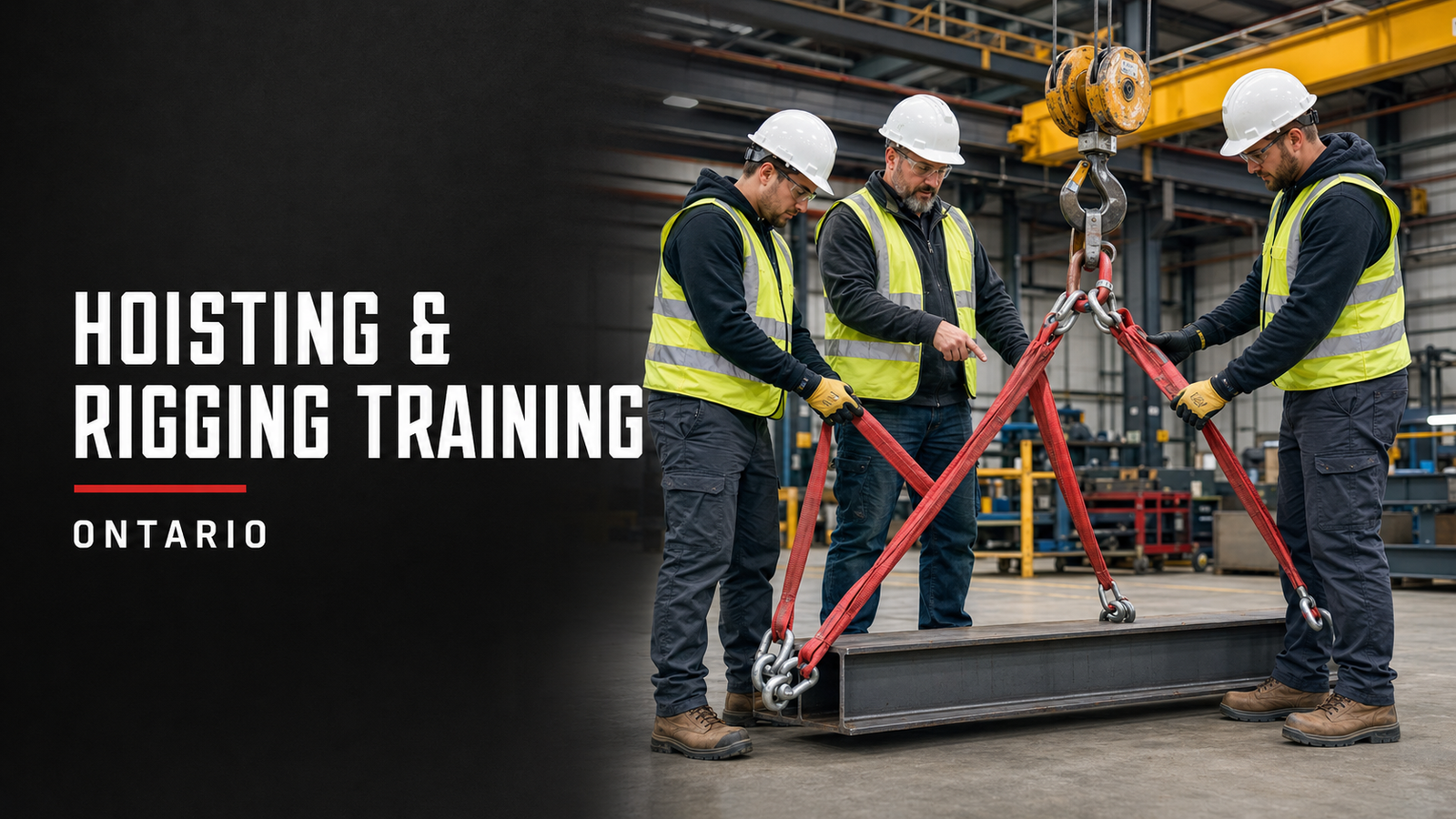
Hoisting and rigging training teaches workers how to prepare and secure loads before they are lifted or moved by a crane or hoist.
A rigger may need to select the correct sling, inspect the equipment, choose an appropriate hitch, account for the load’s weight and shape, protect the sling from sharp edges and communicate with the crane operator. Each decision affects the stability and control of the load.
Achieve Safety’s basic course introduces the knowledge and practical skills required for routine hoisting and rigging work. Training is aligned with CSA B167:26, which addresses overhead cranes, gantry cranes, monorails, hoists and jib cranes.
The course does not qualify a participant to design an engineered lift or perform specialized rigging beyond the limits of their training and experience. Complex, unusual or high-risk lifts may require additional planning, engineering input or advanced qualifications.
What Is the Difference Between Hoisting and Rigging?
Hoisting and rigging are connected activities, but they are not the same task.
Hoisting is the lifting, lowering or movement of a load with equipment such as a crane, chain hoist or other lifting device.
Rigging is the process of selecting, inspecting, arranging and attaching the slings, hooks, shackles and other hardware that connect the load to the lifting device.
| Activity | Primary focus |
|---|---|
| Hoisting | Raising, lowering or moving the load |
| Rigging | Selecting and attaching the equipment that supports the load |
| Crane operation | Controlling the crane and its movements |
| Signalling | Communicating lift directions to the operator |
| Lift planning | Assessing the load, equipment, route, hazards and responsibilities |
One worker may perform more than one role, depending on the workplace and lift. That does not make the roles interchangeable.
A trained crane operator may not have sufficient rigging knowledge to select a sling arrangement. Likewise, a trained rigger should not operate a crane without the required equipment-specific instruction, experience and authorization.
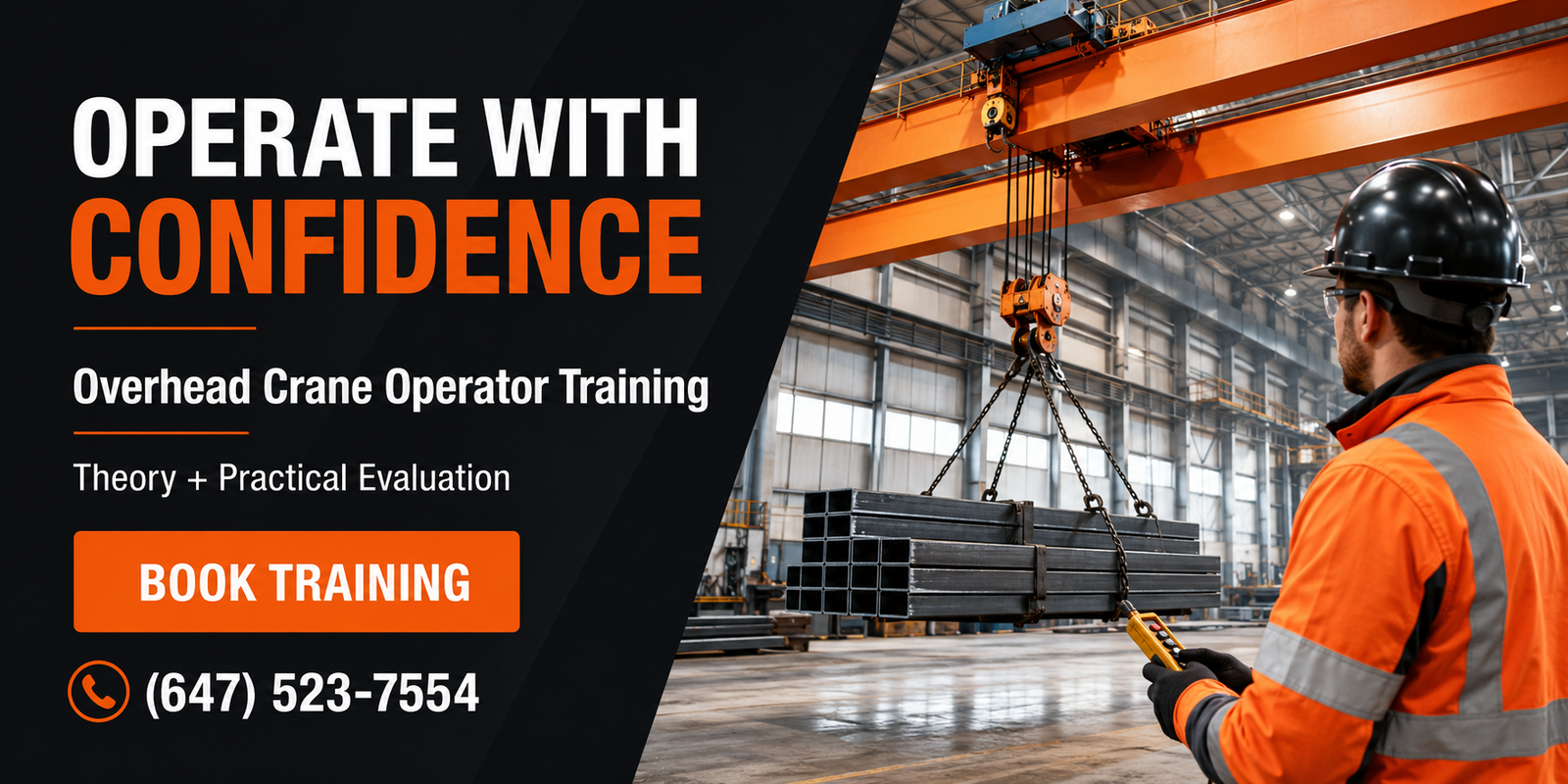
Employers whose workers perform both functions should consider combining this course with Overhead Crane Operator Training.
Is Hoisting and Rigging Training Required in Ontario?
Ontario does not issue one universal “rigger licence” for every workplace and lifting activity. However, employers still have clear duties to provide workers with the information, instruction and supervision needed to work safely.
Under the Occupational Health and Safety Act, an employer must provide information, instruction and supervision to protect workers. The employer must also appoint competent persons as supervisors.
Requirements for lifting devices in industrial workplaces appear in Ontario Regulation 851. Section 51 addresses matters such as:
- Suitable ropes, chains, slings and fittings
- Rated capacity
- Examination of lifting devices by a competent person
- Operation by a competent person or a worker being instructed and accompanied by a competent person
- Keeping loads from passing over workers
- Adequately securing loads
- Preventing workers from remaining beneath suspended loads
Construction projects are subject to additional requirements under Ontario Regulation 213/91. The applicable duties depend on the lifting equipment, load, workplace, project and work being performed.
A certificate is evidence that a participant completed a training program. It does not, by itself, make that person competent for every rigging activity.
Competency depends on the worker having appropriate:
- Knowledge
- Training
- Experience
- Familiarity with the applicable law
- Ability to recognize actual and potential hazards
Employers must determine whether a worker can perform the assigned rigging work safely in the conditions found at that workplace.
Who Should Take Hoisting and Rigging Training?
This course is intended for workers who select, inspect, connect, guide or work with rigging equipment during routine lifting operations.
Participants may include:
- Riggers
- Slingers
- Overhead crane operators
- Hoist operators
- Material handlers
- Warehouse workers
- Maintenance personnel
- Millwrights
- Fabrication workers
- Manufacturing employees
- Shipping and receiving personnel
- Supervisors overseeing lifting operations
- Workers who give crane hand signals
- Workers involved in equipment installation or relocation
Training is particularly important when a worker must decide:
- Which sling is suitable for the load
- Whether rigging hardware is safe to use
- How the load should be attached
- Whether the load is balanced
- Where workers may safely stand
- How the load will travel
- Who will direct the lift
- Whether the lift exceeds the worker’s training or authority
New workers are not the only people who may benefit. Refresher training may be appropriate following an incident, near miss, unsafe observation, change in equipment, change in rigging practices or extended absence from the task.
What Does Basic Hoisting and Rigging Training Cover?
The course builds a practical foundation for workers involved in routine rigging and lifting activities.
Course content may address:
- Ontario workplace responsibilities
- Hoisting and rigging terminology
- Roles of the operator, rigger and signaller
- Common lifting hazards
- Sling types and applications
- Hooks, shackles and rigging hardware
- Equipment identification and markings
- Working load limits
- Sling configurations and hitch types
- Load weight and stability
- Centre of gravity
- Sling angles
- Pre-use inspection
- Damage and removal-from-service indicators
- Load attachment and control
- Sharp-edge protection
- Tag-line considerations
- Standard hand signals
- Communication between the rigger and operator
- Pre-lift planning
- Suspended-load danger zones
- Hands-on rigging exercises
- Practical evaluation
Actual course content can be adapted to the employer’s equipment, common loads and workplace conditions while remaining within the scope of basic training.
What basic training does not cover
Basic hoisting and rigging training should not be treated as automatic authorization to perform:
- Engineered lifts
- Tandem lifts involving multiple lifting devices
- Unusual or critical lifts
- Personnel lifting
- Specialized entertainment rigging
- Tower-crane rigging
- Rigging designed without known load information
- Work beyond the rated capacity of the equipment
- Tasks requiring trade-specific or regulatory qualifications
- Advanced load calculations beyond the participant’s training
When the load, lifting method or consequences of failure exceed routine work, the lift should be stopped and escalated to a person with the required expertise.
Common Hoisting and Rigging Hazards
A lifting incident is rarely caused by the crane alone. Failures often begin with an incorrect assumption about the load, sling, attachment point or work area.
Workers must be prepared to recognize hazards such as:
- Unknown load weight
- Incorrect sling capacity
- Damaged or unidentified rigging
- Poor sling-angle selection
- An unstable centre of gravity
- Side loading of hooks or shackles
- Slings exposed to sharp edges
- Improvised attachment points
- Loose material within the load
- Shock loading
- Pinch and crush points
- Workers beneath or near a suspended load
- Obstructed travel paths
- Conflicting hand signals
- Poor visibility
- Unexpected load movement
- Contact with nearby structures or equipment
- Rigging that is unsuitable for the temperature or environment
A pre-lift discussion helps the team identify these conditions before tension is applied to the rigging.
The suspended-load danger zone
A suspended load can swing, rotate, shift or fall with little warning. Workers should never position themselves where the load or rigging could strike, trap or crush them.
The danger zone may include:
- The area directly beneath the load
- The load’s expected travel path
- The direction in which a load could tip or swing
- Areas near tensioned slings and tag lines
- Pinch points between the load and a fixed object
- Locations where a worker would have no safe escape route
Ontario’s industrial regulation requires loads to be adequately secured and prohibits lifting a load over a worker where practicable. It also prohibits workers from remaining beneath suspended loads.
Rigging Equipment, Slings and Hardware
Rigging equipment must be selected according to the load, lifting points, hitch, environment and manufacturer’s specifications.
Common equipment includes:
| Rigging equipment | Typical characteristics |
|---|---|
| Alloy chain sling | Durable and useful in demanding environments, but each component must be inspected for wear, stretching, cracks and deformation |
| Wire rope sling | Resists abrasion and is used for many industrial loads, but broken wires, kinks, crushing and corrosion can reduce its safety |
| Synthetic web sling | Lightweight and less likely to damage finished surfaces, but vulnerable to cuts, heat, chemicals and abrasion |
| Synthetic round sling | Flexible and suitable for many shaped loads, but its internal load-bearing fibres may be damaged even when the defect is not immediately obvious |
| Shackle | Connects slings and lifting points; its pin, body, capacity and loading direction must suit the application |
| Hook | Connects the load or rigging to the lifting system; deformation, throat opening, wear and latch condition require attention |
| Spreader or lifting beam | Helps control sling angles or distribute the load, but must be designed, rated and used for its intended purpose |
Workers should be able to identify the equipment, find its capacity information and recognize visible defects. If the equipment cannot be positively identified or its rated capacity cannot be established, it should not be used until a competent person determines that it is safe and suitable.
Working Load Limits and Sling Angles
The working load limit is the maximum load the manufacturer permits the equipment to support under stated conditions. It is not a target to exceed or an estimate that workers can adjust informally.
The usable capacity of a rigging arrangement can change according to:
- Sling type
- Number of sling legs
- Hitch configuration
- Sling angle
- Connection method
- Condition of the equipment
- Load distribution
- Temperature
- Chemical exposure
- Manufacturer limitations
A sling does not necessarily retain its full vertical capacity when used in a choker, basket or multi-leg arrangement.
Why sling angle matters
As a multi-leg sling becomes more horizontal, tension in each leg increases. A shallow angle can place far more force on the sling and its attachment points than workers expect.
For that reason, workers should never select rigging based only on the total weight of the load. They must consider the complete configuration and use the applicable manufacturer’s capacity information.
If the load weight, sling angle or rigging capacity cannot be established, the lift should not proceed based on guesswork.
Load Weight, Balance and Centre of Gravity
Before a load is lifted, the team needs reliable information about its weight and configuration.
Possible sources include:
- Manufacturer documentation
- Equipment nameplates
- Shipping records
- Engineered drawings
- Verified calculations
- A reliable weighing method
The lifting point should be positioned so the load remains controlled as it leaves its resting surface. If the hook is not properly located in relation to the centre of gravity, the load may tilt, rotate or shift as the sling takes tension.
An initial test lift can help confirm balance. The load should be raised only enough to verify that:
- The rigging is seated correctly
- The load is secure
- The sling legs are sharing the load as expected
- The brakes and controls are functioning
- The load is stable
- The travel path remains clear
If the load shifts or the rigging changes position, the operator should lower it and allow the team to reassess the arrangement.
Crane Hand Signals and Lift Communication
The rigger, signaller and crane operator must understand who is directing the lift and how instructions will be communicated.
Standard hand signals may be used when the operator has a clear view of the signaller. Radios or another reliable communication method may be required when distance, noise or obstructions prevent clear visual communication.
Before the lift begins, the team should confirm:
- Who is the designated signaller
- Which signals or radio terms will be used
- Whether the operator can see the signaller
- How communication will be maintained along the travel route
- What the stop signal will be
- What happens if communication is lost
- Who has authority to stop the lift
Only one designated person should normally direct routine crane movement. However, the operator must respond to an emergency stop signal from any person who identifies immediate danger.
If the operator does not understand a signal, the movement should stop until the instruction is clear.
Pre-Lift Planning and Hazard Assessment
Even a familiar load deserves a deliberate check before it leaves the ground.
A basic pre-lift plan connects the load, rigging equipment, lifting device, people and travel path. The amount of planning should reflect the lift’s complexity and potential consequences.
Pre-lift checklist
Before applying tension, confirm:
- The load weight is known or reliably established.
- The crane or hoist has adequate rated capacity.
- The slings and hardware are suitable for the complete rigging arrangement.
- Identification and capacity markings are present.
- The rigging has passed its inspection.
- The lifting points are suitable.
- The hook is positioned in relation to the centre of gravity.
- Sling angles have been considered.
- Sharp edges are protected.
- Loose components are secured.
- The load path is clear.
- Workers are outside the danger zone.
- The landing area is ready.
- Communication methods are understood.
- Environmental conditions allow the lift to proceed safely.
- The team knows who will stop the lift if conditions change.
A short test lift should be used where appropriate to check balance, rigging position and load control.
When should a basic lift be escalated?
The lift should be referred for additional planning or expertise when it involves conditions such as:
- Unknown load weight
- Uncertain lifting points
- An unusual or unstable centre of gravity
- Multiple cranes or hoists
- Personnel lifting
- Restricted clearance
- High-value or fragile equipment
- Loads near workers or critical infrastructure
- Specialized below-the-hook devices
- Unusual environmental conditions
- Potential consequences beyond routine lifting work
Basic training helps workers recognize their limits. It does not replace an engineered lift plan when one is required.
Theory Training and Hands-On Practical Evaluation
Hoisting and rigging competency cannot be established through theory alone.
A participant may understand the definition of a choker hitch but still need to demonstrate that they can select, inspect and apply rigging correctly under workplace conditions.
Achieve Safety’s course includes hands-on rigging exercises and a practical evaluation. Participants may be required to demonstrate applicable skills such as:
- Conducting a pre-use inspection
- Identifying rigging equipment and markings
- Selecting suitable equipment for a routine load
- Recognizing damaged or unsuitable rigging
- Attaching the load correctly
- Maintaining safe body positioning
- Checking balance during a test lift
- Communicating with the operator
- Controlling the danger zone
- Responding when conditions become unsafe
The practical component should reflect the equipment and routine lifting activities the participant is expected to encounter.
Private, On-Site and Online Hoisting and Rigging Training
Achieve Safety offers flexible training options for Ontario employers.
| Training option | Best suited for | Practical requirement |
|---|---|---|
| Private training | Employers coordinating a dedicated class for their workforce | Hands-on exercises and evaluation are completed in person |
| On-site training | Workplaces that want training connected to their equipment, loads and operating conditions | Employer equipment and a suitable training area may be required |
| Online theory training | Participants who need a flexible way to complete the knowledge component | Does not replace in-person hands-on training and practical evaluation |
Online training can support knowledge development. It cannot show whether a participant can inspect a sling, secure a load, maintain safe positioning or respond to unexpected load movement.
Employers should verify that each participant completes the delivery components required for the assigned work.
On-Site Training Using Workplace Equipment
On-site training allows workers to apply core principles to familiar equipment and routine loads.
Before training, the employer should ensure that:
- The crane or hoist is available and safe to use
- Rigging equipment is available for exercises
- Manufacturer information can be accessed
- Suitable practice loads are provided
- The training area can be controlled
- Production activities will not interfere
- Participants have the required personal protective equipment
- Equipment defects or maintenance issues are addressed
- A supervisor or workplace contact is available
The exact arrangements should be confirmed with Achieve Safety before the course date.
Training with familiar equipment can improve relevance, but it does not remove the employer’s responsibility to maintain the equipment, develop safe procedures and authorize workers for their assigned duties.
Hoisting and Rigging Certificate
Participants who successfully complete Achieve Safety’s required training and evaluation receive an Achieve Safety certificate.
The certificate documents course completion. Employers should retain a training record that identifies:
- Participant’s name
- Course title
- Training provider
- Completion date
- Delivery method
- Theory assessment result
- Practical evaluation result
- Equipment or course scope, where applicable
- Instructor or evaluator
- Refresher or retraining history
Workers should also keep a copy of their certificate.
A certificate does not create unrestricted authorization to perform every lift. The employer must still determine whether the worker has the knowledge, training and experience required for the equipment, load and workplace conditions.
Does Hoisting and Rigging Certification Expire in Ontario?
Ontario law does not establish one universal expiry date for every basic hoisting and rigging certificate.
That does not mean training remains adequate forever. Employers must ensure workers continue to have the knowledge and ability needed to perform their work safely.
Refresher training or reassessment may be appropriate when:
- The worker demonstrates unsafe technique
- A near miss or lifting incident occurs
- Equipment or rigging changes
- Workplace procedures change
- The worker is assigned unfamiliar loads
- Inspection knowledge is no longer adequate
- The worker has not performed rigging work for an extended period
- A supervisor identifies a competency gap
- A manufacturer, employer policy or project requirement establishes a retraining interval
Achieve Safety offers refresher training for employers who need to reinforce knowledge, reassess practical skills or respond to workplace changes.
Hoisting and Rigging Training Versus Crane Operator Training
Hoisting and rigging training and crane operator training address connected but different responsibilities.
| Hoisting and rigging training | Overhead crane operator training |
|---|---|
| Focuses on the load and its connection | Focuses on the crane and its controls |
| Covers slings, hitches and hardware | Covers operating controls and crane movement |
| Addresses load balance and centre of gravity | Addresses pre-use crane checks and operating limits |
| Teaches rigging inspection | Teaches equipment-specific operator inspection |
| Covers signalling and load attachment | Covers responding to signals and controlling movement |
| Does not automatically authorize crane operation | Does not automatically establish rigging competency |
Workers who operate the crane and rig its loads may require both forms of training.
A hoisting and rigging certificate does not replace training required for other equipment or hazards.
Achieve Safety also provides:
- Elevated Work Platform training for workers who operate scissor lifts, boom lifts and other applicable mobile elevating work platforms
- Working at Heights training for workers who may be exposed to fall hazards on Ontario construction projects
The required combination depends on the work being performed.
For example, a worker using an elevated work platform to access a lifting point may need EWP training, fall-protection instruction and hoisting and rigging knowledge. Each course addresses a different hazard and job function.
Frequently Asked Questions
Is hoisting and rigging training mandatory in Ontario?
Ontario does not provide a single universal rigger licence for all lifting work. However, employers must provide the information, instruction and supervision needed to protect workers. The required training must reflect the equipment, load, hazards and responsibilities assigned to the worker.
Is this an online hoisting and rigging course?
Achieve Safety offers online theory training. Hands-on rigging exercises and the practical evaluation must be completed in person when practical competency is required.
Does the course include practical training?
Yes. The course includes hands-on rigging exercises and a practical evaluation.
Will I receive a certificate?
Successful participants receive an Achieve Safety certificate documenting course completion.
Is the course aligned with a CSA standard?
The course is aligned with CSA B167:26. Training should still be supported by manufacturer instructions, Ontario legal requirements and the employer’s workplace procedures.
Does the certificate authorize me to perform any lift?
No. The certificate documents completion of a basic course. It does not qualify a worker to design engineered lifts or perform specialized work beyond their training, experience and authorization.
Does hoisting and rigging training expire?
There is no single statutory expiry date applying to every basic hoisting and rigging certificate in Ontario. Refresher training or reassessment may still be needed after an incident, equipment change, unsafe observation, long absence or identified competency gap.
Does a crane operator also need rigging training?
A crane operator who selects, inspects or attaches rigging may need both operator and rigging training. Crane operation and load rigging involve different skills.
Can Achieve Safety provide training at our workplace?
Yes. Private and on-site training are available. Contact Achieve Safety to confirm the workplace, equipment, practice loads, training area and scheduling requirements.
Is this an advanced rigging course?
No. This is a basic hoisting and rigging course for routine lifting activities. Engineered, critical, tandem or specialized lifts may require advanced training and additional professional planning.
Book Hoisting and Rigging Training in Ontario
Need practical hoisting and rigging training for your employees?
Achieve Safety provides private, on-site and online theory options for Ontario workplaces. The basic course includes hands-on rigging exercises, a practical evaluation and an Achieve Safety certificate for successful participants. Refresher training is also available.
Contact us to discuss your workplace, equipment, participant group and preferred delivery format.