Scissor Lift Training in Ontario: CSA B354-Compliant Certification

Scissor Lift Training

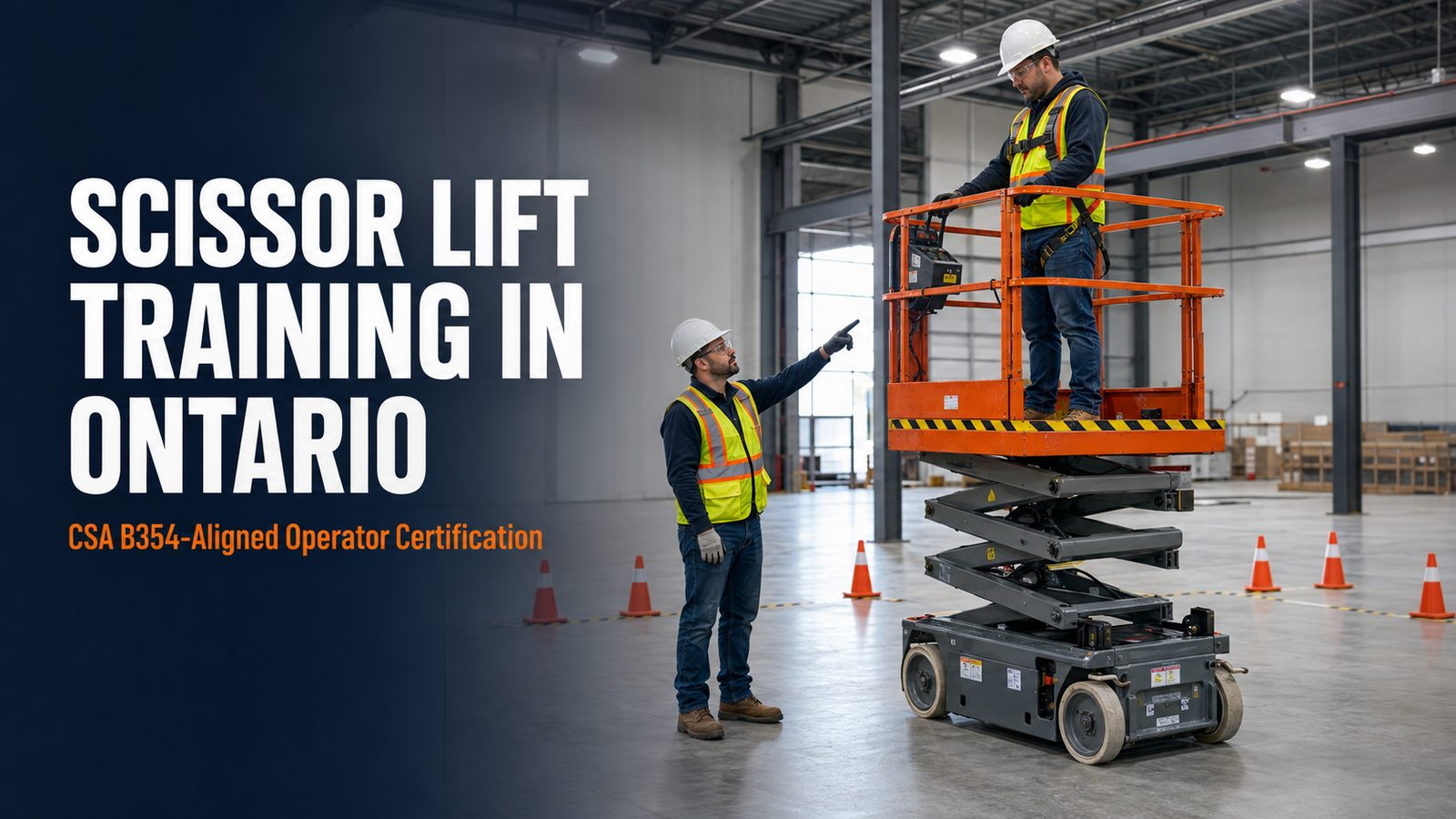
Workers who operate scissor lifts in Ontario need Aerial Lift equipment training that covers the equipment they will use, its operating limitations, workplace hazards and emergency procedures. Operator training should include theory instruction, practical experience and an evaluation of the worker’s ability to operate the lift safely.


Scissor lift training is not simply a matter of learning which control raises the platform. Operators must understand stability, rated capacity, surface conditions, overhead obstructions, fall hazards and the limits of the specific machine being used.

Register for Scissor Lift Training in Ontario


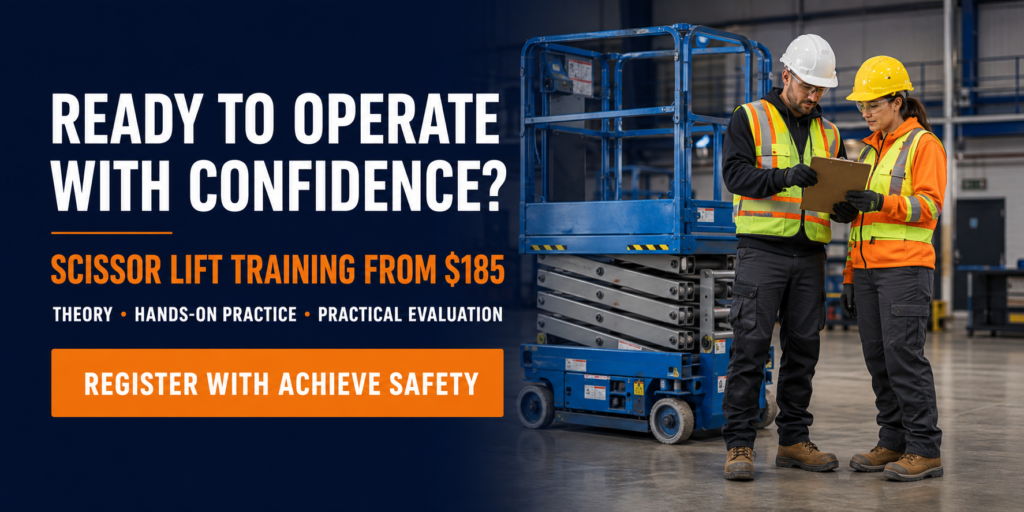
Achieve Safety’s 8-hour Elevating Work Platform training includes scissor lifts, boom lifts and vecrtical mast lifts. The course follows applicable Ontario workplace training requirements and CSA B354 principles. Participants complete practical instruction and an operator competency assessment before receiving an Achieve Safety certificate.


For individual registration or workplace training arrangements, call 647-523-7554 or contact Achieve Safety to discuss your requirements. Within Ontario, we serve Toronto, Etobicoke, Mississauga, Brampton, Hamilton, Kitchener, Markham, Oakville, Barrie and other surrounding areas.
 

 Scissor Lift Training certification course book

Do You Need Scissor Lift Training in Ontario?

A worker must receive appropriate instruction before operating a scissor lift at an Ontario workplace.

For construction projects, section 147 of Ontario Regulation 213/91 currently requires a worker to receive oral and written instruction before operating an elevating work platform for the first time. The instruction must address how to operate the equipment, its load limitations and the conditions that may affect safe use.

Ontario employers also have a broader duty under the Occupational Health and Safety Act to provide workers with the information, instruction and supervision needed to protect their health and safety.


In practical terms, an employer should not allow a worker to operate a scissor lift until the worker has:

  • Completed relevant theory instruction
  • Received hands-on training
  • Demonstrated safe operation
  • Learned the limits of the equipment class
  • Received workplace and task-specific instruction
  • Been familiarized with the actual make and model being used
  • Received any additional fall-protection training required for the work

A certificate documents course completion. The employer must still determine whether the worker is competent to operate the equipment safely under the conditions present at that workplace.

Is a Scissor Lift Licence Required in Ontario?

Ontario does not issue a government scissor lift driver’s licence comparable to a G-class motor vehicle licence.

When employers and job sites ask for a “scissor lift licence,” they are usually referring to a training certificate or operator card showing that the worker completed scissor lift or EWP operator.

That distinction matters. Holding a certificate does not automatically make someone competent on every scissor lift, in every workplace or under every operating condition.

Competency involves more than course attendance. A competent operator must be able to apply their training, recognize hazards and operate the assigned equipment safely. Employers remain responsible for confirming that ability and providing adequate supervision.

What Is CSA B354-Compliant Scissor Lift Training?

CSA B354 is a family of Canadian standards addressing mobile elevating work platforms, commonly called MEWPs.

Two standards are particularly relevant:

  • CSA B354.7:17 (R2022) addresses the safe operation, inspection and maintenance of mobile elevating work platforms.
  • CSA B354.8:17 (R2022) addresses mobile elevating work platform operator training.


The CSA Group identifies B354.8 as the operator-training standard for MEWPs. A properly structured program uses these principles to cover operator knowledge, practical skills, evaluation and equipment classifications.


Most self-propelled scissor lifts are classified as Group A, Type 3 machines:

  • Group A means the platform remains within the machine’s tipping lines throughout its range of movement.
  • Type 3 means the machine can travel while elevated and its travel controls are located on the platform.

Not every scissor lift has the same classification. A manually propelled vertical lift or another less common configuration may fall into a different type. Training and familiarization should match the group and type of equipment the worker will actually operate.

New Ontario MEWP Training Requirements Arrive in 2027

Ontario has enacted O. Reg. 117/26: Elevating Work Platforms, which is scheduled to come into force on January 1, 2027.

The new regulation will introduce more detailed requirements for workers operating mobile elevating work platforms on construction projects. Training will need to address each group and type of MEWP the worker operates.

The program will include both theory and practical components, along with a method of evaluating the worker’s ability to operate the equipment. The regulation also addresses training records, equipment-specific familiarization and proof of completion.


This is an important distinction for employers planning training:

A general aerial-lift video or awareness-only course does not demonstrate that a worker can safely operate a scissor lift.

Employers should choose training that already provides substantive theory, hands-on instruction and practical evaluation. This creates a stronger foundation for current due-diligence responsibilities and the more detailed regulatory framework arriving in 2027.

What Does Scissor Lift Training Cover?

Scissor lift operator training should prepare workers for the hazards and decisions they will face before, during and after operation.

Achieve Safety’s training covers areas such as:

  • Ontario employer, supervisor and worker responsibilities
  • Scissor lift classifications and operating limits
  • Manufacturer instructions and warning labels
  • Pre-use inspections
  • Platform capacity and load distribution
  • Ground and floor conditions
  • Safe travel and platform positioning
  • Guardrails, gates and platform entry
  • Overhead structures and electrical hazards
  • Tip-over and instability risks
  • Entrapment and crushing hazards
  • Fall-protection requirements
  • Emergency stops and lowering controls
  • Shutdown and post-use procedures
  • Practical equipment operation
  • Operator competency evaluation


The Canadian Centre for Occupational Health and Safety recommends inspecting an elevating platform at the beginning of each shift. Operators should check its frame, controls, brakes, tires, hydraulic or electrical systems, safety devices, guardrails, gates, anchorage points and rated capacity information.

Training teaches operators how to conduct that inspection and, just as importantly, when a defect means the equipment must be removed from service.

Why Scissor Lift Training Must Be Equipment-Specific

Scissor lifts and boom lifts both raise workers, but they do not create identical operating conditions.


Training consideration Scissor lift Boom lift
Primary platform movement Mostly vertical Vertical and horizontal outreach
Common CSA group Group A Group B
Typical self-propelled type Type 3 Type 3
Main stability concern Surface condition and load distribution Outreach, position and operating envelope
Common operating environment Warehouses, facilities and construction interiors Construction, exterior maintenance and hard-to-reach areas
Distinct hazards Potholes, slab edges, overhead crushing and uneven loading Boom swing, tail swing, catapult effect and extended reach

A worker trained and evaluated only on a boom lift should not automatically be assumed competent to operate a scissor lift. Likewise, scissor lift training does not establish competency on articulating or telescopic boom lifts.

This is why the equipment class should appear clearly on the worker’s training record or certificate.

Who Should Complete Scissor Lift Operator Training?

Scissor lift training is appropriate for workers who physically control or operate the equipment.

That may include:

  • Construction workers
  • Electricians
  • HVAC technicians
  • Warehouse employees
  • Facility-maintenance teams
  • Painters and drywall installers
  • Sign and lighting installers
  • Industrial maintenance workers
  • Retail and event setup crews
  • Contractors working inside commercial buildings

Workers who only work near a lift may need hazard-awareness instruction, but awareness training does not qualify them to operate the machine.

Supervisors also need enough knowledge to recognize unsafe operation, confirm operator competency, assess workplace hazards and ensure workers follow applicable procedures.

Scissor Lift Training Versus Working at Heights Training

Scissor lift operator training and Working at Heights training serve different purposes.

Scissor lift training teaches workers how to inspect, control and safely operate the equipment.

Working at Heights training teaches workers how to recognize fall hazards and correctly use fall-protection systems.

On construction projects, a worker who is required to use a fall-protection system must complete a Chief Prevention Officer-approved Working at Heights training program in Ontario. Taking an EWP course does not replace this requirement. You can get more info on finding a CPO approved WAH provider here.

Similarly, a Working at Heights certificate does not authorize someone to operate a scissor lift. Workers may require both programs, followed by practical scissor lift instruction and workplace-specific familiarization.

Achieve Safety requires participants to provide proof of applicable fall-protection training before completing the practical EWP component.

Can Scissor Lift Training Be Completed Online?

The theory portion of scissor lift training can be delivered online. However, online theory alone does not demonstrate that a worker can safely operate the equipment.

A complete operator-training process should include:

  1. Theory instruction
  2. Knowledge assessment
  3. Hands-on instruction
  4. Practical operator evaluation
  5. Equipment-specific familiarization at the workplace

An online-only awareness certificate may show that a participant reviewed safety information. It does not replace the practical instruction and demonstrated proficiency needed for operator competency.

Achieve Safety offers online theory options, but workers must still complete the required practical component before receiving full operator certification.

What Happens During the Practical Evaluation?

The practical evaluation gives the participant an opportunity to demonstrate that they can inspect, control and position a scissor lift safely.

An evaluator may ask the participant to:

  • Conduct a pre-use inspection
  • Identify the lift’s rated capacity
  • Locate the manufacturer’s operating manual
  • Inspect guardrails, gates and platform controls
  • Test ground and platform emergency controls
  • Enter and exit the platform safely
  • Evaluate the travel path and work area
  • Raise, lower and position the platform
  • Travel with the platform in an approved position
  • Respond to warning indicators
  • Maintain clearance from obstructions
  • Demonstrate emergency lowering procedures
  • Park, lower and shut down the equipment correctly

The purpose is not simply to see whether the worker can move the machine. The evaluator needs to see whether the operator recognizes hazards, respects the equipment’s limitations and makes safe decisions without constant direction.

If a participant cannot demonstrate the required skills, additional instruction and another evaluation may be needed before the worker operates independently.

How Long Is the Scissor Lift Training Course?

Achieve Safety’s Elevating Work Platform course is approximately 8 hours and includes theory, hazard recognition, equipment operation and practical evaluation.

Actual completion time can vary based on:

  • Number of participants
  • Operator experience
  • Equipment types being covered
  • Training format
  • Workplace conditions
  • Time required for practical exercises
  • Whether participants need additional coaching

Workers who successfully complete the theory and practical requirements receive an Achieve Safety certificate documenting their training.

How Long Is Scissor Lift Certification Valid in Ontario?

This question requires more nuance than the common claim that every scissor lift certificate automatically expires after three years.

Ontario’s current requirements focus on adequate instruction, supervision and operator competency. They do not create a universal three-year expiry period for every scissor lift certificate in every workplace.

Some training providers issue certificates with a three-year validity period. Employers, constructors, site owners or company policies may also require retraining on a specific schedule. Those requirements should not be presented as a universal statutory expiry date.

Beginning January 1, 2027, Ontario Regulation 117/26 will introduce a five-year validity period for the prescribed mobile elevating work platform training program on construction projects.

The new regulation also contains transition provisions for workers who completed qualifying training under the previous construction requirements for the same equipment group and type. Their retraining deadline will generally be measured from the date that earlier training was completed.

Employers should therefore review:

  • When the worker completed training
  • What equipment group and type the training covered
  • Whether the worker completed practical instruction
  • Whether competency was evaluated
  • Whether the worker has used the equipment recently
  • Whether site or client policies impose a shorter interval
  • Whether retraining has been triggered by workplace events

When Is Refresher Training or Retraining Needed?

A certificate should never be the only factor used to decide whether someone can continue operating a scissor lift.

Refresher training or reevaluation may be appropriate when:

  • The worker operates the equipment unsafely
  • An incident or near miss occurs
  • The operator has not used a scissor lift for an extended period
  • A supervisor identifies a gap in knowledge or skill
  • The workplace or operating environment changes
  • The worker begins using a different group or type of MEWP
  • New equipment introduces unfamiliar controls or safety systems
  • Regulations, standards or company procedures change
  • The worker’s certificate reaches its stated renewal date

Retraining should address the actual competency gap. A worker struggling with platform positioning may need supervised practical instruction, while someone unfamiliar with updated workplace procedures may need focused theory and site orientation.

Does Training on One Scissor Lift Cover Every Model?

Training on the correct group and type provides a foundation, but it does not remove the need for familiarization with the actual machine.

Scissor lifts vary in:

  • Control layout
  • Platform capacity
  • Working height
  • Platform extension design
  • Indoor or outdoor rating
  • Maximum wind-speed rating
  • Gradeability and slope limits
  • Pothole-protection systems
  • Emergency-lowering controls
  • Battery, electric or engine power
  • Warning indicators and interlocks

Before using an unfamiliar model, the operator should review the manufacturer’s manual and receive instruction on the machine’s controls, safety devices, limitations and emergency procedures.

Ontario’s incoming 2027 requirements specifically recognize the importance of make-and-model familiarization when the equipment was not covered during the original training.

What Should Operators Inspect Before Using a Scissor Lift?

A pre-use inspection should be completed before the machine is operated. The operator should also assess the surrounding work area.

Equipment inspection

Check the scissor lift for:

  • Structural damage and cracked welds
  • Loose or missing fasteners
  • Hydraulic, pneumatic or fuel leaks
  • Damaged hoses, cables or electrical components
  • Tire and wheel damage
  • Guardrail and gate condition
  • Platform-extension locks
  • Pothole-protection components
  • Steering and braking functions
  • Ground and platform controls
  • Emergency stop and lowering systems
  • Tilt, overload and motion alarms
  • Fall-protection anchor points, where provided
  • Legible warning labels and capacity markings
  • Evidence of unauthorized modification

Work-area inspection

The operator should look for:

  • Floor openings and drop-offs
  • Uneven, soft or sloped surfaces
  • Debris and travel-path obstructions
  • Inadequate floor or ground capacity
  • Overhead beams, doorways and piping
  • Energized electrical conductors
  • Moving vehicles and pedestrians
  • Poor lighting or visibility
  • Hazardous atmospheres
  • Wind, rain, ice and other weather conditions
  • Restricted areas that could trap the operator

A machine can pass its equipment inspection and still be unsafe to use if the surrounding environment creates an uncontrolled hazard.

Common Scissor Lift Hazards

Tip-over and instability

Scissor lifts rely on a stable base. Uneven surfaces, potholes, excessive slope, overloading or sudden movement can shift the machine’s centre of gravity.

Operators must follow the manufacturer’s limits and never assume that a surface is suitable merely because the lift can physically travel across it.

Overhead crushing and entrapment

A worker can become trapped between the platform railing and a ceiling, beam, duct, doorway or other fixed structure.

The operator should look upward before raising or travelling and use slow, deliberate control movements in restricted areas.

Falls from the platform

Guardrails provide important protection, but they are not permission to climb, lean excessively or stand on objects.

Workers should keep both feet on the platform floor. Ladders, boxes, planks and guardrails must not be used to gain extra height.

Falling tools and materials

Tools and materials can strike workers below or interfere with the lift’s controls and guardrails.

The work area may need to be barricaded. Materials must remain within the platform and the total load must stay within the machine’s rated capacity.

Electrical contact

A scissor lift does not automatically protect workers from energized conductors.

Before work begins, the employer and operator must identify electrical hazards, maintain required clearances and follow the applicable electrical-safety procedures.

Collisions with people or equipment

Warehouses and active construction projects may place scissor lifts near forklifts, delivery vehicles, pedestrians and other mobile equipment.

Traffic controls, exclusion zones, spotters and clear communication may be required where the operator’s view is restricted.

Scissor Lift Training Records for Ontario Employers

Employers should maintain training records that clearly identify:

  • Worker’s full name
  • Training completion date
  • Training provider or instructor
  • Theory topics completed
  • Practical training completed
  • Evaluation results
  • Equipment group and type covered
  • Certificate or record number
  • Refresher or reevaluation dates
  • Workplace familiarization completed
  • Make and model used for familiarization

A generic card stating only “aerial lift training” may not provide enough information to confirm which equipment the worker was trained to operate.

Clear records help an employer assign work appropriately and demonstrate the steps taken to provide instruction, assess competency and exercise due diligence.

Scissor Lift Training With Achieve Safety

Achieve Safety provides CSA B354-aligned Elevating Work Platform training for Ontario workers who operate scissor lifts, boom lifts and vertical mast lifts.

The eight-hour program combines operator knowledge with practical skill development. Course topics include:

  • Ontario OHSA responsibilities
  • CSA B354 equipment classifications
  • Scissor lift inspections
  • Platform capacity and stability
  • Ground and slope limitations
  • Safe travel and positioning
  • Fall-protection integration
  • Electrical and overhead hazards
  • Emergency lowering procedures
  • Rescue considerations
  • Practical equipment operation
  • Operator competency evaluation

Participants must provide proof of applicable fall-protection training before completing the practical component. This may be CPO-approved Working at Heights training for construction work or appropriate industrial fall-arrest training for an industrial establishment.

Register for Scissor Lift Training in Ontario

Call (647) 523-7554 to discuss dates and group training.

 Scissor Lift Training certification course book

Frequently Asked Questions

Do you need certification to operate a scissor lift in Ontario?

Workers need appropriate instruction and must be competent to operate the equipment safely. A training certificate provides evidence that formal instruction was completed, but the employer must also confirm practical competency and provide workplace-specific familiarization.

Is a scissor lift considered an elevating work platform?

Yes. A scissor lift is a mobile elevating work platform. Most self-propelled scissor lifts are classified as Group A, Type 3 under the current CSA B354 classification system.

Can I get scissor lift certified entirely online?

Theory can be completed online, but online learning alone cannot evaluate practical operating ability. Full operator certification should include hands-on instruction and a practical assessment.

Do I need Working at Heights training to use a scissor lift?

On an Ontario construction project, workers who are required to use a fall-protection system must have valid CPO-approved Working at Heights training. Achieve Safety requires proof of applicable Working at Heights or industrial fall-arrest training before a participant completes the practical EWP component.

Is scissor lift training the same as boom lift training?

No. Scissor lifts usually raise the platform vertically within the machine’s tipping lines. Boom lifts can extend the platform beyond those lines and create different stability, outreach and operating-envelope hazards. Training records should identify the equipment group and type covered.

Does scissor lift certification expire every three years?

Not universally. Three years is a common provider or workplace renewal interval, but it should not be described as a statutory expiry period applying to every Ontario workplace. Ontario’s new construction regulation, effective January 1, 2027, establishes a five-year validity period for its prescribed MEWP training program.

Can an employer train its own scissor lift operators?

An employer must ensure the training is adequate, delivered by someone with appropriate knowledge and experience, includes the required theory and practical elements, and properly evaluates operator ability. Using a qualified training provider can help create consistent instruction and defensible training records.

Is practical evaluation required for an experienced operator?

Experience does not replace competency verification. An experienced worker should still demonstrate safe operation, especially when entering a new workplace or using a different scissor lift group, type, make or model.

What happens if a worker changes scissor lift models?

The worker may not need to repeat the entire foundational course if the new machine belongs to the same group and type, but they should receive familiarization covering the new model’s controls, safety systems, limitations and emergency procedures.

Who is responsible for ensuring a scissor lift operator is trained?

The employer is responsible for providing appropriate information, instruction and supervision. Supervisors must also ensure workers follow applicable workplace procedures and operate the equipment safely.

CONTACT US

achievesafetytoday@outlook.com

Contact Achieve Safety & Compliance

Let’s discuss how we can support your workplace safety needs

Continue Reading

Overhead Crane Operator Training