
- What Is Overhead Crane Operator Training?
- Theory Training and Practical Operator Evaluation
- Ontario Overhead Crane Operator Requirements
- Training Aligned With CSA B167:26
- Who Should Take Overhead Crane Operator Training?
- Public Overhead Crane Classes in Ontario
- On-Site Overhead Crane Training at Your Workplace
- Employer Requirements for On-Site Practical Training
- Overhead Crane Training Certificate Ontario
- Does Overhead Crane Certification Expire in Ontario?
- When Should an Operator Be Re-Evaluated?
- Initial Training, Refresher Training and Re-Evaluation
- Why Practical Evaluation Matters
- Overhead Crane Training FAQs
- Book Overhead Crane Operator Training in Ontario
- References and Official Sources
Overhead cranes move heavy and awkward materials that cannot be handled safely through manual lifting. However, a suspended load, damaged sling or uncontrolled crane movement can expose operators and nearby workers to severe hazards.
Achieve Safety’s Overhead Crane Operator Training course helps Ontario workers develop the knowledge and practical ability needed to inspect, control and operate overhead lifting equipment safely. We provide this course for various locations within GTA such as Toronto, Hamilton, Mississauga, Brampton, Vaughan, Oakville and other areas.
What This Includes?
The course includes:
- Instructor-led theory training
- Hazard recognition and control
- Pre-use inspection procedures
- Safe load movement principles
- Written knowledge assessment
- Hands-on equipment practice
- Practical operator evaluation
- A certificate for successful participants
Private training can be conducted at the client’s workplace. Public overhead crane classes will also be available.
Contact Achieve Safety to discuss upcoming course dates, training duration, class capacity and workplace requirements.

What Is Overhead Crane Operator Training?
Overhead crane operator training prepares workers to operate cranes and hoists safely within the limits of the equipment, load and workplace.
Operators need more than familiarity with the crane controls. They must understand how crane capacity, load condition, lifting attachments, travel paths and human behaviour affect every lift.
A trained operator should be able to:
- Identify common overhead crane hazards
- Complete a pre-use inspection
- Confirm that the load is within the equipment’s rated capacity
- Recognize visibly damaged or unsuitable lifting equipment
- Select a safe travel path
- Maintain control over the load
- Prevent excessive swinging
- Respond to signals and workplace communication
- Keep workers away from suspended loads
- Report equipment defects and unsafe conditions
- Shut down the crane safely when a problem is identified
Training supports operator competency, but it does not remove the employer’s responsibility to provide site-specific instruction, safe equipment, supervision and workplace procedures.
Theory Training and Practical Operator Evaluation
The course combines theoretical knowledge with hands-on evaluation.
Theory component
Participants learn about crane components, operating limitations, load control and the hazards associated with overhead lifting.
Theory topics may include:
- Operator and employer responsibilities
- Crane and hoist components
- Rated capacity and load limitations
- Control functions and emergency stops
- Pre-use inspection requirements
- Suspended-load hazards
- Load swing and sudden movement
- Side pulling and off-centre lifting
- Pinch points and crushing hazards
- Pedestrian separation
- Basic lifting-device and sling awareness
- Standard communication practices
- Defect reporting and equipment shutdown
The course covers hoisting and rigging principles that directly support overhead crane operation. It should not be represented as a standalone advanced-rigging qualification.
Practical component
Participants must demonstrate their ability to use the equipment safely.
The practical evaluation may assess whether the operator can:
- Inspect the crane and operating area
- Identify controls and safety devices
- Confirm that the intended lift is within rated capacity
- Position the hook appropriately
- Raise and lower a load smoothly
- Control load travel and minimize swing
- Follow signals or agreed communication
- Place the load safely
- Maintain awareness of workers and obstructions
- Respond correctly to an unsafe condition
- Park or secure the equipment after use
For practical training conducted at the employer’s workplace, the employer must provide a compliant crane, an appropriate training area and suitable loads.
Ontario Overhead Crane Operator Requirements
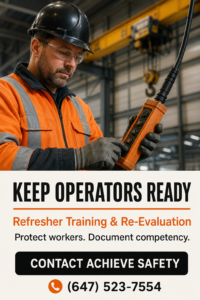
Ontario does not issue one universal overhead crane operator licence for every industrial workplace. However, that does not mean an untrained worker can operate the equipment.
Section 51 of Ontario’s Industrial Establishments Regulation requires a lifting device to be operated by a competent person or by a worker who is being instructed and accompanied by a competent person.
Under Ontario law, competency involves having the knowledge, training and experience needed to organize and perform the work, understanding the applicable legislation, and recognizing actual or potential workplace dangers.
The employer must therefore assess more than whether a worker attended a class. The employer must ensure the operator can use the workplace’s equipment safely under its actual operating conditions.
Training should work alongside:
- Equipment-specific familiarization
- Manufacturer instructions
- Workplace lifting procedures
- Hazard assessments
- Inspection and maintenance programs
- Supervisor oversight
- Operator authorization
- Refresher training and re-evaluation when needed
The regulation also addresses rated capacity, equipment examinations, maintenance and safe operation. These equipment duties remain with the employer even when workers have completed operator training.
Training Aligned With CSA B167:26
Achieve Safety’s course is aligned with CSA B167:26, the current CSA standard addressing overhead cranes, gantry cranes, monorails, hoists and jib cranes.
The standard covers common requirements related to the safe operation, inspection, testing and maintenance of overhead cranes and hoists.
CSA alignment provides a recognized technical framework for training. It does not replace the employer’s obligations under Ontario’s Occupational Health and Safety Act, applicable regulations, equipment instructions or site-specific procedures.
Who Should Take Overhead Crane Operator Training?
This course is designed for workers who operate or may be assigned to operate an overhead crane or hoist in an Ontario workplace.
It may be suitable for:
- Manufacturing and production workers
- Warehouse and material-handling employees
- Steel and metal fabrication workers
- Automotive and parts-manufacturing employees
- Machine-shop personnel
- Maintenance technicians
- Shipping and receiving teams
- Supervisors responsible for lifting operations
- New operators requiring initial training
- Experienced operators who need refresher training or re-evaluation
Workers who help guide loads or work near crane operations may also benefit from relevant hazard-awareness and communication instruction.
The employer should determine which workers require operator training based on the equipment, assigned tasks, workplace hazards and level of supervision.
Public Overhead Crane Classes in Ontario
Achieve Safety offers public overhead crane operator training for individuals and employers who do not require a private course at their own facility.
Public classes include theory instruction and a practical operator evaluation. They can be useful when:
- An employer only needs to train one or two workers
- A new employee requires training before being assigned crane duties
- An operator needs refresher training
- A worker requires re-evaluation after time away from crane operation
- Conducting a private workplace class is not practical
Contact Achieve Safety for upcoming public course dates, locations, duration, availability and registration details.
On-Site Overhead Crane Training at Your Workplace
Private training allows the course to be delivered at the employer’s Ontario workplace using the equipment workers will operate.
This approach helps connect general crane-safety principles to the workplace’s actual:
- Crane controls
- Load types
- Travel paths
- Production activities
- Operating environment
- Pedestrian hazards
- Emergency procedures
- Defect-reporting process
- Site-specific lifting rules
On-site training is often the stronger option for employers with several operators or equipment-specific hazards. Workers can be evaluated under conditions that more closely reflect their regular duties.
Training does not replace equipment familiarization. Operators must still receive the information and instruction needed to understand the particular crane, controls, attachments and procedures used at the workplace.
Employer Requirements for On-Site Practical Training
For the practical portion of workplace training, the employer must provide:
- A compliant and operational overhead crane
- Suitable loads for lifting and placement exercises
- A safe and controlled training area
- Access to the equipment’s operating instructions
- Any required lifting devices or attachments
- Appropriate personal protective equipment
- Information about known site and equipment hazards
- Adequate space for hands-on practice and evaluation
The crane must be suitable for training and available for the scheduled practical exercises. Known defects or unsafe conditions should be corrected before the class begins.
Achieve Safety can discuss the site requirements with the employer before training is scheduled.
Overhead Crane Training Certificate Ontario
Participants who successfully complete the required theory and practical components receive a training certificate from Achieve Safety.
Successful completion may require the participant to:
- Attend the required instruction.
- Demonstrate an understanding of the theory.
- Complete the knowledge assessment.
- Participate in hands-on training.
- Pass the practical operator evaluation.
The certificate documents course completion. It should not be described as a government-issued Ontario crane licence.
Employers should retain the certificate and related training records as part of the worker’s competency documentation. Records may include:
- Participant’s name
- Course name
- Training date
- Instructor or training provider
- Theory assessment result
- Practical evaluation result
- Equipment used during the evaluation
- Refresher or re-evaluation date
- Site-specific orientation and authorization
The employer remains responsible for deciding whether the worker is competent and authorized to operate its equipment.
Does Overhead Crane Certification Expire in Ontario?
Ontario legislation does not establish one universal expiry date for every overhead crane operator certificate.
However, completing the course once does not guarantee that an operator will remain competent indefinitely. Skills, equipment, hazards and workplace procedures can change.
Refresher training or operator re-evaluation may be appropriate when:
- The operator is observed using the crane unsafely
- An incident or near miss occurs
- New equipment or controls are introduced
- The workplace begins handling different loads
- Lifting procedures or site conditions change
- The operator has not used the equipment for an extended period
- A supervisor identifies a knowledge or skill gap
- The employer’s safety policy requires periodic renewal
- Legislation, standards or accepted practices change
A printed expiry date by itself does not prove competency. The practical question is whether the operator can still recognize hazards and perform assigned lifts safely.
Achieve Safety offers overhead crane refresher training and practical operator re-evaluations for Ontario workplaces.
When Should an Operator Be Re-Evaluated?
An operator should be re-evaluated when there is a reasonable concern about their ability to perform the work safely.
For example, an operator may pass an initial course but later develop unsafe habits, such as:
- Travelling with a load raised unnecessarily high
- Allowing workers beneath a suspended load
- Side pulling a load
- Making sudden crane movements
- Ignoring unusual equipment sounds
- Skipping the pre-use inspection
- Failing to maintain a clear travel path
- Continuing to use equipment with a known defect
Re-evaluation gives the employer an opportunity to identify the gap, provide corrective instruction and document the worker’s current practical ability.
Initial Training, Refresher Training and Re-Evaluation
These services address different employer needs.
| Training option | Best suited for |
|---|---|
| Initial operator training | New operators or workers who have not received adequate overhead crane instruction |
| Refresher training | Previously trained operators who need updated knowledge or corrected operating practices |
| Practical re-evaluation | Operators whose current skills or competency need to be reassessed |
| Site-specific familiarization | Workers moving to a different crane, control system, facility or operating environment |
Achieve Safety can help the employer determine the appropriate training format based on the worker’s experience and the equipment involved.
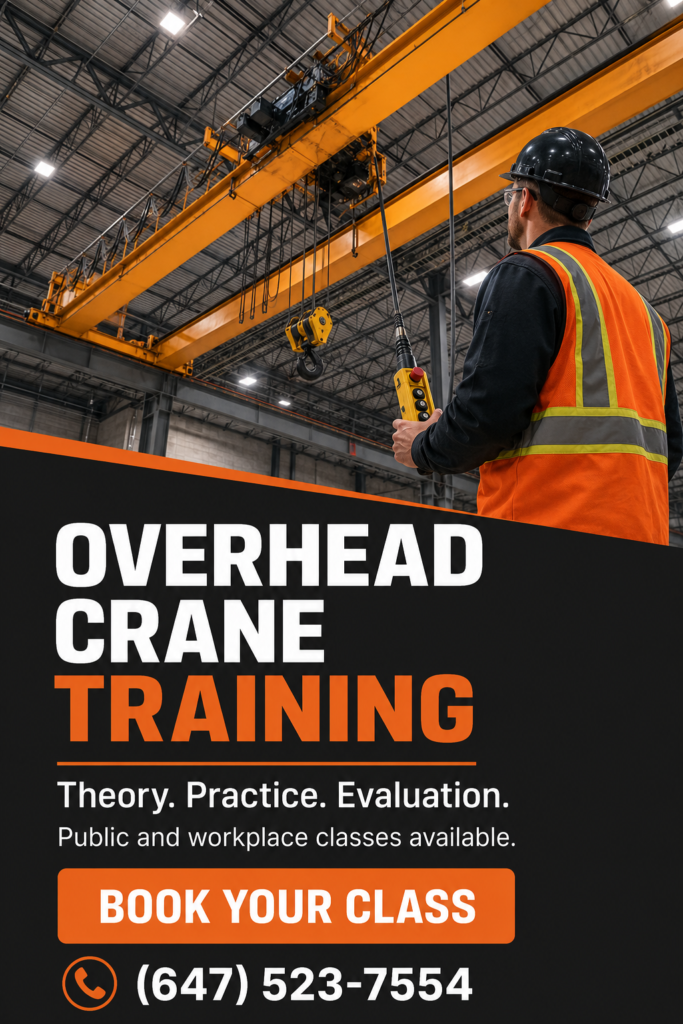
Why Practical Evaluation Matters
An operator may understand crane-safety rules on paper but struggle to apply them during an actual lift.
Practical evaluation allows the instructor to observe whether the participant can translate knowledge into controlled action. This includes equipment inspection, hook positioning, load movement, hazard awareness and safe shutdown.
Theory training answers, “Does the operator understand the requirements?”
Practical evaluation answers, “Can the operator perform the task safely?”
Both are necessary for a meaningful operator-training program.
Overhead Crane Training FAQs
Is overhead crane training mandatory in Ontario?
Ontario’s Industrial Establishments Regulation requires a lifting device to be operated by a competent person or by a worker who is being instructed and accompanied by a competent person. Employers must ensure workers receive the information, instruction and supervision needed to perform their work safely.
The appropriate training must reflect the crane, assigned work, workplace hazards and operator’s experience. See Ontario’s Industrial Establishments Regulation for requirements governing lifting devices.
Do overhead crane operators need an Ontario licence?
Ontario does not issue one universal government licence for every overhead crane operator working in an industrial establishment.
Employers must still ensure operators are properly trained, competent and authorized to use the workplace’s equipment. A course certificate helps document training, but it is not a government-issued crane licence.
Is this course aligned with CSA B167:26?
Yes. Achieve Safety’s overhead crane operator course is aligned with CSA B167:26.
The 2026 edition addresses the design, inspection, testing, maintenance and safe operation of overhead cranes, gantry cranes, monorails, hoists and jib cranes. It also recognizes the relationship between operator training and below-the-hook equipment without replacing a specialized rigging qualification. CSA Group describes the standard’s scope and covered equipment here.
Does the course include rigging training?
The course covers basic sling, lifting-device and rigging awareness as these subjects relate to safe overhead crane operation.
It is not presented as an advanced or standalone hoisting-and-rigging qualification. Employers with complex lifts may require additional instruction, engineered lift planning or specialized rigging expertise.
Does the course include a practical test?
Yes. The course includes theory instruction and a practical operator evaluation.
Participants must demonstrate that they can inspect the equipment and operating area, control a load, recognize hazards and complete the required operating tasks safely.
Can training be completed entirely online?
No. Online or classroom instruction alone cannot demonstrate practical operating ability.
Theory may teach the principles of crane safety, but an operator must also complete hands-on instruction and practical evaluation on suitable equipment.
Can Achieve Safety train employees at our facility?
Yes. Private workplace training is available.
The employer must provide a compliant overhead crane, suitable loads and a safe area for the practical component. Contact Achieve Safety before booking to confirm equipment and site requirements.
Are public overhead crane classes available?
Yes. Public classes are also available for individuals and employers who do not require a private on-site session.
Contact Achieve Safety for upcoming dates, locations and registration availability.
How long is the overhead crane course?
Course duration can vary according to the training format, participant experience, class size, equipment and practical evaluation requirements.
Contact Achieve Safety for the duration and scheduling details that apply to your class.
How many workers can attend?
Maximum class size depends on the training environment, equipment access and time required to evaluate each participant properly.
Contact Achieve Safety with the number of workers requiring training to receive an appropriate delivery plan.
Will participants receive a certificate?
Yes. Participants who successfully complete the course requirements receive a certificate from Achieve Safety.
Is refresher overhead crane training available?
Yes. Achieve Safety provides refresher training and operator re-evaluation.
Employers may request refresher training following an incident, unsafe observation, equipment change, prolonged absence or internal renewal interval.
Book Overhead Crane Operator Training in Ontario
Give your workers the knowledge and hands-on practice needed to inspect equipment, recognize lifting hazards and control loads safely.
Achieve Safety offers:
- Public overhead crane classes
- Private on-site workplace training
- Theory and practical instruction
- Practical operator evaluations
- Certificates for successful participants
- Refresher training
- Operator re-evaluations
- Training aligned with CSA B167:26
Contact Achieve Safety to discuss course dates, workplace requirements, participant numbers and availability.
Call: (647) 523-7554
References and Official Sources
- Ontario Occupational Health and Safety Act
https://www.ontario.ca/laws/statute/90o01 - Ontario Regulation 851: Industrial Establishments
https://www.ontario.ca/laws/regulation/900851 - CSA B167:26: Overhead Cranes, Gantry Cranes, Monorails, Hoists and Jib Cranes
https://www.csagroup.org/store/product/2432418/