- Heat Stress Prevention in Ontario: Policy Guidelines & Checklist
- What Is Heat Stress Prevention in the Workplace?
- Is a Heat Stress Prevention Program Legally Required in Ontario?
- When Does an Ontario Employer Need a Heat Stress Prevention Plan?
- Step 1: Conduct a Task-Specific Heat Stress Risk Assessment
- Step 2: Should Ontario Workplaces Use Humidex or WBGT?
- Step 3: Control Workplace Heat Using the Hierarchy of Controls
- Step 4: Acclimatize New and Returning Workers
- Step 5: Provide Water and Effective Recovery Areas
- Step 6: Train Workers and Supervisors
- Step 7: Prepare for a Heat Illness Emergency
- Ontario Heat Stress Prevention Checklist for Employers
- What Heat Stress Records Should Employers Keep?
- Common Heat Stress Prevention Mistakes
- Frequently Asked Questions About Heat Stress Prevention in Ontario
- Build a Heat Stress Prevention Program That Works in Practice
Heat stress prevention in Ontario is not based on one outdoor temperature. Employers must evaluate the total heat load created by temperature, humidity, radiant heat, physical workload, clothing, personal protective equipment, air movement and worker acclimatization.
Ontario employers can manage heat stress at work by assessing workplace heat exposure, monitoring changing conditions, controlling heat at its source, providing cool drinking water and recovery areas, adjusting workloads and schedules, new or returning workers, training supervisors and preparing an emergency response plan. There is no single maximum workplace temperature that replaces this risk-based process.
Heat Stress Prevention in Ontario: Policy Guidelines & Checklist
Heat stress prevention in Ontario requires more than handing out water when the temperature rises.
Employers need a planned system for identifying heat hazards, monitoring changing conditions, controlling exposure, preparing workers for hot work and responding before early symptoms become a medical emergency.
An effective workplace heat stress prevention program should include:
- A task-specific heat risk assessment
- A method for monitoring workplace conditions
- Engineering and administrative controls
- Worker acclimatization procedures
- Accessible cool drinking water
- Work and recovery arrangements
- Worker and supervisor training
- An emergency response procedure
- Inspection and incident records
Ontario does not use one maximum workplace temperature to decide whether every workplace is safe. Heat exposure must be assessed according to the actual environment, physical workload, radiant heat, humidity, air movement, clothing, personal protective equipment and worker acclimatization.
A roofing crew working in direct sunlight can face serious heat strain at a temperature that may be manageable for a person doing light work inside a ventilated building. The number on a weather app does not describe the entire exposure.
This guide explains how Ontario employers can build and operate a practical heat stress prevention program. For information about maximum temperatures, worker rights, heat breaks and unsafe work refusals, see our complete guide to workplace heat stress and working temperature requirements in Ontario.
Article reviewed for legislative accuracy: July 24, 2026
What Is Heat Stress Prevention in the Workplace?
Heat stress prevention is the process of identifying and controlling the total heat load placed on a worker before that exposure causes harmful heat strain.
The Canadian Centre for Occupational Health and Safety defines heat stress as the overall heat load created by environmental conditions, metabolic heat produced by physical work and the clothing a worker must wear. When the body cannot release heat as quickly as it gains or produces it, its internal temperature begins to rise.
In practical terms, workplace heat stress can be understood through this relationship:
Environmental heat + physical workload + clothing or PPE burden − the body’s ability to cool itself = heat strain risk
This is why air temperature alone cannot determine whether work is safe.
Environmental heat
Environmental heat includes more than the temperature of the surrounding air. It may come from:
- Direct sunlight
- Hot roofs or paved surfaces
- Furnaces, ovens and boilers
- Steam lines and heated equipment
- Molten materials
- Poorly ventilated indoor spaces
- High humidity
- Limited air movement
Radiant heat is especially easy to underestimate. A worker can absorb heat from the sun, hot metal, machinery or surrounding surfaces without touching the heat source.
Metabolic heat
The body produces its own heat while performing physical work.
Lifting, carrying, climbing, shovelling, pushing equipment and repeatedly handling materials increase metabolic heat production. Heavy work can therefore create dangerous heat strain even when the surrounding temperature does not appear extreme.
A supervisor should never evaluate a worker performing heavy labour using the same assumptions applied to someone performing light work.
Clothing and personal protective equipment
Clothing affects how quickly the body can release heat.
Coveralls, chemical-resistant suits, waterproof clothing, respirators, gloves, hoods and other personal protective equipment can trap heat and moisture. Heavy PPE may also increase the physical effort required to perform a task.
CCOHS notes that protective clothing can interfere with heat loss through evaporation, convection and radiation. It can also cause a worker to become hotter more quickly.
PPE may be essential for controlling another hazard. That does not mean the resulting heat burden can be ignored. The employer must assess both hazards and introduce additional controls where required.
The worker’s cooling capacity
The body primarily manages heat by increasing blood flow to the skin and producing sweat.
Sweat only cools the body when it evaporates. High humidity slows evaporation because the surrounding air already contains substantial moisture. Restrictive clothing can create a similar problem by preventing heat and moisture from escaping.
The worker’s ability to tolerate heat may also be affected by:
- Lack of acclimatization
- Recent time away from hot work
- Fatigue
- Dehydration
- Illness
- Certain medications
- Extended shifts
- Inadequate recovery between shifts
Employers should not ask workers to disclose private medical information beyond what is necessary to manage workplace accommodation and safety. Workers who have medical concerns about hot work should be encouraged to seek advice from a qualified healthcare professional.
Heat stress and heat strain are not the same
These terms describe related but different conditions.
Heat stress is the external and internal heat load placed on the worker.
Heat strain is the body’s physical response to that load. It can include rising body temperature, increased heart rate, heavy sweating, dehydration, fatigue and reduced mental performance.
A prevention program should control heat stress before it produces dangerous heat strain.
Waiting for a worker to become dizzy, confused or nauseated means the preventive system has already failed at an earlier stage.
Why early prevention matters
Heat can affect judgement and coordination before a worker collapses.
A worker may become slower, less attentive or more likely to make an error. In construction, manufacturing, warehousing, road work and equipment operation, those changes can increase the risk of falls, collisions, struck-by incidents and improper equipment use.
In our experience, one of the most common weaknesses in workplace heat planning is that action begins only after a worker reports symptoms.
A stronger program uses measurable conditions and predefined triggers. Supervisors know when to increase monitoring, reduce workload, provide additional recovery time, relocate work or suspend a task. Workers know how to report concerns without waiting for the exposure to become severe.
References
- Canadian Centre for Occupational Health and Safety, Hot Environments: Health Effects and First Aid.
- Canadian Centre for Occupational Health and Safety, Hot Environments: Assessment and Control Measures.
Is a Heat Stress Prevention Program Legally Required in Ontario?
Ontario does not currently have one regulation that requires every employer to maintain a document with the exact title “Heat Stress Prevention Program.”
That does not remove the employer’s obligation to address heat.
Under section 25(2)(h) of Ontario’s Occupational Health and Safety Act, an employer must take every precaution reasonable in the circumstances for the protection of a worker. Employers must also provide the information, instruction and supervision needed to protect workers and advise them of hazards associated with their work.
When excessive heat is present or reasonably foreseeable, it becomes a workplace hazard that must be assessed and controlled.
What the OHSA duty means in practice
The precautions considered reasonable will depend on the workplace and the level of risk.
An air-conditioned office may need a procedure for responding to a cooling-system failure during a heat wave. A roofing contractor may need active environmental monitoring, acclimatization schedules, shaded recovery areas and frequent changes to work intensity.
A manufacturing facility may need:
- Heat shielding
- Local exhaust ventilation
- Insulation around hot surfaces
- Mechanical handling equipment
- Cooled operator stations
- Task rotation
- A formal monitoring schedule
A reasonable precaution in one setting may be inadequate in another.
The employer’s legal duty is therefore linked to the actual hazard:
Employer → identifies heat exposure → evaluates worker risk → implements reasonable controls
Law, guidance and recommended practice
Ontario employers should distinguish between a binding legal requirement and an accepted prevention practice.
| Classification | What it means for the employer |
|---|---|
| Legal requirement | A duty imposed by the OHSA or an applicable regulation |
| Official guidance | Ministry recommendations that explain recognized methods for reducing heat risk |
| Industry best practice | A control supported by occupational hygiene, safety or public health evidence |
| Workplace procedure | The employer’s documented method for applying the controls to its own operations |
Ministry guidance is not automatically a regulation. However, following credible prevention guidance can help an employer determine what precautions are reasonable in the circumstances.
Ignoring a known hazard simply because there is no universal maximum temperature is not a defensible heat-stress strategy.
Does Ontario require a written heat stress policy?
There is currently no universal Ontario rule stating that every workplace must have a separately named written heat stress policy.
A written program is still strongly recommended where workers are regularly or foreseeably exposed to hazardous heat.
Documentation becomes more important when:
- Heat exposure occurs repeatedly
- Work is physically demanding
- Workers wear restrictive PPE
- Conditions change during the shift
- New or temporary workers are present
- Several supervisors make heat-related decisions
- The workplace has previously received heat complaints
- A worker has experienced heat-related symptoms
- Controls must be activated at predetermined levels
A verbal instruction to “take a break when needed” does not explain who monitors conditions, when controls begin, how new workers are acclimatized or what happens when a worker becomes ill.
A written program creates consistency. It also gives supervisors clear authority to modify or stop work when controls are no longer adequate.
What should a defensible program contain?
The program should be proportionate to the hazard, but most higher-risk workplaces should document:
- The tasks and locations where heat exposure may occur
- The person responsible for monitoring conditions
- The measurement or screening method being used
- The conditions that trigger stronger controls
- Engineering controls for reducing heat at its source
- Workload, scheduling and recovery procedures
- Acclimatization requirements
- Drinking-water and cooling arrangements
- Worker and supervisor responsibilities
- Heat illness reporting and emergency procedures
- Inspection, training and incident records
- The process for reviewing the program
The program should be developed with input from workers and, where applicable, the Joint Health and Safety Committee or health and safety representative.
Ontario ministry guidance supports a prevention-program approach
Ontario’s guidance for work in extreme temperature conditions recommends a heat stress prevention program containing worker training, a monitoring method and a plan describing when, where and what will be measured or monitored. The guidance identifies Environment Canada alerts, Humidex calculations and Wet Bulb Globe Temperature measurements as possible monitoring inputs.
The Ontario government’s broader heat-stress guidance also recommends planning work in advance, helping workers acclimatize, adjusting schedules, providing cool drinking water and using workplace controls to reduce exposure.
These recommendations should be adapted to the actual workplace. A generic policy copied from another company may not address the heat sources, workloads, clothing and worker population present at the site.
Is Bill 36, the Heat Stress Act, currently law?
No.
As of July 24, 2026, Ontario Bill 36, the Heat Stress Act, 2025, remains at first reading and has been ordered for second reading. It has not received Royal Assent and is not currently in force.
The proposed legislation would require the development of a Worker Heat Protection Standard. Its proposed measures include:
- Heat-stress assessments
- Engineering controls
- Work-practice controls
- Employer heat policies and programs
- Worker and supervisor training
- Cool drinking water
- Protective clothing and cooling equipment
- Consultation with worker representatives
- Paid time for required rest, training and medical removal
These are proposals contained in the bill. They should not be presented as current Ontario statutory requirements unless the bill passes and comes into force.
This distinction matters. Employers need accurate information about the law that applies today, while also understanding the direction in which Ontario’s heat-protection framework may develop.
References
-
Canadian Centre for Occupational Health and Safety, Hot Environments: Health Effects and First Aid. URL: https://www.ccohs.ca/oshanswers/phys_agents/heat/heat_health.html
-
Canadian Centre for Occupational Health and Safety, Hot Environments: Assessment and Control Measures. URL: https://www.ccohs.ca/oshanswers/phys_agents/heat/heat_control.html
-
Occupational Health and Safety Act, Ontario. URL: https://www.ontario.ca/laws/statute/90o01
-
Ontario guidance for working in extreme temperature conditions. www.labour.gov.on.ca/english/hs/pubs/gl_heat.php
-
Legislative Assembly of Ontario, Bill 36, Heat Stress Act, 2025. URL: https://www.ola.org/en/legislative-business/bills/parliament-44/session-1/bill-36
-
Canadian Centre for Occupational Health and Safety, Humidex Rating and Work. URL: https://www.ccohs.ca/oshanswers/phys_agents/humidex.html
When Does an Ontario Employer Need a Heat Stress Prevention Plan?
An Ontario employer should establish a structured heat stress prevention plan whenever workers may be exposed to conditions capable of overwhelming the body’s ability to release heat.
The plan should not be activated only when Environment Canada issues a heat warning.
Regional weather alerts are useful planning signals. They do not account for indoor heat sources, reflected heat, task intensity, PPE or conditions at the worker’s exact location.
A warehouse may remain dangerously hot after outdoor temperatures begin to fall. A worker beside a furnace can face substantial heat exposure during cool weather. A roofer working in direct sunlight may experience conditions that are much hotter than the temperature reported at a shaded weather station.
The workplace assessment must reflect where and how the work is performed.
Work environments that commonly require a plan
A formal or documented approach should be considered for:
- Construction and roofing
- Road maintenance and paving
- Landscaping and agriculture
- Warehouses without effective cooling
- Manufacturing and assembly plants
- Foundries, smelters and metal-processing facilities
- Commercial kitchens and bakeries
- Laundries
- Boiler and mechanical rooms
- Utility and maintenance work
- Emergency response
- Confined or poorly ventilated spaces
- Work requiring heavy or impermeable PPE
CCOHS identifies outdoor construction, road repair and agriculture, as well as foundries, furnaces, kitchens, bakeries and other hot indoor operations, as examples of workplaces where heat may become a serious concern.
Task and worker conditions that increase urgency
Even a workplace without a permanent heat source may need a formal plan when the job involves:
- Heavy lifting or sustained physical exertion
- Direct sun exposure
- Long periods on hot roofs or pavement
- Limited airflow
- High humidity
- Overtime or extended shifts
- Restrictive protective clothing
- Respiratory protection
- Limited access to water
- Remote work locations
- New or temporary workers
- Workers returning after an absence
- Sudden early-season heat
A worker can lose part of their heat acclimatization after only a few days away from hot work.
Practical triggers for activating the plan
The employer should define its triggers before the shift begins.
Possible triggers include:
- A forecasted heat event
- Increasing indoor temperature or humidity
- A process that releases additional heat
- Failure of ventilation or cooling equipment
- Work moving into direct sunlight
- A change from light to heavy work
- The introduction of restrictive PPE
- A worker who has not acclimatized
- A reported heat-related symptom
- Repeated worker complaints
- A previous heat incident or near miss
The trigger should lead to a specific response. “Monitor the situation” is too vague unless the procedure identifies who monitors it, what is measured and what action follows.
A heat warning is a trigger, not a complete assessment
Weather warnings can help an employer prepare staffing, water, shade and work schedules. They should not replace measurements taken at the workplace.
Humidex values reported by weather services are designed for the public. Occupational heat risk also depends on workload, radiant heat, airflow, physical condition and clothing.
CCOHS advises that Humidex may be useful in relatively simple environments where workload, air movement and radiant heat do not make a major contribution. Measurements should still be taken in the actual work area because workplace conditions can differ significantly from regional weather reports.
Higher-risk or more complex exposures may require Wet Bulb Globe Temperature monitoring and competent occupational hygiene support.
Signs that the existing plan is not strong enough
An employer should review the prevention program when:
- Workers do not know when additional controls begin
- Supervisors use different heat thresholds
- Water is available but too far from the work
- Workers avoid breaks because of production pressure
- New workers begin at a full workload
- No one records temperature, humidity or WBGT readings
- PPE is not included in the assessment
- Symptoms are treated as personal weakness
- Ventilation failures do not trigger task reassessment
- The plan depends entirely on workers requesting help
A good program does not make a hot workplace risk-free. It creates an organized response that becomes more protective as the exposure increases.
Step 1: Conduct a Task-Specific Heat Stress Risk Assessment
A heat stress risk assessment should identify where workers may be exposed, how much heat strain the work can create and what controls must be in place before the task begins.
The assessment should not evaluate the building or outdoor temperature in isolation.
It should evaluate a specific combination:
Worker + task + location + time + environmental conditions + clothing = actual heat exposure
Two employees at the same workplace can face very different risks. One may operate equipment inside a cooled cab. Another may lift materials beside a hot process while wearing coveralls and respiratory protection.
CCOHS recommends assessing job-specific conditions, including air temperature, humidity, radiant heat and other exposure factors, before selecting controls. Heat measurement, control measures, training, monitoring, recordkeeping and emergency planning should form part of a broader heat stress management program.
When should the assessment be completed?
The employer should assess heat exposure before predictable hot work begins.
The assessment should also be reviewed when:
- Seasonal temperatures begin to rise
- A heat warning or prolonged hot period is forecast
- Work moves into direct sunlight
- Production speed or physical workload increases
- Workers begin wearing different clothing or PPE
- Ventilation or air-conditioning equipment fails
- A hot process starts, changes or releases more heat
- Employees begin working longer shifts
- A new or returning worker joins the task
- A worker reports symptoms or discomfort
- A heat-related incident or near miss occurs
- Existing controls appear ineffective
A risk assessment is not a once-a-year form. Heat exposure can change within the same shift.
Morning conditions may be acceptable, while direct afternoon sun, increased humidity or accumulated indoor heat can make the same task unsafe several hours later.
Who should conduct the heat stress assessment?
The employer should assign the assessment to someone who understands:
- Workplace heat sources
- The work being performed
- Environmental monitoring methods
- Workload classification
- Acclimatization
- Clothing and PPE adjustments
- Heat-control methods
- Emergency response requirements
A supervisor may be able to perform routine Humidex screening after receiving suitable instruction.
More complex assessments may require an occupational hygienist or another qualified professional. CCOHS specifically recommends that qualified professionals perform WBGT measurements because the readings must be collected and interpreted in relation to the physical demands of the job.
Buying a WBGT meter does not automatically make the assessment reliable. The person using it must know where and when to measure, how long the instrument needs to stabilize and how workload, clothing and acclimatization affect the result.
Identify every source of workplace heat
Begin by documenting where the heat comes from.
Potential sources include:
- Outdoor air temperature
- Direct solar exposure
- Heated roofs and paved surfaces
- Furnaces, ovens and kilns
- Boilers and steam lines
- Hot machinery
- Molten or heated materials
- Welding and cutting operations
- Commercial cooking equipment
- Poor ventilation
- High humidity
- Heat generated by nearby processes
- The worker’s own physical exertion
Radiant heat requires special attention.
A standard thermometer measures air temperature. It does not fully describe the heat a worker absorbs from direct sunlight, hot metal, equipment or nearby surfaces.
This is one reason a room thermometer may show a moderate temperature while workers beside a furnace or under direct sun experience a much greater heat load.
Assess the task, not only the temperature
Physical work creates metabolic heat inside the body.
A task involving repeated lifting, shovelling, climbing or carrying can expose a worker to more heat strain than a sedentary task performed in the same environment.
The assessment should document:
- The movements required
- The weight being handled
- The pace of work
- Whether the task is continuous or intermittent
- Whether the worker can control the pace
- The duration of the exposure
- The recovery time available
- Whether recovery occurs in a genuinely cooler area
A “break” does not provide effective heat recovery when the worker remains beside the heat source or performs another physically demanding task.
How to classify workplace workload
Workload should be classified before a WBGT result or work-rest recommendation is interpreted.
The following categories provide a practical starting point based on current CCOHS examples.
| Workload | Typical characteristics | Workplace examples |
|---|---|---|
| Rest | Sitting quietly or performing limited arm movement | Seated observation in a cooled area |
| Light work | Standing or sitting with light hand and arm work, occasional walking | Operating controls, driving, light assembly |
| Moderate work | Continuous walking with moderate lifting, pushing or pulling | Cleaning, material handling, steady warehouse work |
| Heavy work | Sustained whole-body effort, heavy loads or rapid movement | Digging, carrying heavy materials, manual sawing |
| Very heavy work | Intense activity performed at a fast or maximum pace | Rapid heavy shovelling or highly demanding emergency work |
These labels should not be assigned from a job title.
A maintenance worker may perform light monitoring for part of the shift and very heavy work during an emergency repair. A construction worker may move between equipment operation, material handling and intensive manual labour.
Each meaningful exposure period should be assessed according to the work actually performed.
Assess clothing and personal protective equipment
Clothing can substantially change the effective heat load.
The assessment should record whether workers wear:
- Standard work clothing
- Coveralls
- Multiple clothing layers
- Waterproof clothing
- Chemical-resistant clothing
- Vapour-barrier coveralls
- Hoods
- Gloves
- Respirators
- Welding protection
- Fully or partially encapsulating suits
Some garments restrict sweat evaporation. Others add insulation, weight or physical effort.
This creates an important hazard relationship:
Protective clothing → restricts heat loss → increases heat strain
The solution is not to remove PPE that is required for another hazard.
The employer must account for the additional heat burden and strengthen other controls. This may involve reducing exposure time, providing cooled recovery areas, rescheduling the work, using mechanical assistance or selecting protective equipment that controls the primary hazard with less heat burden.
CCOHS’s current guidance requires WBGT readings to be adjusted for certain clothing systems. For example, its published assessment example adds 3°C to a measured WBGT when a worker wears double-layer woven clothing. A measured WBGT of 28°C would therefore be treated as an effective WBGT of 31°C in that example.
That difference can significantly change the required response.
Determine whether the worker is acclimatized
Acclimatization is the body’s gradual adaptation to repeated heat exposure.
The assessment should identify whether the worker is:
- New to hot work
- Returning after time away
- Moving into a hotter task
- Beginning work during sudden early-season heat
- Wearing heavier PPE than usual
- Recovering from an illness or absence
- Accustomed to the specific workload and conditions
A worker who performs office work most of the year is not automatically acclimatized because they spend time outside during the summer.
Acclimatization must relate to the workplace exposure, physical effort, duration and clothing involved.
New and unacclimatized workers generally require more protective exposure limits and closer supervision. Current CCOHS screening guidance therefore separates acclimatized workers from unacclimatized workers when WBGT results are interpreted.
Use a structured assessment table
The following table can be adapted for a workplace heat stress assessment form.
| Assessment factor | Questions to answer | Evidence to record |
|---|---|---|
| Work location | Where is the task performed? Is it indoors, outdoors, shaded or in direct sun? | Work area, floor, roof, equipment or project location |
| Heat sources | Is heat produced by sunlight, equipment, hot surfaces, steam or a process? | Source description and proximity to workers |
| Air conditions | What are the air temperature, humidity and air movement? | Instrument readings, date and time |
| Radiant heat | Are workers exposed to direct sunlight or hot surrounding surfaces? | Source, duration and shielding |
| Workload | Is the work light, moderate, heavy or very heavy? | Task description, pace and load |
| Exposure time | How long does each exposure period last? | Start time, end time and task rotation |
| Clothing and PPE | Does clothing trap heat or restrict evaporation? | Garments, layers and adjustment factors |
| Acclimatization | Is the worker accustomed to the heat and workload? | New, returning or acclimatized status |
| Existing controls | What reduces the heat or limits exposure? | Ventilation, shade, insulation, scheduling and recovery areas |
| Water access | Is cool water close enough to support frequent drinking? | Location, supply and inspection result |
| Emergency readiness | Can workers obtain first aid and emergency assistance quickly? | First-aid procedure and communication method |
| Required action | What must change before or during the work? | Assigned control, responsible person and completion time |
Measure the conditions workers actually experience
Regional weather information can support planning. It should not be treated as the workplace measurement.
Conditions can differ because of:
- Direct sun
- Roof or pavement temperature
- Process heat
- Humidity created by operations
- Poor indoor ventilation
- Heat stored inside a building
- Local airflow
- Enclosed work areas
For occupational Humidex screening, CCOHS recommends using temperature and relative-humidity measurements taken in the actual work area. Indoor workplace conditions can differ significantly from weather-station readings or media reports.
Measurements should represent the worker’s exposure.
A reading from an air-conditioned office does not describe conditions on a loading dock, production floor, rooftop or boiler room.
Where conditions vary, the employer may need readings from multiple locations and times.
Reassess after controls are introduced
A control should not be considered effective simply because it has been installed.
The employer should verify whether:
- Ventilation reaches the worker
- A heat shield blocks the radiant source
- Shade remains available as the sun moves
- Recovery areas are meaningfully cooler
- Water remains accessible
- Reduced production rates lower physical effort
- Task rotation reduces total exposure
- Workers are using the control as intended
- Symptoms or complaints continue
For example, placing a fan near a workstation may increase sweat evaporation under some conditions. It does not reduce the air temperature, and it may not adequately control exposure near a strong radiant heat source.
The assessment should measure the remaining risk after controls are applied.
What heat stress records should be retained?
The assessment record should include enough information to explain the employer’s decision.
Record:
- Date and time
- Work area
- Task
- Workers or roles exposed
- Heat sources
- Temperature and humidity
- Humidex or WBGT result
- Instrument used
- Workload classification
- Clothing and PPE
- Acclimatization status
- Existing controls
- Additional controls activated
- Worker complaints or symptoms
- Name of the person completing the assessment
- Time of the next review
These records help the employer identify recurring exposure patterns. They also allow another supervisor to understand why work was changed, delayed, relocated or stopped.
Heat Stress Risk Assessment References
- CCOHS: Hot Environments, Assessment and Control Measures
- CCOHS: Humidex Rating and Work
- Ontario: Managing Heat Stress at Work
Step 2: Should Ontario Workplaces Use Humidex or WBGT?
Ontario workplaces can use Humidex for simplified heat screening under suitable conditions. Wet Bulb Globe Temperature, or WBGT, is the more appropriate assessment method when workload, direct sun, radiant heat, air movement, hot processes or protective clothing materially affect the exposure.
The two measurements are not interchangeable.
Humidex helps screen simple heat and humidity conditions. WBGT evaluates occupational heat exposure in greater detail.
Some workplaces can use both.
Humidex may provide an early planning trigger. A WBGT assessment can then be used for higher-risk tasks, complex environments or conditions approaching the workplace’s action level.
What does Humidex measure?
Humidex combines air temperature and humidity to describe how hot the conditions feel to an average person.
Environment and Climate Change Canada uses Humidex as a public weather communication tool. It reflects perceived heat rather than the complete occupational heat load.
Humidex does not directly account for:
- Physical workload
- Direct solar radiation
- Hot machinery or surfaces
- Variations in air movement
- Restrictive clothing
- Most PPE
- Worker acclimatization
- Exposure duration
For that reason, the Humidex reported in a weather forecast should not be treated as a final workplace exposure assessment.
When can workplace Humidex be useful?
Humidex can be a practical screening tool when:
- Air temperature and humidity are the main heat factors
- There is no substantial process heat
- Radiant heat is limited
- Air movement is not a major variable
- Workers perform relatively light or moderate tasks
- Clothing does not create an unusual heat burden
- Temperature and humidity are measured in the actual work area
CCOHS gives an office as an example of a workplace where Humidex may be useful because workload, wind speed and radiant heat do not usually make a major contribution to the exposure.
Other workplaces may use a Humidex-based response plan as an initial screening system, provided its limitations are understood.
Workplace Humidex is not the forecast Humidex
A supervisor should not copy the Humidex value from a weather app and assume it represents every work area.
A proper workplace Humidex calculation uses:
- The air temperature measured at the workplace
- The relative humidity measured at the workplace
- Readings taken where the exposure occurs
- Readings collected often enough to detect changing conditions
The regional forecast remains useful. It can alert the employer to prepare water, shade, staffing and schedule changes.
The actual control decision should reflect conditions at the worksite.
What does WBGT measure?
Wet Bulb Globe Temperature is the most widely used measure of occupational heat exposure.
WBGT accounts for several environmental factors that affect the body’s heat balance:
- Air temperature
- Humidity
- Sweat evaporation
- Air movement
- Radiant heat
- Direct sunlight, where applicable
It can then be interpreted in relation to:
- Physical workload
- Acclimatization
- Work and recovery allocation
- Clothing and PPE
How is WBGT calculated?
For work in direct sunlight, WBGT incorporates natural wet-bulb temperature, globe temperature and dry-bulb temperature:
WBGT = 0.7 × natural wet-bulb temperature + 0.2 × globe temperature + 0.1 × dry-bulb temperature
For indoor or shaded work without direct solar exposure:
WBGT = 0.7 × natural wet-bulb temperature + 0.3 × globe temperature
A direct-reading WBGT meter can perform these calculations automatically.
The black-globe component captures radiant heat. The natural wet-bulb component reflects evaporative cooling and air movement. The dry-bulb component measures ordinary air temperature.
The instrument must be given enough time to respond to the environment. CCOHS notes that traditional black-globe and natural wet-bulb thermometers can require approximately 20 minutes to reach equilibrium.
Humidex versus WBGT comparison
| Assessment issue | Humidex | WBGT |
|---|---|---|
| Air temperature | Included | Included |
| Humidity | Included | Included |
| Air movement | Not directly included | Included through natural wet-bulb measurement |
| Radiant heat | Not directly included | Included |
| Direct sunlight | Not directly included | Included in the outdoor formula |
| Physical workload | Not part of the number | Considered during interpretation |
| Clothing and PPE | Requires a separate adjustment method | Clothing adjustments can be applied |
| Acclimatization | Not part of the number | Considered during interpretation |
| Best use | Simplified screening | Occupational heat assessment |
| Typical workplace | Office or simple indoor environment | Construction, industrial work, hot processes and demanding tasks |
Which method should the workplace choose?
Use this decision table as a starting point.
| Workplace condition | Recommended starting approach |
|---|---|
| Office or light indoor work with no process heat | Workplace Humidex screening |
| General summer planning | Forecast plus workplace Humidex measurements |
| Outdoor work in direct sun | WBGT |
| Roofing, road work or landscaping | WBGT |
| Warehouse with variable workload | Humidex screening, with WBGT for higher-risk tasks |
| Furnace, oven, boiler or hot machinery | WBGT |
| High radiant heat | WBGT |
| Heavy or very heavy physical work | WBGT |
| Multiple work areas with different conditions | Location-specific WBGT or appropriate measurements |
| Restrictive or vapour-barrier clothing | WBGT with clothing adjustment |
| Rapidly changing exposure | Repeated or time-weighted WBGT |
| Uncertain or conflicting results | Occupational hygiene assessment |
This table is a practical decision aid. It does not replace a competent assessment of the individual workplace.
Can Humidex be converted directly into WBGT?
No reliable direct conversion exists between Humidex and WBGT.
The two systems measure different combinations of factors.
CCOHS states that direct comparison is not possible and that no universal conversion table or formula can convert one value into the other. Limited estimates may be possible when radiant heat is absent and air movement is low, but those assumptions do not apply to many industrial or outdoor workplaces.
Employers should be cautious with online tools that present a simple Humidex-to-WBGT conversion without asking about sunlight, radiant heat, air movement, workload or clothing.
How should an employer interpret a WBGT reading?
A WBGT number is not meaningful until it is connected to the work.
The assessment process should follow this sequence:
- Measure representative workplace conditions.
- Determine whether the work is indoors, shaded or in direct sun.
- Classify the physical workload.
- Identify whether the worker is acclimatized.
- Apply an appropriate clothing adjustment.
- Consider exposure duration and the work-rest cycle.
- Compare the effective result with current occupational hygiene guidance.
- Introduce controls and monitor worker response.
- Reassess when the conditions change.
The American Conference of Governmental Industrial Hygienists publishes heat-stress Threshold Limit Values and Action Limits in WBGT units.
ACGIH expressly states that its TLVs are guidelines, not legal standards. They are designed to support decisions by industrial hygienists and should be considered with other workplace factors.
Why one WBGT number can lead to different actions
Consider two workers exposed to the same measured WBGT:
- Worker A performs light equipment monitoring and is acclimatized.
- Worker B performs heavy lifting, is returning after an absence and wears double-layer clothing.
The environmental reading is the same.
The risk is not.
Worker B produces more metabolic heat, may have less heat adaptation and has a clothing system that restricts cooling. The employer may need to reduce Worker B’s exposure even when Worker A can continue with existing controls.
This illustrates an important assessment rule:
WBGT measures the environment. Workload, acclimatization and clothing determine how the reading applies to the worker.
Using the OHCOW Humidex-Based Heat Stress Calculator
The Occupational Health Clinics for Ontario Workers provides a Humidex-based calculator and response-plan tool for Ontario workplaces.
It can help employers:
- Calculate workplace Humidex
- Estimate WBGT under suitable conditions
- Consider clothing and PPE
- Identify sample response actions
- Build a simplified heat-response plan
The tool is useful, but it has defined assumptions.
Employers should follow the questions and limitations provided with the calculator rather than copying only the response table.
Measurements that should not be used alone
The following do not provide a complete occupational heat assessment:
- A phone weather app
- A regional airport weather reading
- A wall thermostat in another room
- A vehicle temperature display
- A single measurement taken before the shift
- Air temperature without humidity
- Humidex without considering workload
- WBGT without clothing adjustment
- A worker comfort survey without measurements
- A response chart copied from another workplace
Worker feedback remains important. Symptoms should never be dismissed because a meter shows a value below an action level.
No environmental reading can prove that an individual worker is safe when they are showing signs of heat illness.
WBGT and Humidex References
- CCOHS: Humidex Rating and Work
- CCOHS: Hot Environments, Assessment and Control Measures
- OHCOW: Humidex-Based Heat Stress Calculator and Plan
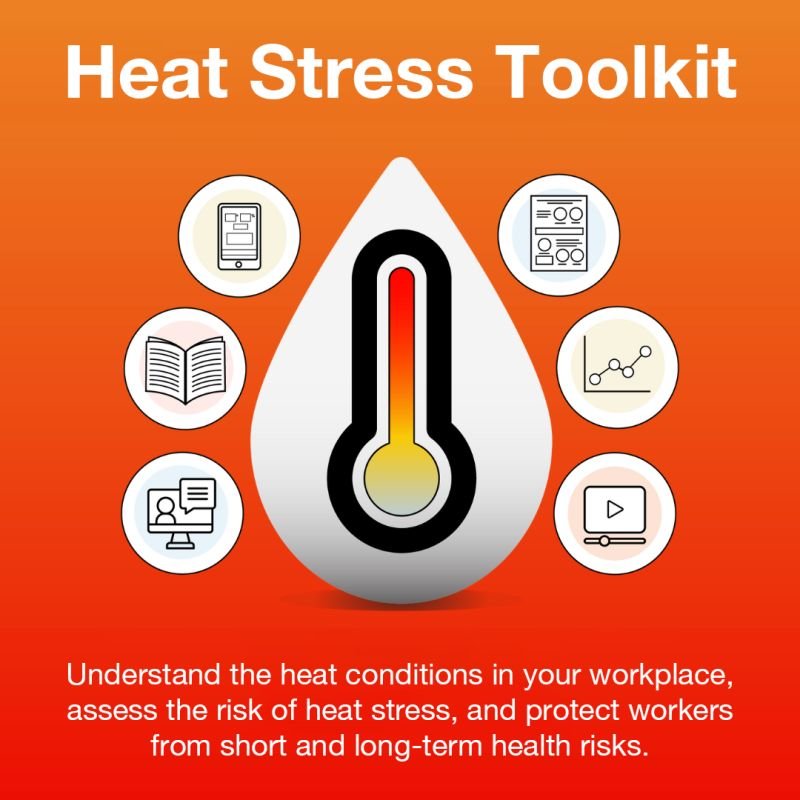
- OHCOW: Heat Stress Toolkit
- ACGIH: TLV and BEI Guidelines
Step 3: Control Workplace Heat Using the Hierarchy of Controls
Once an employer identifies a heat hazard, the next step is to reduce exposure using the hierarchy of controls.
Water, rest breaks and worker training are important. However, they should not replace controls that remove heat or reduce it at the source.
Eliminate or reduce the heat source
Where reasonably possible, employers should first change the work or process that creates the exposure.
Examples include:
- Completing hot work when equipment is shut down
- Moving the task away from furnaces, ovens or steam lines
- Performing demanding outdoor work earlier in the day
- Reducing unnecessary physical handling
- Using mechanical equipment instead of manual lifting
- Delaying non-essential work during severe heat conditions
Eliminating heat exposure is not always practical. The employer should then consider engineering controls.
Use engineering controls
Engineering controls reduce workplace heat without depending entirely on worker behaviour.
Depending on the workplace, these may include:
- Mechanical ventilation
- Local exhaust systems
- Air conditioning
- Portable cooling equipment
- Insulation around hot surfaces
- Radiant heat shields
- Cooled operator booths
- Dehumidification
- Shaded work areas
- Mechanical lifting or material-handling equipment
A control should be tested after installation.
A fan, for example, may improve evaporation in some conditions. It does not remove heat from a workplace and may provide limited protection where humidity or radiant heat is high.
Adjust how the work is performed
Administrative controls limit the amount or intensity of heat exposure.
They may include:
- Scheduling demanding work during cooler hours
- Reducing the pace of work
- Rotating workers between hot and cooler tasks
- Increasing recovery time
- Shortening exposure periods
- Moving recovery breaks to a cooled or shaded area
- Using a buddy system
- Increasing supervision during changing conditions
- Stopping non-essential work when controls are no longer effective
Work-rest decisions should reflect the task, workplace conditions, clothing and worker acclimatization. One universal break schedule will not suit every workplace.
Step 4: Acclimatize New and Returning Workers
Acclimatization is the body’s gradual adaptation to working in heat.
New workers, temporary workers and employees returning after an absence may be more vulnerable because their bodies have not adapted to the conditions.
Experienced workers returning to hot work may also need a reduced workload during their first few days back.
Employers should provide closer supervision when a worker:
- Is new to the job
- Returns after an extended absence
- Moves into a hotter work area
- Begins wearing heavier PPE
- Starts work during an early-season heat event
- Has not previously performed the task in hot conditions
Physical fitness does not replace heat acclimatization.
Workers should also be encouraged to report illness, medication concerns or accommodation needs through the appropriate workplace process without being required to disclose unnecessary private medical details.
Step 5: Provide Water and Effective Recovery Areas
Workers exposed to heat need convenient access to cool drinking water.
Ontario heat-stress guidance recommends encouraging workers to drink regularly rather than waiting until they feel thirsty. Water should be located close enough to the work area that drinking does not interfere with production expectations.
A practical hydration procedure should include:
- Cool potable water near the work area
- Regular reminders from supervisors
- Frequent opportunities to drink
- Replenishment during the shift
- Clean cups or individual containers
- Additional planning for remote worksites
- Electrolyte replacement where prolonged heavy sweating is expected
Workers should not be pressured to avoid drinking water because of production targets or limited washroom access.
Recovery areas should provide meaningful relief from the exposure. A break beside the same heat source may reduce physical effort, but it may not allow the body to cool.
Where possible, recovery areas should be:
- Shaded or air-conditioned
- Away from hot machinery
- Well ventilated
- Supplied with cool water
- Large enough for affected workers
- Accessible without delay
Step 6: Train Workers and Supervisors
A heat stress prevention program is only effective when workers understand it and supervisors know when to act.
Worker training should cover:
- Common heat hazards
- Early signs of heat illness
- Hydration expectations
- Acclimatization procedures
- Use of cooling and recovery areas
- The buddy system
- How to report symptoms
- Emergency procedures
Supervisor training should cover:
- Identifying high-risk tasks
- Monitoring workplace conditions
- Recognizing changes in worker behaviour
- Adjusting schedules and workload
- Protecting new and returning workers
- Activating stronger controls
- Responding to reported symptoms
- Documenting readings and decisions
- Stopping work when controls are inadequate
Supervisors must have the authority to reduce, relocate or suspend work when the risk can no longer be controlled.
A policy that assigns responsibility without decision-making authority is unlikely to work during an actual heat event.
Step 7: Prepare for a Heat Illness Emergency
Heat illness can progress quickly.
Workers should be instructed to report early symptoms such as:
- Headache
- Dizziness
- Unusual fatigue
- Nausea
- Muscle cramps
- Heavy sweating
- Weakness
- Reduced coordination
Confusion, collapse, loss of consciousness, seizures or unusual behaviour may indicate heat stroke.
Heat stroke is a medical emergency. Call 911 and begin rapid cooling while waiting for emergency assistance.
The workplace emergency procedure should identify:
- Who calls emergency services
- Who provides first aid
- Where cooling supplies are located
- How the worker will be moved to a cooler area
- Who will meet emergency responders
- How remote workers will request help
- Who will document and investigate the incident
- How other exposed workers will be protected
Workers showing symptoms should not be left alone or expected to drive themselves home.
For a detailed comparison of heat cramps, heat exhaustion and heat stroke, see our guide to workplace heat stress and temperature requirements in Ontario.
Ontario Heat Stress Prevention Checklist for Employers
Use this checklist before and during hot work.
Before the shift
- Review the weather forecast and workplace conditions
- Identify high-heat tasks and locations
- Confirm which workers are acclimatized
- Check ventilation and cooling equipment
- Ensure cool drinking water is available
- Prepare shaded or cooled recovery areas
- Review the emergency procedure
- Assign responsibility for monitoring conditions
During the shift
- Measure conditions in the actual work area
- Watch for changing humidity, sunlight or process heat
- Increase monitoring for new and returning workers
- Encourage regular water consumption
- Adjust workload and recovery periods
- Confirm workers are using required controls
- Respond immediately to reported symptoms
- Stop or relocate work if controls become ineffective
After the shift
- Record heat readings and actions taken
- Document worker complaints or symptoms
- Replenish water and cooling supplies
- Correct ventilation or equipment problems
- Review near misses and first-aid cases
- Plan additional controls for the next shift
What Heat Stress Records Should Employers Keep?
Heat-stress documentation helps employers identify recurring risks and demonstrate that preventive action was taken.
Useful records include:
- Heat risk assessments
- Humidex or WBGT readings
- Weather alerts reviewed
- Workload classifications
- Clothing and PPE considerations
- Acclimatization schedules
- Work-rest adjustments
- Water and recovery-area inspections
- Worker and supervisor training
- Reported symptoms
- First-aid treatment
- Corrective actions
- Equipment or ventilation failures
- Supervisor checklists
- Incident investigations
There is no benefit in collecting readings that do not lead to action.
The workplace procedure should explain what happens when conditions rise, a worker reports symptoms or a control fails.
Common Heat Stress Prevention Mistakes
Ontario employers should avoid these common failures:
- Relying only on a weather app
- Treating water as the only control
- Waiting until a worker becomes ill
- Ignoring physical workload
- Forgetting the heat burden created by PPE
- Starting new workers at a full workload
- Providing breaks in an area that is still hot
- Using the same response plan for every task
- Failing to record heat-related decisions
- Giving supervisors responsibility without authority
- Assuming the absence of a heat warning means the work is safe
The strongest heat-stress programs are proactive. They define responsibilities and control triggers before conditions become dangerous.
Frequently Asked Questions About Heat Stress Prevention in Ontario
Does Ontario require a heat stress prevention policy?
Ontario does not currently require every employer to maintain a document with that exact title. However, employers must take every precaution reasonable in the circumstances to protect workers from foreseeable hazards, including excessive heat.
A written plan is strongly recommended when heat exposure is recurring, physically demanding or difficult to control.
Is there a maximum legal workplace temperature in Ontario?
Ontario does not use one universal maximum temperature for all workplaces.
Risk depends on humidity, radiant heat, air movement, workload, clothing, PPE, exposure duration and worker acclimatization.
Should employers use Humidex or WBGT?
Humidex can support basic screening where temperature and humidity are the main concerns.
WBGT is generally more appropriate for outdoor work, direct sunlight, radiant heat, heavy physical work, hot industrial processes and restrictive clothing.
How long does heat acclimatization take?
Many workers require several days of gradually increasing exposure. Some may need a week or longer, depending on the task, conditions and individual response.
Acclimatization can also decline after time away from hot work.
Are heat breaks legally required in Ontario?
Ontario does not prescribe one universal heat-break schedule for all workplaces.
Employers must still provide reasonable precautions. Depending on the risk, this may require reduced workload, recovery periods, task rotation, cooling areas or suspension of work.
When should work be stopped?
Work should be reduced, relocated or stopped when required controls are unavailable, workplace conditions exceed the plan’s action level or workers cannot be adequately protected.
Work must also stop for an affected worker when signs of heat illness appear.
Build a Heat Stress Prevention Program That Works in Practice
A heat stress prevention program should tell supervisors and workers what to do before conditions become dangerous.
The most effective programs connect each part of the process:
Hazard assessment → monitoring → control → worker protection → emergency response → documented review
Achieve Safety and Compliance helps Ontario employers assess workplace hazards, develop health and safety training programs, train workers and supervisors, and audit how safety procedures are being applied.
Contact Achieve Safety to discuss a workplace heat stress assessment, customized prevention program or supervisor training.
Official Heat Stress Resources
- Ontario: Managing Heat Stress at Work
- CCOHS: Hot Environments, Assessment and Control Measures
- CCOHS: Humidex Rating and Work
- OHCOW: Heat Stress Toolkit
- Ontario Occupational Health and Safety Act
RESOURCES
- HEAT STRESS Prevention Tools 2024 EDITION and Strategies
- Heat Stress Awareness Guide
- Humidex-Based Heat Stress Calculator and Plan
References
- Bernard, T. E., & Iheanacho, I. (2015). Heat index and adjusted temperature as surrogates for wet bulb globe temperature to screen for occupational heat stress. Journal of Occupational and Environmental Hygiene, 12(5),
323-333. https://doi.org/10.1080/15459624.2014.989365 - Climate Risk Institute (CRI). (2023). Ontario Provincial Climate Change Impact Assessment: Technical Report. https://www.publications.gov.on.ca/CL32819
- Notley, S. R., Meade, R. D., D’Souza, A. W., McGarr, G. W., & Kenny, G. P. (2018). Cumulative effects of successive
workdays in the heat on thermoregulatory function in the aging worker. Temperature, 5(4), 293-295. https://doi.org/10.1080/23328940.2018.1512830 - Occupational Health and Safety Council of Ontario. (2022). Humidex-Based Heat Response Plan. ACGIH TLV: Heat
Stress and Strain Documentation ACGIH. - Taylor, N. A., Machado-Moreira, C. A., van den Heuvel, A. M., & Caldwell, J. N. (2014). Hands and feet: physiological
insulators, radiators and evaporators. European Journal of Applied Physiology, 114, 2037-2060. https://doi.org/10.1007/s00421-014-2940-8