- Is Worker Health and Safety Awareness Training Mandatory in Ontario?
- Who Must Complete Worker Health and Safety Awareness Training?
- When Must Workers Complete Health and Safety Awareness Training in Ontario?
- What Does Ontario’s Worker Health and Safety Awareness in 4 Steps Cover?
- 1 Get On Board
- 2 Get In the Know
- 3 Get Involved
- 4 Get More Help
- Can Workers Complete Health and Safety Awareness Training for Free in Ontario?
- How Long Does Worker Health and Safety Awareness Training Take?
- Does Worker Health and Safety Awareness Training Expire in Ontario?
- What Is the Difference Between Worker and Supervisor Awareness Training in Ontario?
- Employer Checklist: Meeting Ontario’s Worker Awareness Training Requirements
- Frequently Asked Questions About Worker Health and Safety Awareness Training
- Supporting Workplace Health and Safety Training Across Ontario
Is Worker Health and Safety Awareness Training Mandatory in Ontario?
Yes. Worker health and safety awareness training is mandatory for workers covered by Ontario’s Occupational Health and Safety Act (OHSA), subject to the exemptions in Ontario Regulation 297/13. Employers must ensure workers receive basic instruction about their workplace safety rights, responsibilities, common hazards and the people they can approach with safety concerns.
Under section 1 of O. Reg. 297/13, employers must ensure workers complete the required awareness training as soon as practicable. The regulation sets out minimum learning topics but does not establish a fixed course duration or require employers to purchase training from a private provider.
Ontario offers a free program called Worker Health and Safety Awareness in Four Steps. Employers may also use another program that meets the regulation’s requirements.
Completing this training provides workers with foundational knowledge of workplace health and safety. Additional instruction may be necessary before they can safely perform particular jobs or operate equipment.
Who Must Complete Worker Health and Safety Awareness Training?
The requirement generally applies to workers covered by Ontario’s OHSA, regardless of whether they work full-time, part-time or on a temporary basis.
This means an employer should consider awareness training when onboarding:
-
Full-time and part-time employees
-
Seasonal workers hired for short-term operations
-
Temporary workers assigned through staffing agencies
-
New employees entering the workforce
-
Experienced employees who cannot provide acceptable evidence of previous qualifying training
The requirement is based on a person’s status as a worker under the OHSA, rather than their job title or the number of hours they work each week.
Do Experienced Workers Need to Take the Training Again?
Not necessarily.
Section 4 of O. Reg. 297/13 provides an exemption where a worker has previously completed qualifying awareness training and provides proof to the employer. The employer must verify that the earlier training meets the applicable requirements.
For example, an employee who completed Ontario’s Four Steps awareness training with a previous employer may not need to repeat it when joining another company, provided the new employer receives satisfactory proof and verifies the training.
An employer should not assume that previous employment or general safety experience is sufficient evidence.
What About Temporary Agency Workers?
Temporary agency assignments require particular attention because more than one organization may be involved in the employment arrangement.
The parties should clarify who will deliver basic awareness training, verify previous completion and maintain the relevant records. Responsibilities under the OHSA depend on the working arrangement and applicable legal duties.
The host workplace must also ensure workers receive the information and instruction needed to understand its specific hazards and procedures.
A temporary worker who has completed general awareness training may still require instruction about site traffic, emergency exits, equipment restrictions and hazard reporting before starting an assignment.
When Must Workers Complete Health and Safety Awareness Training in Ontario?
Ontario Regulation 297/13 requires employers to ensure workers complete basic awareness training as soon as practicable.
The regulation does not prescribe a universal deadline of three days, seven days or 30 days for worker awareness training.
For most employers, including awareness training in the initial onboarding process is a practical way to meet the requirement and introduce workers to their rights and responsibilities before they become familiar with workplace routines.
However, the legal wording matters. Employers should not present an internal onboarding target as though it were a fixed statutory deadline.
Can a New Employee Start Working Before Completing Awareness Training?
The regulation uses the phrase as soon as practicable, so it does not establish an absolute rule that every worker must finish the awareness program before performing any work.
That does not remove the employer’s other safety obligations.
Under the OHSA, employers must provide the information, instruction and supervision necessary to protect workers. Depending on the task, certain hazard-specific instruction or qualifications may be required before work begins.
For example, a newly hired warehouse employee may need immediate instruction on pedestrian routes, forklift traffic and emergency procedures, even if the basic awareness module is scheduled as part of their initial onboarding.
Practical employer approach: Arrange basic awareness training promptly, document completion and separately identify any instruction workers need before undertaking hazardous tasks.
What Does Ontario’s Worker Health and Safety Awareness in 4 Steps Cover?
Ontario’s Worker Health and Safety Awareness in Four Steps program introduces workers to the basic principles of workplace health and safety. It explains how the OHSA protects workers, who is responsible for safety and what employees should do when they identify a hazard.
The four steps organize the learning material into practical topics. They are part of one awareness training program, rather than four separate certifications.
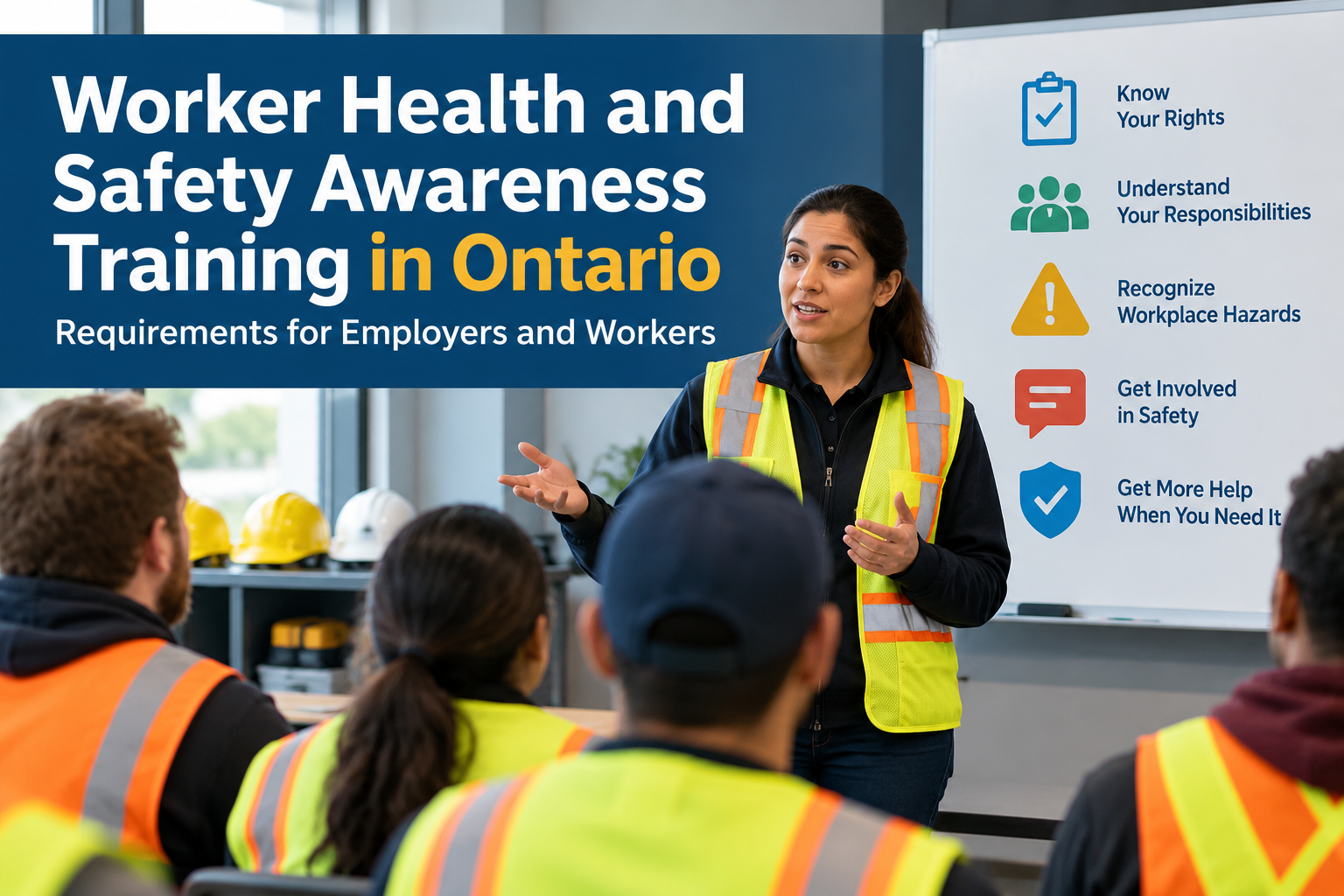
1 Get On Board
Introduces the Occupational Health and Safety Act, the internal responsibility system and the roles of employers, supervisors and workers. Workers learn that workplace safety is a shared responsibility, with specific legal duties assigned to each party.
2 Get In the Know
Explains common workplace hazards, how workers can recognize potential dangers and why employers must provide information and instruction about risks. This includes understanding hazards that may cause immediate injuries or occupational illnesses over time.
3 Get Involved
Covers worker participation in workplace health and safety, including raising concerns, reporting hazards and understanding the roles of joint health and safety committees and health and safety representatives.
4 Get More Help
Explains where workers can find additional safety information and assistance, including their supervisor, employer, workplace health and safety representatives, unions where applicable and Ontario’s Ministry of Labour, Immigration, Training and Skills Development.
What Are the Seven Required Topics Under Ontario Regulation 297/13?
Although the Ministry program is organized into four steps, section 1(3) of O. Reg. 297/13 identifies seven minimum areas that worker awareness training must cover.
| Required topic | What workers should understand |
|---|---|
| Duties and rights of workers | Their responsibilities under the OHSA and their rights concerning workplace health and safety |
| Duties of employers and supervisors | The legal responsibilities of those directing and organizing work |
| Roles of JHSCs and health and safety representatives | How workplace safety concerns can be raised and addressed |
| Roles of the Ministry, WSIB and designated entities | Where regulatory, compensation and occupational health and safety support fit within Ontario’s system |
| Common workplace hazards | How to recognize hazards and understand basic preventive measures |
| WHMIS information and instruction requirements | Why workers need information about hazardous products and related precautions |
| Occupational illness and latency | How workplace exposures can contribute to illnesses that may develop over time |
This distinction is important for employers creating their own awareness training materials. A program does not need to copy the Ministry’s exact presentation format, but it must address the prescribed subject matter.
Does Completing the Four Steps Course Mean a Worker Is Fully Trained?
No. Basic awareness training provides general knowledge of Ontario workplace health and safety responsibilities.
It does not replace instruction on the actual hazards, equipment and procedures workers encounter.
A manufacturing employee, for example, may understand their right to report unsafe conditions after completing Four Steps. They may still require separate instruction on machine guarding, lockout procedures, chemical handling or safe equipment operation.
The same applies to workers in construction, warehousing, maintenance and other workplaces where tasks involve specific hazards.
Employers should treat awareness training as a foundational part of their safety program and determine what additional instruction is required for each job.
Can Workers Complete Health and Safety Awareness Training for Free in Ontario?
Yes. Ontario’s Ministry of Labour, Immigration, Training and Skills Development provides free Worker Health and Safety Awareness in Four Steps training materials. Workers and employers can access the program without purchasing a course from a private training company.
The Ministry provides two main learning options:
-
Online training: An interactive eLearning program covering the required awareness topics. Workers who successfully complete the module can obtain a certificate of completion.
-
Training workbook: A downloadable resource that employers can use to deliver the required instruction. Employers are responsible for documenting completion when using this approach.
Employers may also develop their own awareness training or use an external provider, provided the program meets the requirements of Ontario Regulation 297/13.
The Ministry’s free program is a practical option for employers seeking to meet the basic awareness requirement. A private provider may offer additional services, such as group delivery, administrative support or integration with a broader employee training program.
How Long Does Worker Health and Safety Awareness Training Take?
Ontario’s online Worker Health and Safety Awareness in Four Steps program is designed to take approximately 45 to 60 minutes to complete.
Actual completion time may vary depending on the worker’s familiarity with the material, reading pace and learning needs.
Importantly, Ontario Regulation 297/13 does not prescribe a minimum number of training hours for basic worker awareness training. Instead, the regulation identifies the subjects that workers must learn.
An employer using an internally developed program should therefore focus on whether the instruction covers the prescribed content and allows workers to understand the information.
Completing a short presentation without addressing the required topics would not satisfy the regulation simply because attendance was recorded.
Employers should also allow workers sufficient time to ask questions and clarify unfamiliar concepts, particularly when introducing employees to Ontario’s workplace safety system for the first time.
Does Worker Health and Safety Awareness Training Expire in Ontario?
Ontario’s basic worker health and safety awareness training does not have a general expiry date prescribed under O. Reg. 297/13.
A worker who has successfully completed qualifying awareness training does not automatically need to repeat the same program every year.
However, employers must continue providing appropriate health and safety information, instruction and supervision as workplace conditions change.
For example, additional instruction may be necessary when:
-
A worker is assigned unfamiliar duties involving different hazards.
-
New equipment, chemicals or operating procedures are introduced.
-
An incident or workplace inspection identifies gaps in safety knowledge.
-
Applicable legislation or workplace safety procedures change.
-
A worker demonstrates that they do not understand an important safety requirement.
Employers may choose to provide periodic awareness refreshers as part of their internal safety programs. Such refresher schedules should be distinguished from legally prescribed retraining requirements.
Some other Ontario safety training programs have specific renewal or refresher requirements. Those rules should not be applied automatically to basic worker awareness training.
What Is the Difference Between Worker and Supervisor Awareness Training in Ontario?
Ontario Regulation 297/13 establishes separate basic awareness training requirements for workers and supervisors.
Both programs introduce the Occupational Health and Safety Act, but supervisor training places additional emphasis on the responsibilities involved in directing work, recognizing hazards and responding to safety concerns.
| Requirement | Worker Awareness Training | Supervisor Awareness Training |
|---|---|---|
| Who it applies to | Workers covered by the OHSA, subject to exemptions | Supervisors covered by the OHSA, subject to exemptions |
| Completion deadline | As soon as practicable | Within one week of performing supervisory work |
| Main focus | Worker rights, responsibilities and hazard awareness | Supervisory duties, hazard recognition and workplace safety responsibilities |
| Ontario’s free program | Worker Health and Safety Awareness in Four Steps | Supervisor Health and Safety Awareness in Five Steps |
| General certificate expiry | No prescribed general expiry | No prescribed general expiry |
Does a Supervisor Need Both Worker and Supervisor Awareness Training?
Not necessarily.
Ontario Regulation 297/13 contains exemptions that address previous qualifying training and the relationship between worker and supervisor awareness requirements.
For example, a supervisor who has completed qualifying supervisor awareness training may be exempt from the separate worker awareness requirement under the conditions specified in the regulation.
Employers should assess the individual’s role, training history and the applicable exemptions rather than automatically requiring both programs.
Supervisors also need sufficient knowledge of the hazards associated with the work they oversee. Basic awareness training alone may not provide all the technical knowledge necessary to supervise specialized or hazardous operations.
Employer Checklist: Meeting Ontario’s Worker Awareness Training Requirements
Employers can use the following checklist when introducing basic awareness training into their onboarding process.
-
Confirm that the worker falls within the scope of the OHSA and the applicable awareness training requirements.
-
Select Ontario’s Four Steps program or another course that covers the required topics under O. Reg. 297/13.
-
Arrange training as soon as practicable after the worker begins employment.
-
Make the instruction accessible and understandable to the worker.
-
Ensure the worker understands their basic rights, responsibilities and how to raise safety concerns.
-
Identify any additional job-specific instruction required before the worker undertakes particular tasks.
-
Review the training approach when legal requirements or workplace conditions change.
A consistent onboarding process helps employers introduce safety expectations early and reduces the likelihood that basic awareness instruction will be overlooked during busy hiring periods.
Frequently Asked Questions About Worker Health and Safety Awareness Training
Is Worker Health and Safety Awareness Training Mandatory for Part-Time Employees?
Yes. Part-time workers covered by Ontario’s OHSA are generally subject to the same basic awareness training requirements as full-time workers, subject to the regulation’s exemptions. The number of hours worked each week does not create a general exemption.
Do Seasonal and Temporary Workers Need Awareness Training?
Generally, yes. Workers covered by the OHSA may be subject to the requirement regardless of whether their employment is permanent or temporary. Employers should determine the applicable duties and ensure workers receive the instruction necessary for their assignments.
Can Employers Provide Worker Awareness Training In-House?
Yes. Employers may deliver basic awareness training through qualified internal personnel or use the Ministry’s free materials. The program must address the subjects prescribed by O. Reg. 297/13.
There is no general requirement to purchase this training from a government-approved commercial provider.
Is Ontario’s Four Steps Training a Government Certification?
Four Steps is an official Ontario awareness training program designed to satisfy the basic requirements under O. Reg. 297/13.
Successful completion of the Ministry’s online program provides proof of completion. It should not be confused with a professional safety designation, equipment operator qualification or government licence.
Can Worker Awareness Training Be Completed Online?
Yes. Ontario provides an online version of Worker Health and Safety Awareness in Four Steps.
Online delivery can be suitable for the basic awareness curriculum. Employers must still provide any additional instruction or practical training required for the worker’s actual duties.
Does the Four Steps Program Qualify Someone to Work on a Construction Site?
Completing Four Steps provides foundational awareness of Ontario workplace safety requirements.
Construction workers may also require additional training depending on their duties, equipment and exposure to hazards.
For example, workers performing activities covered by Ontario’s approved Working at Heights training requirements must satisfy those separate requirements.
Is Annual Worker Awareness Refresher Training Mandatory?
O. Reg. 297/13 does not establish a general annual refresher requirement for basic worker awareness training.
Employers should nevertheless assess whether workers need additional instruction when their duties, workplace hazards or applicable safety procedures change.
Supporting Workplace Health and Safety Training Across Ontario
Basic worker awareness training helps employees understand their rights, recognize common hazards and participate in workplace health and safety.
For employers, it forms part of a broader responsibility to provide suitable instruction and supervision based on the work being performed.
Achieve Safety supports Ontario workplaces with health and safety training, instructor development and practical programs addressing workplace hazards.
Employers looking to develop internal training capabilities can explore Achieve Safety’s Train the Trainer program or contact Achieve Safety to discuss their workplace training requirements and book your workplace safety training in Ontario here.