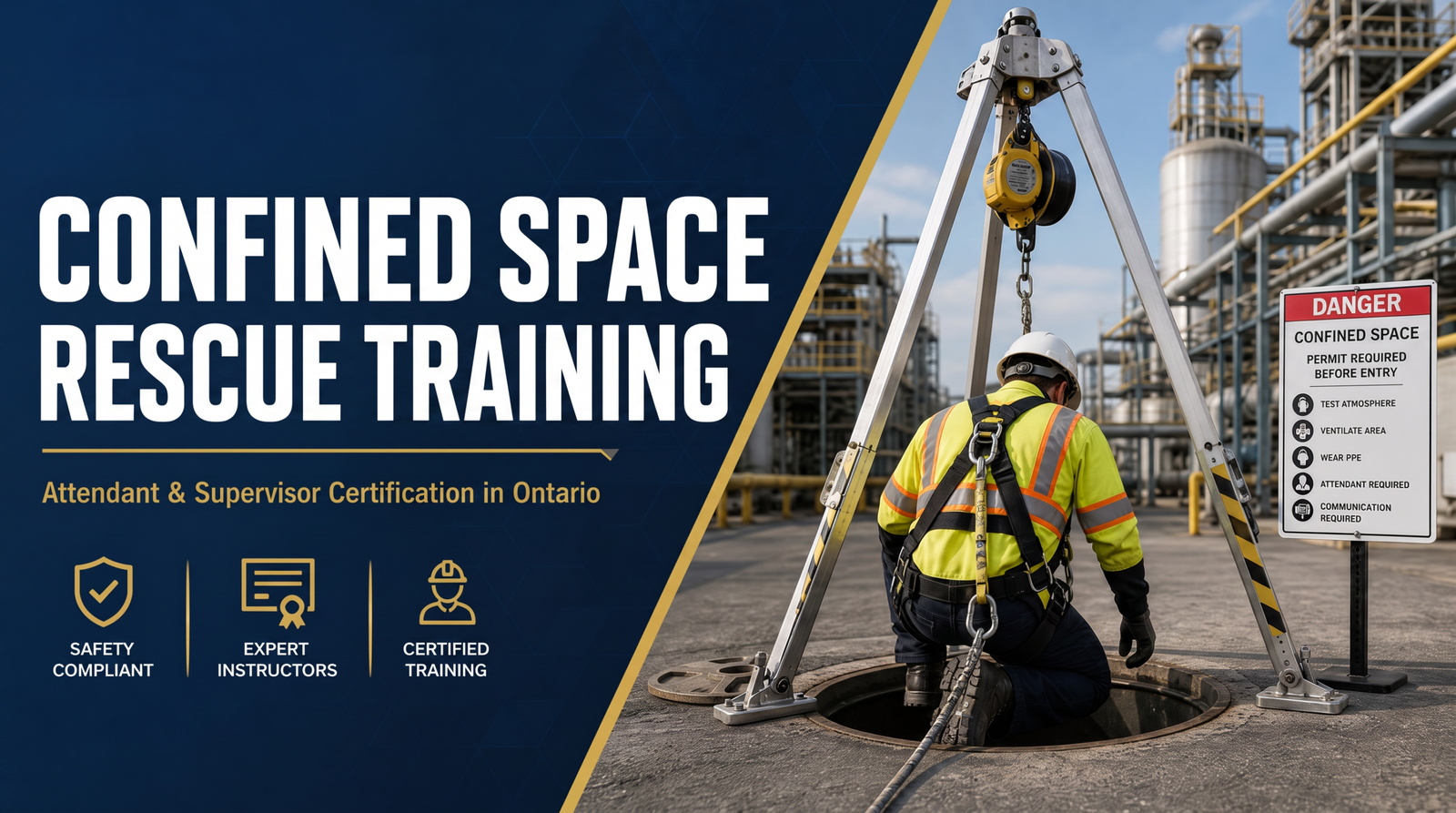

What’s Covered in this article:
- does confined space training expire in Ontario?
- how long is confined space certification valid?
- confined space retraining requirements ?
- does confined space training transfer employers?
Ontario does not set one universal expiry date for every confined space awareness training certificate.
In this article we explain the difference between:
- A provider-issued certificate expiry date
- Employer-required refresher cycles
- Workplace-specific confined space procedures
- Entrant, attendant, supervisor and rescue roles
- Retraining after hazards, equipment or procedures change
- Practical rescue drills and competency
- Training when a worker changes employers or worksites
Confined Space Training Expiry in Ontario
Confined space training certificates often display an expiry or renewal date. However, the date printed on a wallet card does not tell the complete compliance story for an Ontario employer.
Ontario does not establish one universal expiry period that automatically applies to every confined space training certificate, workplace or worker role.
Instead, employers must ensure that workers entering a confined space or performing related work receive adequate training based on the applicable confined-space plan, identified hazards, equipment and assigned responsibilities.
A worker may therefore require refresher training before the date printed on a certificate. This can happen when entry procedures change, unfamiliar hazards are introduced, equipment is replaced or the worker takes on a different confined-space role.
The opposite issue can also arise. A certificate may reach the renewal date selected by the training provider, but simply issuing a new card does not prove that the worker remains competent to perform their assigned duties.
Quick Answer
Ontario’s confined-space regulations do not prescribe one standard expiry period for every confined space training certificate.
Training providers and employers may establish their own renewal or review periods. However, employers remain responsible for confirming that workers are adequately trained for:
- The specific confined space
- The hazards identified in the assessment
- The employer’s entry procedures
- The equipment being used
- Atmospheric testing and monitoring
- Communication and attendant duties
- Emergency response procedures
- The worker’s assigned role
Refresher training or reassessment may be needed whenever changes could affect worker safety, even when the original certificate has not reached its printed expiry date.
| Confined space training question | General Ontario position |
|---|---|
| Is there one universal certificate expiry period? | No |
| Can a provider place an expiry date on its certificate? | Yes |
| Does an unexpired certificate prove current competency? | Not by itself |
| Can retraining be required before the printed expiry date? | Yes |
| Does one course qualify a worker for every confined-space role? | No |
| Does training automatically transfer between employers? | Not completely |
| Is workplace-specific instruction required? | Yes |
| Should training records be maintained? | Yes |
The key distinction is this:
Certificate validity records when training was completed. Competency shows that the worker can safely perform their assigned role under current workplace conditions.
Does Confined Space Training Expire in Ontario?
A confined space training certificate may show an expiry date established by the course provider or the employer’s internal safety program.
However, Ontario Regulation 632/05 does not set one universal period, such as one year or three years, that applies to every confined-space training certificate.
The regulatory focus is whether workers have received adequate training in accordance with the relevant confined-space plan.
This means employers must look beyond the training card and consider whether the worker still understands:
- How to recognize confined-space hazards
- The controls identified in the hazard assessment
- Safe entry and exit procedures
- Atmospheric testing requirements
- Ventilation procedures
- Lockout and energy-isolation controls
- Communication methods
- Personal protective equipment
- Rescue and emergency procedures
- The limits of their assigned role
Training that was adequate three years ago may no longer be sufficient when the equipment, hazards, entry plan or worker’s responsibilities have changed.
A certificate date is an administrative control
An expiry date can help an employer organize training records and schedule formal reviews.
It can also prevent workers from continuing indefinitely without any reassessment of their knowledge or practical skills.
However, the printed date should not become the employer’s only decision-making tool.
For example, an employee may hold a certificate that remains valid for another year but may have recently:
- Changed from an attendant role to an entrant role
- Begun using unfamiliar gas-monitoring equipment
- Started working in a different type of confined space
- Been assigned to a rescue team
- Returned after an extended absence
- Failed to follow an entry procedure
- Been involved in a near miss
- Started working under a revised confined-space plan
In each case, the employer should assess whether additional training, instruction or practical evaluation is needed before the employee performs the new or changed work.
Refresher training can be required before certificate expiry
An employer should not wait for the training card to expire when there is reason to believe that a worker’s knowledge or ability is no longer adequate.
Earlier refresher training may be necessary when:
- A confined-space assessment identifies new hazards
- The entry plan is revised
- New testing or ventilation equipment is introduced
- Rescue equipment or procedures change
- The worker is assigned a new role
- Unsafe behaviour is observed
- An incident or near miss occurs
- A worker cannot explain the entry procedure
- A drill reveals weaknesses in communication or rescue readiness
- An inspection or audit identifies a training deficiency
The central question is not simply, “Is the card still valid?”
The better question is:
Can the employer demonstrate that the worker remains adequately trained for the specific work they are expected to perform?
References
Ontario Regulation 632/05, Confined Spaces:
https://www.ontario.ca/laws/regulation/050632
Canadian Centre for Occupational Health and Safety, Confined Space Introduction:
https://www.ccohs.ca/oshanswers/hsprograms/confinedspace/confinedspace_intro.html
Is There a Legally Defined Confined Space Certificate Expiry Date?
Ontario does not issue one general confined space licence that authorizes a worker to enter every type of confined space at every workplace.
What is commonly called a confined space “licence” or “certification” is usually a training certificate issued by:
- A safety training provider
- An employer
- An industry association
- A union training centre
- Another qualified organization
The certificate may confirm that the worker completed a course covering general confined-space principles.
It may include:
- The worker’s name
- Course title
- Completion date
- Training provider
- Instructor’s name
- Certificate number
- Course level or role
- Recommended renewal date
These details support recordkeeping. They do not replace the employer’s obligation to provide training that matches the workplace’s actual confined spaces and entry procedures.
General course training is only one layer
A general confined-space course may teach workers about:
- Hazard recognition
- Oxygen-deficient atmospheres
- Toxic contaminants
- Flammable atmospheres
- Atmospheric testing
- Ventilation
- Entry permits
- Attendant responsibilities
- Lockout
- Emergency response
- Rescue planning
This foundation is valuable. However, workers must also understand the specific plan that applies to the space they will enter or support.
Workplace-specific training may need to address:
- The location and configuration of the space
- Known and potential contaminants
- Isolation points
- Acceptable atmospheric limits
- The entry permit
- Required personal protective equipment
- Alarm settings
- Communication systems
- Entry and exit routes
- Rescue equipment
- Rescue-team availability
- The identities and responsibilities of each participant
A worker who completed a generic course may still be unprepared to enter a particular tank, vault, pit, vessel, sewer or process enclosure.
Provider expiry and legal competency are different attributes
A provider may choose to make its certificate valid for a particular number of years.
That renewal period can create a useful training-management cycle. However, it should not be presented as a universal Ontario legal expiry date unless a specific legal or industry requirement supports that statement.
Employers should evaluate two attributes separately:
1. Certificate status
This establishes whether the worker’s provider-issued credential is within the printed validity period.
2. Current competency
This establishes whether the worker has the knowledge, training and practical ability to perform their assigned duties safely.
A worker may have a current certificate but lack competency for a new role or worksite.
A worker may also have extensive experience but still require renewal because the employer’s policy, client contract or provider credential requires it.
Both factors matter, but they answer different questions.
Key distinction: An expiry date is a training-administration deadline. Competency is an ongoing workplace-safety requirement.
References
- Ontario Regulation 632/05, Confined Spaces:
https://www.ontario.ca/laws/regulation/050632 - Canadian Centre for Occupational Health and Safety, Confined Space Program:
https://www.ccohs.ca/oshanswers/hsprograms/confinedspace/confinedspace_program.html