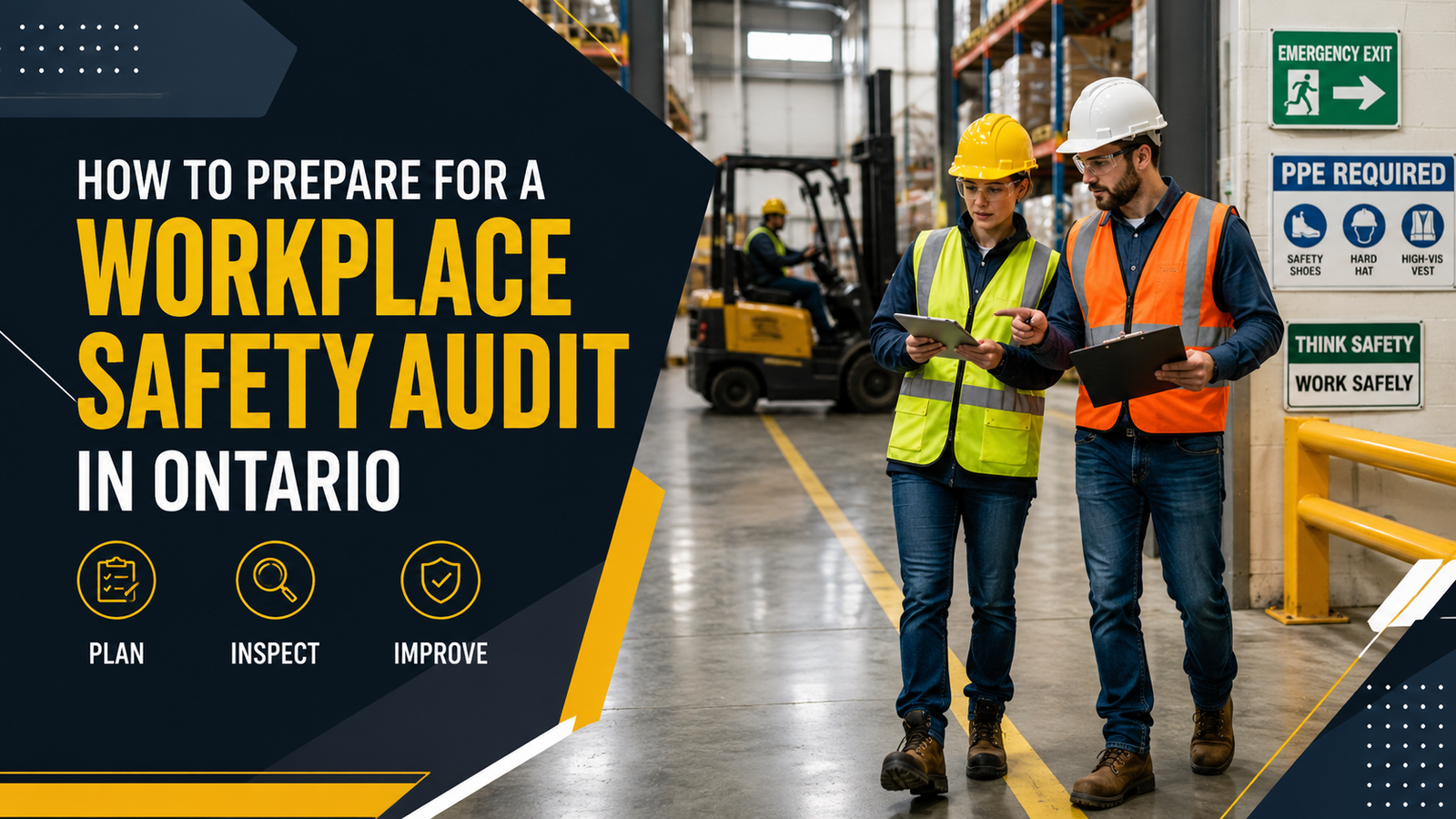
- What Is a Workplace Safety Audit?
- Why Ontario Employers Conduct Workplace Safety Audits
- Workplace Audits Help Identify Hidden Risks
- Audits Also Strengthen Employer Due Diligence
- What Inspectors and Auditors Usually Look For
- Common Areas Reviewed During Workplace Audits
- Review Worker Training Records Before the Audit
- Training Records Should Match Real Workplace Duties
- Competency Matters More Than Attendance
- Inspect the Workplace Before the Audit
- Common Workplace Hazards Auditors Notice Quickly
- Warehouses Often Develop “Invisible” Hazards
- Construction Sites Create Different Audit Risks
- Review Safety Policies and Procedures
- Common Workplace Safety Audit Failures
- How Supervisors Impact Workplace Audit Results
- Preparing for a Ministry of Labour Inspection vs Internal Safety Audit
- How Workplace Safety Audits Improve Due Diligence
- Choosing a Workplace Safety Audit Provider in Ontario
- What Employers Should Look For
- Why Workplace Safety Audits Matter
Preparing for a workplace safety audit in Ontario involves more than organizing paperwork before an inspection. Employers need to demonstrate that workplace hazards are actively identified, workers are properly trained, safety procedures are enforced, and OHSA responsibilities are being followed consistently across the workplace.
A strong workplace safety audit preparation process usually includes reviewing training records, inspecting equipment, updating workplace policies, correcting hazards, documenting inspections, and verifying supervisor and worker responsibilities. Ontario employers should also ensure safety programs match actual workplace conditions, not just written procedures.
Workplace safety audits commonly focus on worker competency, hazard controls, due diligence documentation, incident prevention, and whether safety policies are actively enforced on site.
What Is a Workplace Safety Audit?
A workplace safety audit is a structured review of how a company manages workplace health and safety.
The goal is not just finding paperwork.
A proper audit evaluates whether safety procedures actually function under real workplace conditions.
That distinction matters.
Many businesses have written policies sitting in binders that workers never read and supervisors rarely enforce. Audits are designed to expose those gaps.
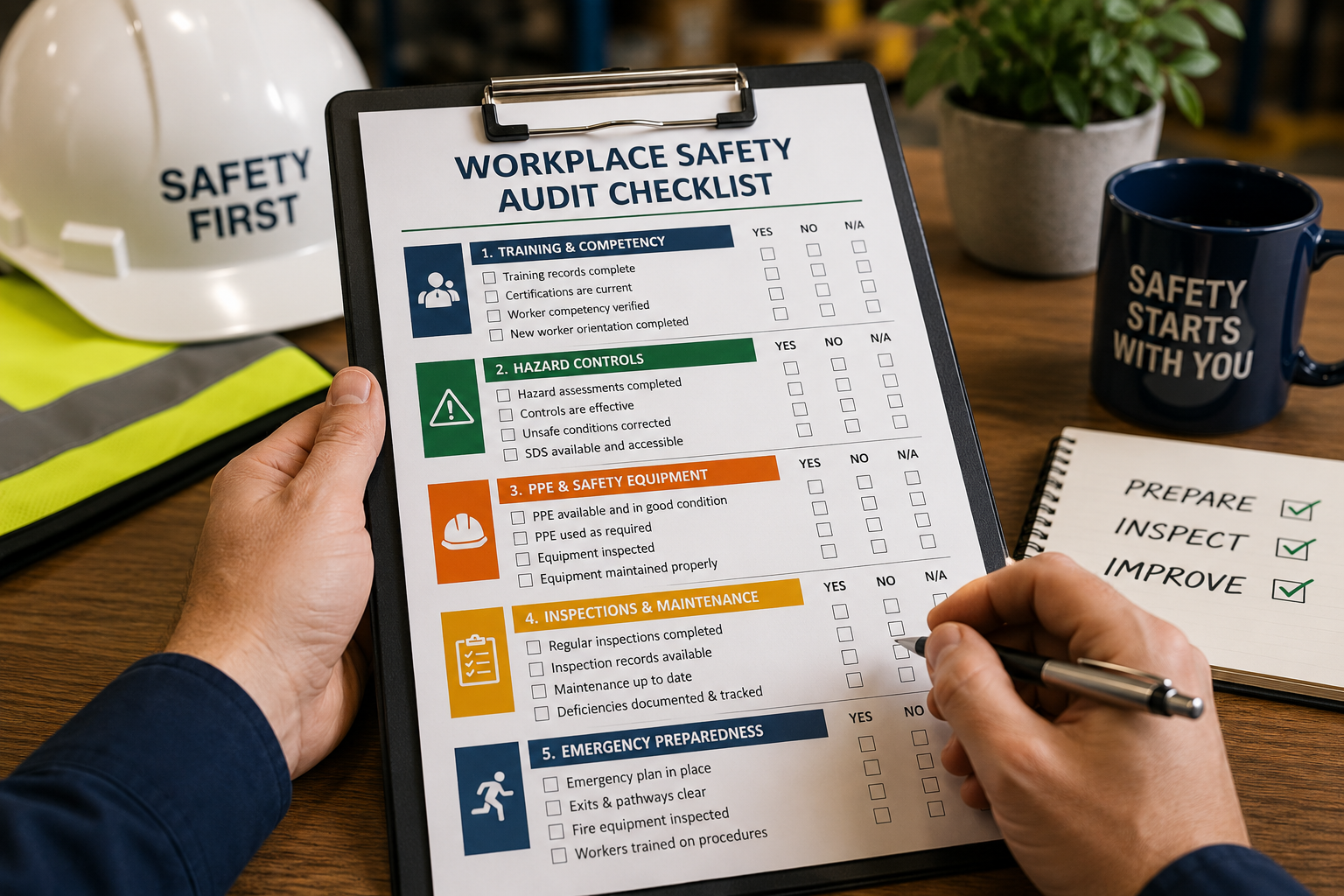
In Ontario workplaces, safety audits commonly review:
- Worker training records
- Hazard assessments
- Equipment inspections
- Incident reporting procedures
- Supervisor involvement
- Emergency response plans
- PPE compliance
- Workplace housekeeping
- Safe work procedures
- Documentation consistency
Audits may be:
- Internal company audits
- Third-party safety audits
- Client-required audits
- Insurance-related audits
- Regulatory inspections
In practice, most workplace safety problems are not caused by one major violation.
They usually come from smaller issues building up quietly over time.
A missing inspection here.
An expired forklift record there.
Workers taking shortcuts supervisors stopped correcting months ago.
Good audits uncover those patterns before a serious incident happens.
Why Ontario Employers Conduct Workplace Safety Audits
Most employers do not start thinking about safety audits until something forces the issue.
That “something” is often:
- A workplace injury
- A near miss
- A Ministry inspection
- A WSIB issue
- A client compliance request
- An insurance concern
The smarter companies audit proactively before those situations happen.
One reason audits matter is because workplace hazards slowly become normalized.
Workers walk past the same issue every day until nobody notices it anymore.
Examples include:
- Damaged pallet racking
- Blocked emergency exits
- Unsafe forklift traffic patterns
- Missing guardrails
- Incomplete lockout procedures
- Workers skipping PPE
Over time, unsafe conditions start feeling “normal.”
A proper audit interrupts that complacency.
Audits Also Strengthen Employer Due Diligence
In Ontario, employers are expected to take reasonable precautions to protect workers.
That means safety programs need to be active, documented, enforced, and regularly reviewed.
Audits help employers verify whether:
- Training records are current
- Workers remain competent
- Supervisors are enforcing procedures
- Hazards are being corrected
- Safety documentation is complete
This becomes especially important in:
- Warehouses
- Manufacturing plants
- Construction sites
- Industrial facilities
- Distribution centres
These environments change constantly.
New equipment gets introduced.
Layouts shift.
Contractors rotate in and out.
Without regular audits, safety systems often fall behind actual workplace conditions.
What Inspectors and Auditors Usually Look For
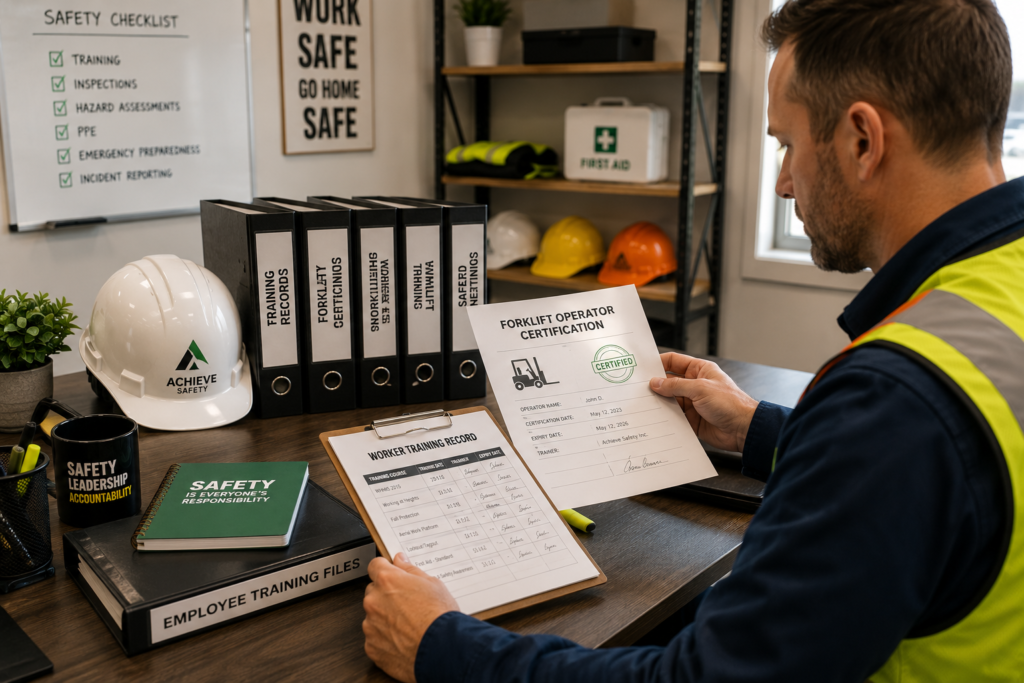
One of the biggest mistakes employers make is assuming audits only focus on paperwork.
They do not.
Experienced auditors usually notice operational problems within minutes of entering a workplace.
For example:
A warehouse may have perfect forklift training records on paper, but operators are speeding through blind intersections without using horns.
That immediately tells an auditor the real problem is enforcement and supervision, not documentation.
Common Areas Reviewed During Workplace Audits
Auditors commonly examine:
- Worker training records
- Forklift certification
- Working at Heights documentation
- EWP operator records
- Equipment inspections
- Hazard assessments
- PPE compliance
- Emergency procedures
- Incident reporting systems
- Supervisor responsibilities
- Workplace signage
- Housekeeping conditions
- Lockout/tagout procedures
- Safety meeting records
Many audits also involve direct workplace observation.
That means auditors may watch:
- Forklift operators
- Loading dock activity
- Worker PPE usage
- Ladder practices
- Equipment operation
- Supervisor interaction with workers
This is where many companies get exposed.
Their written procedures may look strong, but actual workplace behaviour tells a different story.
Review Worker Training Records Before the Audit
Training documentation is one of the first things most auditors review.
Missing or outdated records immediately create compliance concerns.
Common Training Record Problems
Auditors frequently find:
- Expired certifications
- Missing practical evaluations
- Incomplete onboarding records
- Workers using equipment without documentation
- No refresher training records
- Missing supervisor training
- Inconsistent sign-off procedures
This happens more often than employers realize, especially in fast-moving workplaces with frequent staffing changes.
Training Records Should Match Real Workplace Duties
One common issue involves workers performing tasks outside the scope of their documented training.
Examples include:
- Warehouse staff operating forklifts without updated evaluations
- Workers using boom lifts without equipment-specific familiarization
- Supervisors overseeing tasks they were never trained on
- Temporary workers missing site-specific orientation
Auditors usually compare documentation against actual workplace activities.
If records and reality do not match, it raises immediate concerns.
Competency Matters More Than Attendance
One area many employers overlook is competency verification.
A completed course does not automatically mean the worker can safely perform the task months later.
This is especially important for:
- Forklift operators
- Working at Heights workers
- EWP operators
- Industrial maintenance teams
Strong safety programs include:
- Refresher instruction
- Practical reevaluations
- Supervisor observations
- Site-specific assessments
That operational follow-through is what strengthens due diligence during audits.
Inspect the Workplace Before the Audit
One of the fastest ways to fail a workplace safety audit is having visible hazards that nobody addressed before the inspection.
Auditors often form their first impression within the first few minutes of walking through the workplace.
If they immediately notice unsafe conditions, they usually start looking deeper.
Common Workplace Hazards Auditors Notice Quickly
In Ontario workplaces, some of the most commonly observed issues include:
- Blocked emergency exits
- Damaged ladders
- Missing guardrails
- Unsafe forklift traffic
- Poor housekeeping
- Exposed electrical hazards
- Unsecured materials
- Damaged PPE
- Unsafe storage practices
- Slippery walking surfaces
These problems may seem minor individually.
Together, they signal weak safety oversight.
Warehouses Often Develop “Invisible” Hazards
Warehouses are especially vulnerable to gradual safety breakdowns because layouts and traffic patterns constantly evolve.
For example:
A warehouse originally designed for light pedestrian traffic may slowly become overcrowded after inventory expansion. Forklift operators start using tighter aisles, pallets begin stacking higher, and temporary storage areas appear near loading docks.
Nobody intentionally creates unsafe conditions.
The environment simply changes faster than the safety procedures do.
That mismatch is something auditors notice quickly.
Common Warehouse Audit Issues
- Forklift congestion
- Blind intersections
- Damaged racking
- Blocked fire extinguishers
- Unsafe dock conditions
- Poor pedestrian separation
- Incomplete inspection records
One overlooked issue in warehouses is floor damage.
Small cracks, uneven surfaces, or damaged dock plates can create forklift instability risks that operators stop noticing over time.
Construction Sites Create Different Audit Risks
Construction environments are less predictable and often harder to control consistently.
Auditors commonly focus on:
- Fall hazards
- Guardrail protection
- Ladder use
- Scaffold conditions
- EWP operation
- Housekeeping
- Electrical safety
- Excavation hazards
- Worker PPE compliance
One common audit problem on construction sites is assuming subcontractors are fully managing their own safety responsibilities.
In reality, poor coordination between trades often creates overlapping hazards that nobody actively monitors.
Review Safety Policies and Procedures
Many companies have safety policies that technically exist but no longer match the actual workplace.
That creates a major due diligence problem during audits.
Outdated Policies Are a Common Audit Failure
A surprising number of Ontario workplaces still use:
- Old procedures from previous operations
- Generic online templates
- Policies copied from other companies
- Procedures that workers never received training on
Auditors often compare written procedures against actual workplace practices.
If workers are doing something completely different from the documented process, the policy loses credibility immediately.
Policies Auditors Commonly Review
Auditors may examine:
- Workplace health and safety policies
- Emergency response plans
- Lockout/tagout procedures
- Equipment operation procedures
- Incident investigation processes
- Hazard reporting systems
- PPE requirements
- Working at Heights procedures
- Forklift safety procedures
- Workplace violence policies
The issue is not just whether these documents exist.
The real question is whether they are:
- Updated
- Relevant
- Understood by workers
- Actually enforced
One of the Biggest Problems: “Binder Safety”
Many workplaces accidentally create what safety professionals sometimes call “binder safety.”
That means:
The safety program looks organized on paper, but daily operations tell a completely different story.
Examples include:
- Workers signing training forms without understanding procedures
- Safety meetings with no follow-through
- Inspection forms completed automatically without real inspections
- Supervisors ignoring repeat unsafe behaviour
- Procedures nobody has reviewed in years
Auditors can usually identify these disconnects very quickly during worker interviews and site walkthroughs.
Common Workplace Safety Audit Failures
Most failed audits are not caused by one catastrophic violation.
They usually happen because smaller issues combine into a larger pattern of weak safety management.
Outdated Training Records
One of the most common problems is incomplete or outdated training documentation.
Examples include:
- Expired Working at Heights records
- Missing forklift evaluations
- Incomplete onboarding forms
- No refresher training documentation
- Missing supervisor training records
This becomes especially risky when workers are actively using equipment tied to those missing records.
Inconsistent Enforcement
Many companies have strong written rules but inconsistent enforcement.
For example:
A workplace may require high-visibility PPE in forklift zones, but supervisors regularly ignore workers violating the rule.
Auditors usually interpret this as a supervision problem rather than a worker problem.
Poor Supervisor Involvement
Weak supervisor engagement is one of the biggest hidden audit failures.
Auditors often notice when supervisors:
- Do not correct unsafe behaviour
- Rarely document hazards
- Fail to monitor workers
- Ignore near misses
- Do not understand company procedures
In many workplaces, supervisors become heavily focused on production targets while safety oversight gradually weakens.
That operational drift often appears during audits.
Relying Too Heavily on Paperwork
Another major mistake is believing documentation alone proves compliance.
It does not.
A workplace may have:
- completed inspection forms
- signed training sheets
- written procedures
but still operate unsafely in practice.
Experienced auditors pay close attention to this gap between documentation and real-world operation.
That is often where the most serious problems exist.
How Supervisors Impact Workplace Audit Results
Supervisors have a major influence on how workplace safety audits unfold.
In many Ontario workplaces, auditors quickly assess whether supervisors are actively managing safety or simply reacting after problems happen.
That difference becomes obvious fast.
Auditors Often Evaluate Supervision Indirectly
An auditor may never directly ask:
“Is your supervisor effective?”
Instead, they look for operational signs such as:
- Workers following procedures consistently
- Unsafe behaviour being corrected
- Hazards being reported quickly
- PPE rules being enforced
- Equipment inspections being completed properly
- Traffic rules being followed around forklifts
These patterns usually reflect the quality of day-to-day supervision.
Weak Supervision Creates Visible Audit Problems
Many workplace safety gaps develop because supervisors gradually stop enforcing procedures consistently.
This often happens in busy environments where production pressure starts overriding safety oversight.
Examples include:
- Forklift operators speeding through warehouse aisles
- Workers bypassing lockout procedures
- Missing PPE in active work zones
- Unsafe ladder usage becoming normalized
- Near misses going undocumented
Over time, unsafe shortcuts quietly become part of the workplace culture.
Auditors usually identify this quickly during walkthroughs and worker interviews.
Supervisors Are Often the Missing Link Between Policies and Reality
A company may have strong written procedures, but supervisors are usually responsible for making sure those procedures actually happen in practice.
That includes:
- Monitoring workers
- Correcting unsafe behaviour
- Reporting hazards
- Escalating concerns
- Conducting inspections
- Reinforcing training expectations
When supervisors stop actively engaging with safety systems, compliance gaps start spreading across the workplace.
Preparing for a Ministry of Labour Inspection vs Internal Safety Audit
Many employers treat internal audits and Ministry inspections as completely separate things.
In reality, strong internal audits are often what prevent serious problems during external inspections.
Internal Safety Audits
Internal audits are proactive.
Their purpose is to identify weaknesses before incidents, complaints, or enforcement action occurs.
Good internal audits help companies:
- Detect hazards early
- Correct unsafe behaviour
- Update outdated procedures
- Improve worker competency
- Strengthen documentation
- Identify supervision gaps
The strongest workplaces treat internal audits as operational improvement tools, not paperwork exercises.
Ministry of Labour Inspections
A Ministry inspection is different because it focuses on regulatory compliance and enforcement.
Inspections may occur because of:
- Workplace injuries
- Worker complaints
- Critical incidents
- Industry inspection blitzes
- Repeat violations
- High-risk work activity
Inspectors commonly examine:
- Worker training
- Equipment safety
- Fall protection
- Supervisor responsibilities
- Hazard controls
- Workplace documentation
- Compliance enforcement
One thing many employers underestimate is how quickly inspectors notice workplace culture problems.
If workers appear confused about procedures or supervisors cannot explain safety expectations clearly, it raises immediate concerns.
Strong Internal Audits Reduce External Risk
Internal audits help employers identify smaller issues before they become regulatory problems.
For example:
A company may discover during an internal review that forklift inspections are being signed off inconsistently across shifts.
Correcting that issue early may prevent larger compliance concerns later during an inspection or incident investigation.
That is where audits become valuable beyond basic compliance.
They expose operational drift before it becomes expensive.
How Workplace Safety Audits Improve Due Diligence
In Ontario workplaces, due diligence means employers actively take reasonable precautions to protect workers.
Audits help demonstrate that safety systems are not being ignored.
Audits Create Operational Accountability
Strong workplace audits help verify whether companies are actually:
- enforcing procedures
- correcting hazards
- monitoring competency
- documenting inspections
- supervising workers properly
Without audits, many businesses assume their safety systems are functioning properly even when gaps already exist.
Documentation Alone Is Not Enough
One of the biggest misconceptions about due diligence is believing paperwork automatically proves compliance.
It does not.
A completed inspection sheet means very little if equipment hazards are still visible on the floor.
Likewise:
Training records lose value when workers continue operating equipment unsafely.
Auditors usually evaluate whether safety systems produce real operational control, not just organized documentation.
Audits Help Identify Systemic Problems
Sometimes the issue is not one unsafe worker.
It is a larger operational pattern.
Examples include:
- supervisors not enforcing rules consistently
- departments using different procedures
- outdated training records across multiple teams
- recurring near misses nobody investigated properly
- workers unclear about reporting procedures
These systemic problems often remain hidden until audits force the workplace to examine them closely.
Choosing a Workplace Safety Audit Provider in Ontario
Not all workplace safety audits provide meaningful value.
Some audits only produce generic reports filled with template recommendations that never address the actual operational risks inside the workplace.
Ontario employers should look for audit providers who understand real workplace conditions, not just documentation requirements.
What Employers Should Look For
Strong workplace safety audit provider in Ontario usually offer:
- Ontario OHSA knowledge
- Industry-specific experience
- Practical hazard identification
- Supervisor engagement
- Compliance guidance
- Training support
- Actionable recommendations
This becomes especially important in:
- Warehousing
- Construction
- Manufacturing
- Industrial operations
- Material handling environments
A warehouse audit should not look identical to a construction site audit.
Different industries create different operational risks.
Practical Audits Are More Valuable Than Generic Checklists
The best audits usually focus on how work actually happens.
For example:
A practical auditor may observe forklift traffic flow during active warehouse operations instead of only reviewing written traffic policies.
That type of operational review often uncovers risks paperwork alone would never reveal.
Why Workplace Safety Audits Matter
Workplace safety audits help employers identify problems before they turn into injuries, enforcement issues, or operational disruptions.
That matters because many workplace hazards develop gradually over time.
Workers adapt to unsafe conditions.
Supervisors become overloaded.
Procedures stop matching reality.
Documentation falls behind operations.
Audits help reset that drift.
They create an opportunity to:
- identify hidden hazards
- improve accountability
- strengthen supervision
- reinforce worker competency
- update outdated systems
- improve workplace consistency
For Ontario employers, audits are not just about passing inspections.
They help build safer, more organized workplaces across warehouses, industrial facilities, construction environments, manufacturing plants, and commercial operations.
Achieve Safety helps Ontario businesses improve workplace safety systems through practical audits, OHSA training courses and support, hazard assessments, compliance guidance, and workplace safety consulting designed around real operational conditions rather than generic checklists.