- Common Working at Heights Hazards Checklist Ontario
- Why Identifying Working at Heights Hazards Matters
- Falls From Unprotected Edges
- Improper Use of Ladders
- Failure to Use Fall Protection Correctly
- Slippery or Unstable Working Surfaces
- Fragile Surfaces and Openings
- Poor Planning and Inadequate Supervision
- Inadequate Training and Competency Gaps
- Working at Heights Hazard Risk Assessment Template (Ontario) Free Download
- Precautions for Working at Heights
- How Training Helps Control These Hazards
- Connecting Hazards to Compliance
- Final Takeaway
Working at heights remains one of the highest-risk activities in construction and maintenance work. Every year, falls from height continue to cause serious injuries, fatalities, stop-work orders, and prosecutions across Ontario.
Most of these incidents are predictable and preventable.
Understanding the most common working at heights hazards is the first step in meeting legal obligations, protecting workers and ensure they get CPO Approved Working At Heights Training in Ontario.
Common Working at Heights Hazards Checklist Ontario
Employers must identify and control the following working at heights hazards on Ontario job sites:
-
Unprotected roof edges, floor edges, and open-sided platforms
-
Improper or missing guardrails
-
Unsafe ladder use, including overreaching and unstable placement
-
Incorrect use of fall protection equipment such as harnesses and lanyards
-
Missing or improperly rated anchor points
-
Slippery surfaces caused by ice, snow, water, or debris
-
Fragile surfaces such as skylights or temporary coverings
-
Poor housekeeping on elevated work areas
-
Lack of a fall protection or rescue plan
-
Inadequate working at heights training or expired certification
If any of these hazards are present and workers are exposed to a fall risk of 3 metres or more, Ontario law requires approved working at heights training.
Why Identifying Working at Heights Hazards Matters
Under Ontario safety law, employers are required to:
- Identify hazards in the workplace
- Assess the level of risk
- Implement controls to eliminate or reduce those risks
Fall hazards are treated as high-consequence hazards, meaning the expectation for prevention and training is higher than for many other risks.
Inspectors from the Ontario Ministry of Labour routinely focus on working at heights during construction blitzes, especially during roofing, residential builds, and industrial maintenance work.
If hazards are not properly identified and controlled, enforcement action is likely.
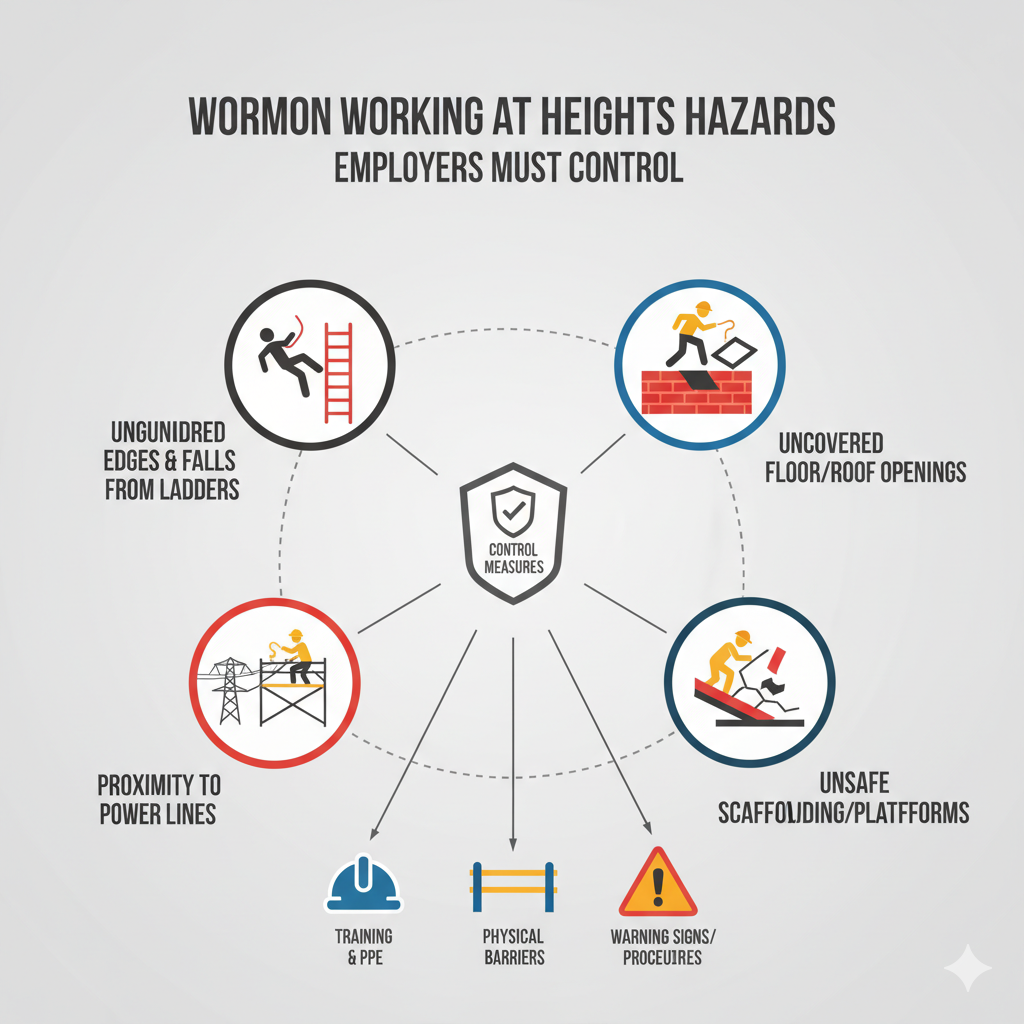
Falls From Unprotected Edges
One of the most common and deadly hazards is exposure to unprotected edges.
This includes:
- Roof edges
- Floor openings
- Mezzanines
- Balconies and open-sided platforms
Workers may fall simply by losing balance, tripping, or stepping backward while carrying materials.
Common causes
- Missing or removed guardrails
- Improperly installed guardrail systems
- Reliance on visual awareness instead of physical barriers
Required controls
- Guardrails where possible
- Travel restraint or fall arrest systems when guardrails are not feasible
- Working at heights training so workers understand edge awareness and tie-off requirements
Improper Use of Ladders
Ladders continue to be a major source of fall injuries.
Many workers underestimate ladder risks because ladders are familiar and used daily.
Common ladder-related hazards
- Using ladders on uneven or unstable surfaces
- Overreaching beyond the ladder rails
- Standing on top rungs
- Carrying heavy materials while climbing
- Using damaged or makeshift ladders
Falls from ladders often occur at heights under 3 metres, yet still result in serious injuries.
Working at heights training reinforces:
- Proper ladder selection
- Angle and placement
- Three-point contact
- When a ladder is not an appropriate solution
Failure to Use Fall Protection Correctly
Providing fall protection equipment alone is not enough.
Many incidents occur because equipment is used incorrectly or not used at all.
Typical issues
- Harnesses worn incorrectly
- Lanyards too long for the working height
- Anchor points that are not rated
- Workers not tied off continuously
These failures often come down to lack of training or supervision.
Working at heights training teaches workers how fall protection systems function, when each system should be used, and how to recognize unsafe setups before work begins.
Slippery or Unstable Working Surfaces
Slips at height significantly increase fall risk.
Common contributing factors include:
- Ice, snow, or frost
- Wet surfaces from rain or condensation
- Loose debris
- Poor housekeeping
- Oil or grease on platforms
Seasonal conditions make this hazard worse in Ontario, particularly during early spring and late fall.
Employers must assess surface conditions daily and adjust work methods accordingly. Training helps workers recognize when conditions are unsafe and empowers them to stop work when necessary.
Fragile Surfaces and Openings
Some surfaces appear solid but cannot support a worker’s weight.
Examples include:
- Skylights
- Roof panels
- Temporary coverings over openings
- Aged decking materials
Workers may step onto these surfaces unintentionally, resulting in sudden falls.
Training emphasizes:
- Hazard identification before accessing a surface
- Use of covers, barriers, or travel restraint
- Never assuming a surface is load-bearing
Poor Planning and Inadequate Supervision
Many working at heights incidents are rooted in planning failures, not worker behaviour.
Examples include:
- No fall protection plan in place
- Lack of rescue planning
- Workers unsure of tie-off locations
- Supervisors unaware of fall hazards
Working at heights training supports planning by teaching:
- Hazard assessment principles
- Fall protection hierarchy
- Employer and worker roles
- Importance of rescue readiness
Supervision is critical. Even trained workers require oversight to ensure safe practices are followed consistently.
Inadequate Training and Competency Gaps
This is the underlying factor in most serious fall incidents.
Without proper training, workers may:
- Misjudge risks
- Use equipment incorrectly
- Bypass controls to save time
- Fail to recognize when conditions are unsafe
Ontario law requires workers exposed to fall hazards at heights of 3 metres or more on construction projects to complete approved working at heights training.
Training ensures workers understand not just what to do, but why it matters.
Working at Heights Hazard Risk Assessment Template (Ontario) Free Download
Precautions for Working at Heights
Working at heights hazards should be controlled before a worker leaves the ground. A harness alone does not make elevated work safe.
The employer should first assess the task, identify where a worker or object could fall, and select controls suited to the work area, equipment and site conditions. Guardrails and other methods that prevent exposure to the fall hazard should generally be considered before relying on personal fall-arrest equipment. Ontario’s fall-prevention guidance emphasizes guardrails, travel restraint and other protective systems based on the conditions of the project.
1. Plan the Work Before It Begins
A pre-job assessment should identify:
- Open edges, floor openings and fragile surfaces
- Changes in elevation
- Access and exit routes
- Suitable anchor or connection points
- Overhead and electrical hazards
- Falling-object exposure below the work area
- Weather, lighting and surface conditions
- Equipment and rescue requirements
Work should be delayed when wind, rain, snow, ice, poor visibility or another site condition makes the planned control ineffective.
The assessment should be repeated when the task, equipment, location or work conditions change.
2. Prevent Access to the Fall Hazard
Where reasonably possible, workers should be separated from the edge or opening.
Controls may include:
- Properly constructed guardrail systems
- Covers over floor or roof openings
- Secured work platforms
- Scaffolds with complete edge protection
- Travel-restraint systems that prevent a worker from reaching the edge
- Barriers that restrict unauthorized entry
Guardrails, toe boards and opening covers can protect more than one worker without requiring each person to take an individual action. Personal fall protection becomes essential when the hazard cannot be adequately controlled through the work platform or another collective measure.
Ontario’s Construction Projects regulation contains requirements for guardrail systems, including toe boards used to help protect people from falling objects.
3. Select the Correct Access and Work Equipment
The equipment must match the task.
A ladder may be suitable for short-duration access but may not provide an appropriate working platform for tasks that require force, prolonged positioning or two-handed work. Depending on the job, a scaffold or elevating work platform may provide a safer and more stable option.
Before use, confirm that:
- The equipment is suitable for the required height and load
- Ladders are positioned and secured correctly
- Scaffold components are complete and stable
- EWP guardrails, gates and controls are functioning
- Wheels, outriggers or stabilizers are deployed as required
- The supporting surface is firm and level
- Manufacturer instructions are available and followed
The equipment should never be improvised, altered or used for a purpose for which it was not designed.
4. Inspect Fall-Protection Equipment Before Use
Harnesses, lanyards, lifelines, connectors and self-retracting devices should be inspected before use.
The worker should check for:
- Cuts, burns or damaged webbing
- Torn or loose stitching
- Corrosion, cracks or deformation
- Damaged hooks, gates or connectors
- Missing or unreadable labels
- Signs that an energy absorber has deployed
- Contamination from paint, chemicals or other materials
- Damage caused by improper storage
Defective or questionable equipment should be removed from service and reported. It should not be returned to use until an authorized person determines that it is safe.
5. Control Falling Tools and Materials
Workers below an elevated task can be injured even when the person working above is fully protected from falling.
Precautions may include:
- Installing toe boards, screens or debris netting
- Using tool-tethering systems where appropriate
- Keeping materials away from platform edges
- Securing loose equipment and supplies
- Establishing a controlled area below the work
- Posting warning signs and restricting access
- Using lifting containers rather than carrying loose items
- Maintaining good housekeeping on platforms and scaffolds
Tools and materials should be stored so they cannot roll, slide or be knocked from the work surface. The source article similarly identifies secured tools, appropriate protective equipment and regular risk assessment as core precautions against falling-object incidents.
6. Keep Work Surfaces Stable and Clear
Wet, icy, uneven or cluttered surfaces can cause a worker to lose balance before the fall-protection system becomes involved.
Employers and supervisors should ensure that:
- Access routes are adequately lit
- Debris and unnecessary materials are removed
- Spills are cleaned promptly
- Cords and hoses do not create trip hazards
- Damaged platforms are taken out of service
- Workers use footwear suited to the surface
- Warning signs or barriers identify temporary hazards
- Work stops when weather or surface conditions become unsafe
Good housekeeping is especially important near roof edges, ladders, platforms and scaffold access points. The referenced hazard guidance identifies poor lighting, slippery surfaces, debris, uneven terrain and adverse weather as factors that can destabilize a worker at height.
7. Provide Training and Site-Specific Instruction
Workers on Ontario construction projects who use prescribed fall-protection methods must complete an approved Working at Heights training program. That foundational training does not replace instruction on the equipment, hazards and procedures used at the actual project.
Before assigning the task, confirm that the worker can:
- Recognize the site’s fall hazards
- Inspect and fit the required equipment
- Identify the approved connection point
- Distinguish between travel restraint and fall arrest
- Use the selected system correctly
- Follow the site’s emergency procedure
- Explain how a suspended worker will be rescued
Training should be supported by competent supervision and practical observation. A valid training record is important, but the employer must also confirm that the worker can apply the required precautions under current site conditions.
8. Prepare a Rescue Plan
A fall-arrest system may stop a worker from striking a lower level, but it can leave the person suspended and unable to return to a safe surface.
Before work begins, the employer should establish how a rescue will be completed. The plan should identify:
- Who will initiate and perform the rescue
- How emergency assistance will be contacted
- What rescue equipment is required
- How rescuers will access the suspended worker
- How the area will be controlled
- How workers will practise or review the procedure
The plan must be realistic for the location. Calling emergency services should not be the only preparation when workers need a prompt, site-specific rescue response.
Need practical Working at Heights training for your team? Achieve Safety provides approved training for Ontario workers, along with private and employer-focused course options. Ensure workers understand both the fall hazards and the controls required before elevated work begins.
How Training Helps Control These Hazards
Working at heights training is designed to:
- Improve hazard recognition
- Teach proper equipment use
- Reinforce safe decision-making
- Reduce reliance on unsafe shortcuts
- Support a stronger safety culture
When workers understand the risks and controls, incidents decrease and compliance improves.
This is why employers who invest in proper training see fewer injuries, fewer orders, and better inspection outcomes.
Connecting Hazards to Compliance
During inspections, hazards are rarely evaluated in isolation.
Inspectors look at:
- The hazard present
- The controls in place
- The training workers received
If a fall hazard exists and workers are not trained, enforcement action is likely.
Training is often the link between hazard identification and legal compliance.
Final Takeaway
Working at heights hazards are well known and consistently enforced.
Falls from edges, ladder misuse, improper fall protection, unstable surfaces, and poor planning continue to cause preventable injuries across Ontario.
The good news is that these hazards can be controlled.
Proper planning, supervision, and CPO approved working at heights training in Ontario from Achieve Safety, remain the most effective tools employers have to protect workers and meet their legal obligations.