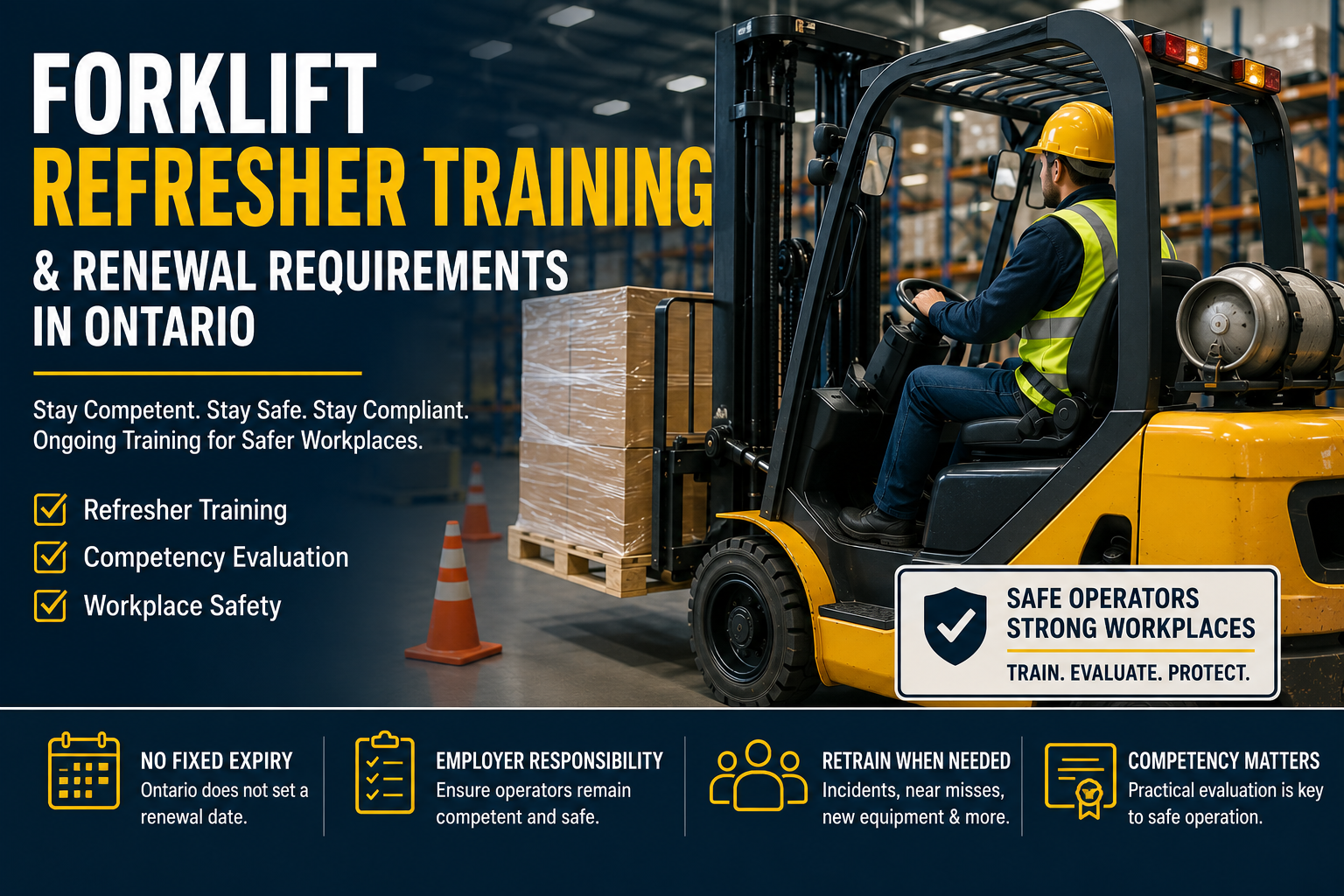
- Forklift Training Expiry in Ontario
- Do Forklift Certifications Expire in Ontario?
- When Forklift Refresher Training May Be Required
- Real Workplace Examples
- Signs a Forklift Operator Needs Additional Training
- How Employers Evaluate Forklift Competency
- Warehouse vs Construction Site Refresher Training Risks
- Ontario Employer Responsibilities for Forklift Refresher Training
- Common Mistakes Employers Make With Forklift Renewal
- Choosing a Forklift Refresher Training Provider in Ontario
- What Employers Should Look For
- Why Forklift Refresher Training Matters
TL:DR
Ontario does not use a government-issued forklift licence renewal system with a fixed expiry date. However, employers are expected to ensure forklift operators remain competent, properly supervised, and capable of operating equipment safely under current workplace conditions.
Forklift Training Expiry in Ontario
Forklift training certificates in Ontario commonly display a three-year validity period, but Ontario does not issue a universal provincial forklift licence that automatically authorizes someone to operate every type of lift truck at every workplace.
The employer must determine whether the worker:
- Has received appropriate forklift theory training
- Can safely operate the specific class of lift truck
- Understands the workplace’s hazards and traffic procedures
- Has completed an appropriate practical evaluation
- Continues to demonstrate competent operating behaviour
- Requires refresher training because of changes, incidents or observed deficiencies
This means certificate validity and operator competency are related, but they are not the same thing.
| Forklift training question | General Ontario position |
|---|---|
| Does a training card usually show an expiry date? | Many providers use a three-year validity period |
| Is there one government-issued Ontario forklift licence? | No general provincial forklift operator licence is issued |
| Does an unexpired card automatically prove competency? | No |
| Can refresher training be needed before the card expires? | Yes |
| Should practical ability be reassessed? | Yes, particularly when risks, equipment or performance change |
| Can one certificate cover every forklift? | Not automatically |
| Does changing employers require another review? | Usually, because workplace hazards and equipment may differ |
Do Forklift Certifications Expire in Ontario?
One of the most common questions employers ask is:
“Does forklift certification expire in Ontario?”
The answer is not as straightforward as many people expect.
Ontario does not issue a government forklift operator licence similar to a driver’s licence. There is no province-wide forklift card with a universal legal expiry date.
That said, forklift training is not something employers can simply ignore after the first course is completed.
Competency Matters More Than the Certificate
A wallet card does not automatically prove a worker is still competent years later.
An operator may have completed forklift training previously but still develop unsafe habits over time, especially in busy warehouses or high-pressure industrial environments.
That is why many Ontario employers establish internal forklift renewal schedules as part of their workplace safety program.
These internal policies often involve:
- Periodic refresher training
- Practical reevaluation
- Supervisor observations
- Updated workplace instruction
- Equipment-specific reassessment
The focus is ongoing competency, not paperwork alone.
Why Employers Still Track Forklift Renewal
Many Ontario companies maintain forklift renewal schedules because they help support:
- Workplace safety programs
- Insurance expectations
- Due diligence documentation
- Supervisor accountability
- Operator competency monitoring
This is especially common in:
- Warehouses
- Manufacturing facilities
- Construction environments
- Distribution centres
- Industrial workplaces
For example:
A warehouse operator working daily around pedestrians and loading docks may require more frequent reassessment than a worker who rarely operates equipment.
Likewise, construction forklift operators often face changing terrain, weather exposure, and unstable operating conditions that increase risk levels significantly.
When Forklift Refresher Training May Be Required
Forklift refresher training is usually triggered by workplace conditions, operator behaviour, or competency concerns.
The goal is correcting unsafe operation before a serious incident occurs.
Common Situations That Trigger Refresher Training
Employers may require additional forklift training after:
- Workplace incidents
- Near misses
- Unsafe operation
- Equipment damage
- Changes in workplace layout
- Introduction of new forklift equipment
- New workplace hazards
- Long periods without forklift operation
- Supervisor concerns about competency
Refresher instruction may also follow changes in:
- Warehouse traffic patterns
- Loading dock procedures
- Pedestrian routes
- Racking systems
- Outdoor terrain conditions
Real Workplace Examples
Loading Dock Incident
A forklift operator reverses too quickly near a loading dock edge and narrowly avoids driving off the dock after misjudging stopping distance.
Even without injuries, this type of near miss may trigger reevaluation and refresher instruction.
Warehouse Layout Changes
A warehouse introduces narrower aisles and increased pedestrian traffic after expanding inventory storage.
Operators who previously worked in open layouts may require reassessment to ensure they can safely maneuver equipment in tighter spaces.
Rough Terrain Forklift Operation
A worker experienced with indoor counterbalance forklifts begins using rough-terrain equipment outdoors on uneven construction surfaces.
Additional familiarization and practical evaluation may be necessary because the operating environment has changed significantly.
Signs a Forklift Operator Needs Additional Training
Unsafe forklift habits usually develop gradually.
Supervisors who actively monitor operators often notice warning signs long before serious incidents happen.
Common Warning Signs
Forklift operators may require additional instruction when they consistently demonstrate:
- Excessive speed
- Sharp turning
- Elevated loads during travel
- Unsafe reversing
- Poor pedestrian awareness
- Repeated inspection failures
- Rack or pallet collisions
- Improper load handling
- Ignoring traffic rules
- Unsafe dock approach procedures
These behaviours create major workplace hazards in busy Ontario warehouses and industrial facilities.
How Employers Evaluate Forklift Competency
Forklift competency is not measured by a certificate alone.
Ontario employers are expected to evaluate whether operators can safely use powered industrial trucks under actual workplace conditions.
That usually involves direct observation, practical evaluation, and ongoing supervision.
Practical Operator Evaluations
A proper forklift competency assessment often includes observing operators while they:
- Perform pre-use inspections
- Maneuver safely around pedestrians
- Handle loads correctly
- Travel through aisles and intersections
- Park equipment properly
- Approach loading docks safely
- Follow workplace traffic procedures
Supervisors often identify unsafe habits during routine operations rather than during formal classroom testing.
That is why practical evaluation remains one of the most important parts of forklift refresher training.
Site-Specific Orientation Matters
An experienced forklift operator may still require additional instruction when entering a different workplace.
For example:
A worker familiar with open warehouse layouts may struggle operating inside narrow aisle distribution centres with heavy pedestrian traffic.
Likewise, outdoor construction environments create different hazards compared to indoor manufacturing facilities.
Site-specific orientation may involve:
- Workplace traffic systems
- Pedestrian routes
- Dock safety procedures
- Surface conditions
- Racking layouts
- Restricted operating zones
Different Forklift Types Require Different Familiarity
Experience on one forklift type does not automatically transfer to another machine safely.
Employers often evaluate competency separately for:
- Counterbalance forklifts
- Reach trucks
- Order pickers
- Walkie stackers
- Rough terrain forklifts
A reach truck operator working inside high-racking warehouses faces different visibility and maneuvering challenges compared to a worker operating rough-terrain forklifts outdoors on uneven construction surfaces.
Warehouse vs Construction Site Refresher Training Risks
Forklift refresher needs vary depending on the environment where the equipment is being used.
Warehouse operators and construction forklift operators face very different hazard patterns.
Operators working in these environments often require refresher instruction focused on traffic awareness, reversing procedures, pedestrian safety, and confined maneuvering.
One of the biggest warehouse risks is routine familiarity.
Workers repeating the same routes daily sometimes become less alert to changing hazards around them.
Ontario Employer Responsibilities for Forklift Refresher Training
Ontario employers are responsible for more than simply providing initial forklift instruction.
They are expected to actively monitor operator competency and maintain safe workplace practices over time.
Employer Responsibilities Often Include
- Ensuring workers remain competent
- Providing refresher instruction when necessary
- Supervising forklift operation
- Communicating workplace hazards
- Conducting practical evaluations
- Enforcing workplace traffic procedures
- Maintaining training documentation
- Monitoring unsafe operation
Employers also need to take reasonable precautions to protect both operators and nearby workers.
That responsibility becomes especially important in workplaces with:
- High pedestrian traffic
- Busy loading docks
- Narrow warehouse aisles
- Outdoor industrial activity
- Multiple forklift operators
OHSA and CSA B335 Considerations
Ontario workplace forklift safety programs commonly reference:
- Occupational Health and Safety Act
- Canadian Standards Association B335 safety guidance for lift trucks
These frameworks reinforce concepts such as:
- Operator competency
- Safe equipment operation
- Workplace hazard control
- Training and supervision
- Due diligence
Most workplace inspections focus heavily on whether employers actively enforced safe forklift practices rather than simply issuing certificates.
Common Mistakes Employers Make With Forklift Renewal
Many forklift safety gaps develop because employers rely too heavily on paperwork and not enough on real-world observation.
Relying Only on Certificates
One of the biggest mistakes is assuming a forklift card automatically means the operator remains competent indefinitely.
Unsafe habits can develop slowly over time.
Without monitoring and reevaluation, those risks often go unnoticed until an incident occurs.
Skipping Practical Reevaluations
Some employers only provide classroom refresher instruction without observing operators on actual equipment.
This creates a major gap because many unsafe behaviours only appear during real workplace operation.
Ignoring Near Misses
Near misses are often early warning signs of larger problems.
Examples include:
- Dock approach mistakes
- Pedestrian close calls
- Minor rack contact
- Unstable loads
- Unsafe reversing
Ignoring these incidents allows unsafe operation patterns to continue.
Assuming Experienced Workers Need No Reassessment
Experience does not eliminate risk.
Long-term operators sometimes become overconfident and stop following safe procedures consistently.
In many workplaces, experienced workers are actually involved in incidents because shortcuts become normalized over time.
Choosing a Forklift Refresher Training Provider in Ontario
Not all forklift refresher programs provide the same level of evaluation or workplace relevance.
Ontario employers should look beyond low-cost online certificates and focus on actual competency development.
What Employers Should Look For
Strong refresher programs often include:
- Practical operator evaluation
- Equipment-specific instruction
- Site-relevant hazard discussion
- Workplace-specific examples
- Training documentation
- Experienced instructors
- Observation-based assessment
Why Forklift Refresher Training Matters
Forklift refresher training helps reinforce safe operating habits before unsafe behaviour leads to serious workplace incidents.
That matters because workplace conditions constantly change.
Warehouses evolve.
Traffic patterns shift.
Equipment changes.
Operators develop shortcuts.
New hazards appear.
Refresher instruction helps operators stay aware of:
- Pedestrian safety risks
- Equipment limitations
- Workplace traffic systems
- Dock hazards
- Load stability concerns
- Changing operating conditions
For employers, refresher training also strengthens due diligence, workplace safety culture, and hazard prevention across Ontario warehouses, industrial facilities, manufacturing plants, and construction environments.
Achieve Safety’s Forklift Training Ontario provides forklift refresher training, operator evaluations, and workplace safety support designed to help Ontario employers improve operator competency and reduce workplace forklift hazards.
Sources