- What Ontario Employers and Workers Must Know About Forklift Training Requirements
- What Proper Forklift Training Includes in Ontario
- Do Forklift Operators Need Certification or Licensing in Ontario?
- How Much Does Forklift Certification Cost in Ontario?
- How Long Does Forklift Training Take in Ontario?
- Forklift Types Covered in Ontario Training Programs
- Who Needs Forklift Training in Ontario?
- Warehouse vs Construction Site Forklift Hazards in Ontario
- Construction Forklift Risks
- When Is Forklift Refresher Training Needed in Ontario?
- Employer Duties for Forklift Safety Compliance in Ontario
- Choosing a Forklift Training Provider in Ontario
- Frequently Asked Questions
- References and Further Reading
Forklift operator training requirements in Ontario focus on operator competency, workplace safety, and the employer’s responsibility to ensure powered lift trucks are operated safely. Workers need appropriate instruction and practical skills, while employers must address equipment-specific risks, workplace hazards, and safe operating procedures.
The Occupational Health and Safety Act (OHSA) and applicable regulations establish key employer responsibilities. Ontario’s official Guideline for the Safe Operation and Maintenance of Powered Lift Trucks explains how those responsibilities apply to forklift operations.
A forklift training certificate is useful evidence of training, but it does not automatically establish that an operator can safely operate every type of forklift in every workplace.
This guide explains Ontario forklift training requirements, certification costs, course duration, operator competency, and the steps employers can take to support compliance.
Ontario forklift training requirements are commonly supported by Occupational Health and Safety Act (OHSA) duties and CSA B335 lift truck safety standards.. A forklift certificate alone does not automatically make a worker competent for every workplace or forklift type. Employers are expected to ensure forklift operators receive proper instruction, supervision, and competency evaluation under workplace safety requirements.
What Ontario Employers and Workers Must Know About Forklift Training Requirements
Ontario employers must ensure that workers receive appropriate information, instruction, and supervision to protect their health and safety. Powered lift truck operators must also meet the applicable competency requirements.
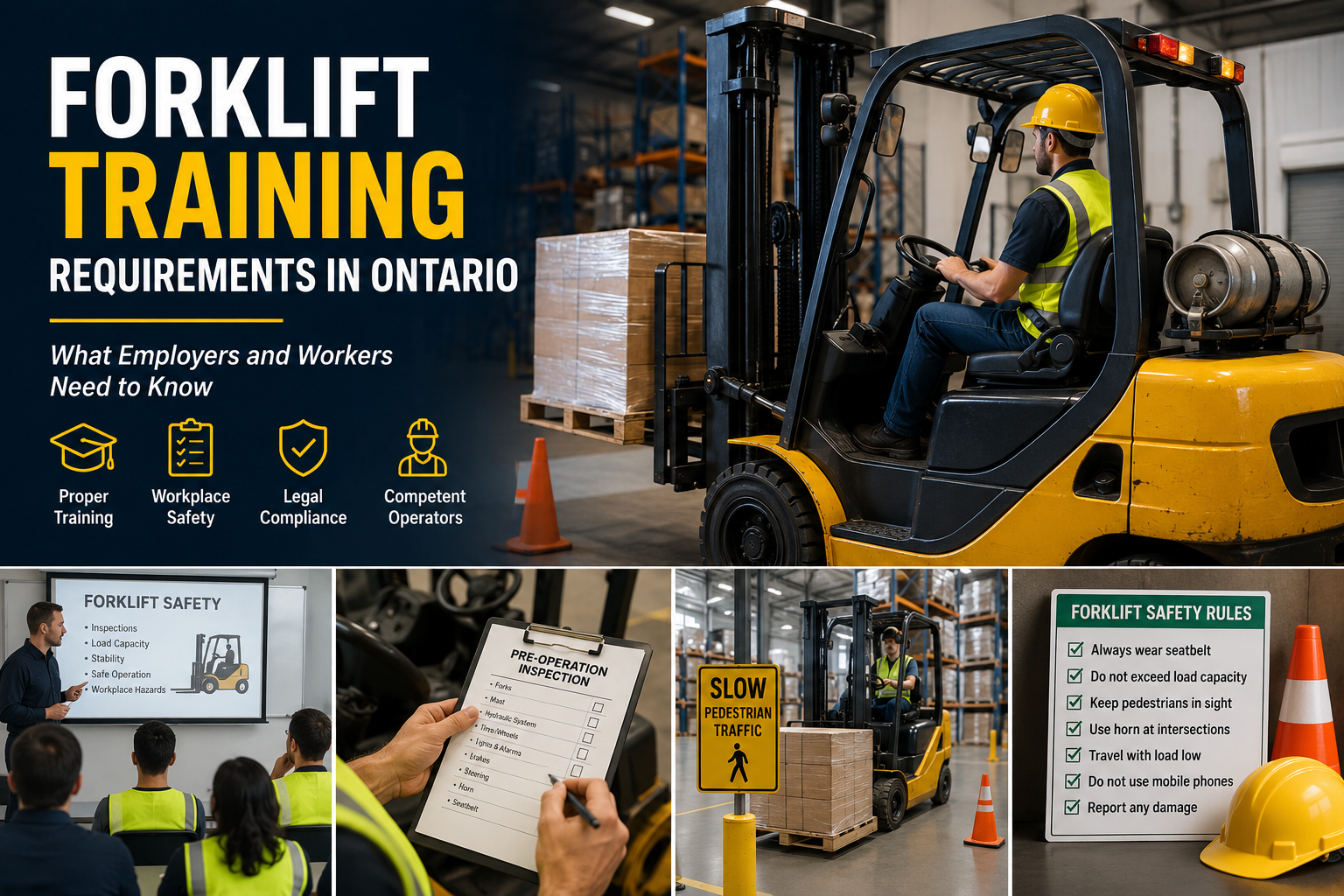
In practice, an effective forklift safety programme should address:
-
Operator knowledge and practical skills.
-
Safe operation of the specific equipment being used.
-
Identification of workplace hazards.
-
Load capacity, stability, and load-handling procedures.
-
Pedestrian safety and workplace traffic management.
-
Equipment inspections and maintenance.
-
Supervision, operating procedures, and competency records.
These responsibilities extend beyond issuing a certificate. An operator who has completed training may still require workplace-specific instruction before working around unfamiliar machinery, loading docks, pedestrians, or restricted warehouse aisles.
Employers should refer to the Ontario government’s powered lift truck safety guideline and the legislation applicable to their workplace.
Ontario employer responsibilities for forklift safety and training
Employers should establish a forklift safety programme that includes appropriate training, supervision, hazard identification, and operating procedures.
Depending on the workplace, this may involve:
-
Providing training and assessing operator competency.
-
Explaining site-specific hazards and traffic rules.
-
Ensuring operators understand the manufacturer’s instructions and equipment limitations.
-
Establishing procedures for pre-use inspections and reporting defects.
-
Maintaining suitable pedestrian controls and traffic routes.
-
Keeping records of operator training and competency assessments.
-
Providing further instruction when equipment, tasks, or workplace conditions change.
The exact measures depend on the equipment, work environment, and applicable regulatory requirements.
What Proper Forklift Training Includes in Ontario
Forklift training generally combines theoretical instruction with practical training and assessment. The objective is to establish that an operator understands the relevant safety principles and can apply them while operating the equipment.
Forklift theory training
The theoretical component typically covers:
-
Forklift components and operating controls.
-
Stability, load centres, and rated load capacity.
-
Safe lifting, transporting, stacking, and unstacking.
-
Pre-operational inspection procedures.
-
Pedestrian awareness and traffic management.
-
Operating on ramps and other challenging surfaces.
-
Loading dock and trailer safety.
-
Battery charging, refuelling, and fuel-related hazards, where applicable.
-
Workplace hazard recognition and emergency procedures.
Training should reflect the type of forklift and the conditions in which it will be used.
Practical forklift operator evaluation
Practical training gives operators the opportunity to demonstrate their skills under suitable supervision. The assessment should reflect the equipment and tasks relevant to the operator’s work.
Depending on the equipment and workplace, practical exercises may include:
-
Conducting a pre-use inspection.
-
Starting, stopping, turning, and manoeuvring safely.
-
Travelling forward and in reverse.
-
Picking up, transporting, and placing loads.
-
Stacking and retrieving materials.
-
Parking and securing the forklift.
-
Operating around pedestrians and obstacles.
-
Identifying unsafe conditions and responding appropriately.
A written test alone cannot demonstrate practical operating competence. Employers should establish that operators can perform their assigned tasks safely, including under the workplace conditions in which they will operate.
Do Forklift Operators Need Certification or Licensing in Ontario?
Ontario does not have a general government-issued forklift driver’s licence equivalent to a road driver’s licence. However, employers must meet their applicable obligations to ensure operators are competent and properly instructed.
Commercial training providers commonly issue certificates or cards after successful completion of their programmes. Employers may use these documents as evidence of training, but they should also consider the operator’s practical ability, familiarity with the equipment, and understanding of workplace hazards.
Before accepting a training certificate, employers should check:
-
What training the worker completed.
-
Which forklift type or class was covered.
-
Whether practical skills were assessed.
-
Whether the worker has experience with the assigned equipment.
-
Whether additional site-specific instruction or assessment is necessary.
A certificate should support the employer’s competency assessment, not replace it.
How Much Does Forklift Certification Cost in Ontario?
Forklift certification costs in Ontario vary by training provider, equipment type, course format, and the amount of practical instruction included.
As an initial market benchmark, one Ontario training provider advertises typical forklift certification prices of $150–$250. Actual prices should be confirmed directly with safety training provider .
What affects forklift training costs?
| Cost factor | How it can affect pricing |
|---|---|
| Initial training versus refresher | Refresher programmes may require less instructional time, depending on the operator’s experience and assessment needs. |
| Training format | Classroom, online theory with in-person practice, and fully in-person programmes may have different pricing. |
| Forklift type | Different equipment may require additional instruction, practice, or assessment. |
| Individual versus group booking | Employers booking training for multiple workers may receive different pricing arrangements. |
| On-site training | Training at the employer’s facility may involve instructor travel, equipment availability, and minimum group sizes. |
| Practical assessment | Confirm whether hands-on instruction and evaluation are included in the quoted price. |
What should be included in the quoted price?
Before booking a course, ask the provider whether the fee includes:
-
Theoretical instruction and course materials.
-
Supervised practical training.
-
Written and practical assessments, where applicable.
-
Training documentation or a certificate after successful completion.
-
Equipment use and any additional charges.
-
Reassessment fees if the participant does not pass initially.
Employers should compare the training delivered, assessment process, and suitability for their equipment—not just the advertised price.
How Long Does Forklift Training Take in Ontario?
Course duration depends on the provider, training format, operator experience, equipment, and practical assessment requirements.
Some providers advertise one-day courses, often lasting approximately six to eight hours. That is a common commercial format, not a universal statutory training duration.
Refresher training may take less time when an experienced operator needs to address a specific competency gap. However, the amount of training and assessment should be appropriate to the operator’s skills and the risks of the assigned work.
When comparing courses, confirm that the programme allows enough time for practical instruction and assessment rather than focusing only on how quickly a certificate can be issued.
Forklift Types Covered in Ontario Training Programs
Forklifts differ in their operating controls, stability characteristics, load-handling capabilities, and workplace applications.
Common equipment types include:
-
Counterbalance forklifts: Commonly used to lift and transport palletised materials.
-
Reach trucks: Designed for warehouse storage systems and narrow-aisle applications.
-
Order pickers: Used to help operators retrieve individual items from elevated storage locations.
-
Walkie stackers: Used for certain material-handling and stacking tasks.
-
Powered pallet trucks: Used to move palletised goods over shorter distances.
-
Rough-terrain forklifts: Designed for suitable outdoor applications and uneven surfaces.
Training and assessment should be appropriate to the equipment being operated. Familiarity with one forklift does not automatically establish competence on another type.
Employers should also consider attachments, load characteristics, operating conditions, and manufacturer instructions.
Who Needs Forklift Training in Ontario?
Workers who operate powered lift trucks need appropriate training and must meet the applicable competency requirements. This includes workers in warehouses, manufacturing plants, distribution centres, shipping and receiving areas, and other industrial workplaces.
Roles that may involve forklift operation include:
-
Warehouse operators.
-
Material handlers.
-
Shipping and receiving employees.
-
Manufacturing workers.
-
Distribution centre staff.
-
Construction and industrial workers.
-
Employees responsible for moving stock or equipment.
Prior experience at another employer does not automatically establish that a worker can safely operate unfamiliar equipment or work under different site conditions.
Employers should verify existing training and assess any additional instruction needed before assigning forklift duties.
Warehouse vs Construction Site Forklift Hazards in Ontario
Forklift hazards change dramatically depending on the environment.
A worker operating indoors in a warehouse faces completely different risks compared to a worker using a rough-terrain forklift outdoors on a construction site.
Warehouse Forklift Risks
Warehouses create constant interaction between forklifts, pedestrians, shelving systems, and tight operating spaces.
Common Warehouse Hazards
- Blind corners
- Congested aisles
- Pedestrian traffic
- Falling inventory
- Loading dock edges
- Overhead obstructions
- Narrow maneuvering areas
One of the biggest warehouse risks is complacency.
Operators often repeat the same routes daily and slowly become less alert to changing traffic patterns or pedestrian movement.
Many struck-by incidents happen during reversing operations or while approaching intersections inside busy facilities.
Construction Forklift Risks
- Uneven terrain
- Mud and gravel
- Excavations
- Weather exposure
- Unstable loads
- Sloped surfaces
- Multiple trades working simultaneously
Outdoor forklifts also face visibility issues during rain, snow, fog, or poor lighting conditions.
A machine that feels stable on dry compact ground can quickly become dangerous after weather conditions shift.
That is one reason rough-terrain forklift operation requires additional awareness compared to standard warehouse equipment.
When Is Forklift Refresher Training Needed in Ontario?
Employers should monitor operator competency and determine when additional training or reassessment is necessary.
Refresher training or further evaluation may be appropriate when:
-
An operator demonstrates unsafe practices.
-
An incident or near miss identifies a competency gap.
-
The operator changes to unfamiliar equipment.
-
Workplace conditions or assigned tasks change.
-
An assessment identifies weaknesses in operating skills.
-
The employer has concerns about the operator’s ability to work safely.
There is no single universal statutory expiry date that applies to every forklift training certificate in Ontario. Employers may adopt periodic refresher schedules as part of their safety programmes, and applicable standards, customer requirements, or workplace policies may impose additional expectations.
For more detail, see our forklift refresher training and renewal article.
Employer Duties for Forklift Safety Compliance in Ontario
Forklift training is one part of a broader workplace safety programme.
Employers should address operator competency alongside equipment condition, supervision, workplace layout, and safe operating procedures.
A practical compliance checklist includes:
-
Confirming that operators have suitable training and demonstrated competency.
-
Providing instruction on workplace-specific hazards.
-
Establishing pre-use inspection and defect-reporting procedures.
-
Ensuring equipment is maintained in safe working condition.
-
Assessing load-handling capacity and equipment suitability.
-
Managing pedestrian traffic and vehicle movement.
-
Maintaining appropriate training and competency records.
-
Reviewing incidents and near misses to identify corrective actions.
Ontario’s powered lift truck safety guideline explains employer responsibilities, operator competency, inspections, maintenance, and operating procedures.
Choosing a Forklift Training Provider in Ontario
Employers and workers should evaluate training providers based on the quality and relevance of their instruction, practical assessment, and training documentation.
Before enrolling, ask whether the programme includes:
-
Theory instruction covering relevant safety principles.
-
Practical training and appropriate competency assessment.
-
Instruction relevant to the forklift type.
-
Workplace hazard awareness.
-
Safe load handling and equipment inspections.
-
Clear documentation of completed training.
-
Options for refresher training and employer group bookings.
Online vs. in-person forklift training
Online instruction can help workers learn theoretical safety concepts, terminology, and hazard awareness. However, online theory alone does not demonstrate that an operator can safely manoeuvre a forklift, handle loads, or work around pedestrians.
Employers should confirm how the programme assesses practical competence and whether additional workplace-specific training is needed.
Why training quality matters
The lowest-priced course is not necessarily the most suitable option. Training should prepare operators for the equipment, tasks, and working conditions they will encounter.
Achieve Safety provides workplace health and safety training to help employers and workers develop relevant safety knowledge and practical skills. Employers can explore the Achieve Safety website to find the appropriate training option and confirm course details.
Frequently Asked Questions
Is forklift training mandatory in Ontario?
Employers must comply with applicable occupational health and safety requirements, including providing appropriate instruction and ensuring that powered lift truck operators are competent. The exact measures depend on the workplace, equipment, and applicable regulations.
How much does forklift certification cost in Ontario?
One Ontario training provider advertises a typical price range of $150–$250. Actual costs vary by provider, equipment, course format, practical assessment, and group booking arrangements. Request a current quote before enrolling.
How long does forklift certification take?
Some providers offer one-day courses lasting approximately six to eight hours. Duration varies, and employers should ensure that the programme provides adequate instruction and assessment.
Do I need a driver’s licence to operate a forklift in Ontario?
A general government-issued forklift driver’s licence is not required in the same way as a road driver’s licence. However, operators must meet applicable workplace competency and safety requirements.
Does forklift certification expire in Ontario?
Ontario does not prescribe one universal expiry date for all forklift training certificates. Employers may establish refresher schedules, and additional training or assessment may be needed when equipment, tasks, or workplace conditions change.
Can I complete forklift training online?
Online courses can cover theoretical material. However, theoretical instruction alone does not demonstrate practical operating competence. Confirm how the provider handles practical assessment and what further workplace instruction is required.
Can I operate any forklift after completing one course?
Not automatically. Different forklift types and workplace conditions can introduce different risks. Employers should establish whether an operator’s existing skills and training are suitable for the equipment and assigned tasks.
Can an employer train forklift operators on-site?
On-site training can be arranged through providers that offer workplace programmes. It can help address the equipment, loads, layout, and hazards present at the facility. Employers should confirm the provider’s scope, practical assessment process, and documentation.
References and Further Reading
- Ontario Occupational Health and Safety Act (OHSA)
- Powered Lift Truck Health and Safety Guidelines (Ontario)
- Workplace Safety and Prevention Services (WSPS) – Forklift Safety Resources