- Book Confined Space Rescue Training in Ontario
- Confined Space Rescue Course Overview
- What Is Confined Space Rescue Training?
- Is Confined Space Rescue Training Required in Ontario?
- Who Should Take Confined Space Rescue Training?
- Entry Rescue and Non-Entry Rescue
- What Does Confined Space Rescue Course Covers
- Rescue Equipment Setup and Inspection
- Formal Practical Evaluation
- What the Employer Should Prepare Before Training
- Confined Space Rescue Training Prerequisites
- Confined Space Entry Training Vs Rescue Training
- Record of Training and Employer Responsibilities
- Does Confined Space Rescue Training Expire?
- Frequently Asked Questions
A confined-space emergency can leave little time for improvisation. The rescue team needs a workable procedure, suitable equipment and clearly assigned roles before anyone enters the space.
Achieve Safety provides eight-hour Confined Space Rescue Training at the client’s facility. The course covers both entry rescue and non-entry rescue through instructor-led exercises. Participants complete a formal practical evaluation based on the rescue duties taught during the program.
Course pricing starts from $185. Successful participants receive an Achieve Safety Record of Training.
Book Confined Space Rescue Training in Ontario
Prepare your designated rescue personnel to carry out a planned response using entry and non-entry rescue methods.
Achieve Safety provides:
- Eight-hour confined-space rescue training
- Pricing starting from $185
- Training at the client’s facility
- Entry and non-entry rescue instruction
- Practical rescue exercises
- Formal practical evaluation
- An Achieve Safety Record of Training upon successful completion
Call (647) 523-7554 to discuss your facility, rescue team, equipment and preferred training date. Within Ontario, we serve Toronto, Etobicoke, Mississauga, Brampton, Hamilton, Kitchener, Markham, Oakville, Barrie and other surrounding areas.
Confined Space Rescue Course Overview
| Course detail | Information |
|---|---|
| Course name | Confined Space Rescue Training |
| Duration | Eight hours |
| Starting price | From $185 |
| Delivery location | Client’s facility |
| Intended participants | Designated rescue personnel and workplace rescue-team members |
| Rescue methods | Entry rescue and non-entry rescue |
| Training format | Theory, equipment practice and rescue exercises |
| Evaluation | Formal practical evaluation |
| Completion document | Achieve Safety Record of Training |
| Regulatory focus | Ontario Regulation 632/05 |
Course arrangements depend on the facility, class size, confined-space configuration, available equipment and planned rescue scenarios. These details should be reviewed before the training date so the practical portion reflects the rescue team’s working condition
What Is Confined Space Rescue Training?
Confined-space rescue training prepares designated personnel to implement the employer’s on-site rescue procedure when an entrant cannot leave safely.
The course focuses on the decisions and physical tasks involved in reaching, securing and removing a worker. Participants learn how the rescue method relates to the space, its access point, the identified hazards and the equipment available at the workplace.
Training may address situations such as:
- An entrant becoming unresponsive
- A worker being unable to climb or exit independently
- A retrieval system becoming necessary
- Atmospheric conditions changing during the work
- A medical emergency occurring inside the space
- An entry route preventing straightforward casualty removal
A rescue response must protect the casualty and the people carrying out the rescue. An unplanned entry can expose additional workers to the atmosphere, energy source or physical condition that caused the original emergency.
Achieve Safety’s course develops practical workplace rescue capability. It does not replace the employer’s hazard assessment, confined-space plan, written rescue procedure or equipment-specific instruction.
Is Confined Space Rescue Training Required in Ontario?
Ontario employers must have adequate written on-site rescue procedures before a worker enters or remains in a confined space. Those procedures must be ready for immediate implementation.
The employer must ensure that enough people are available to carry out the procedure. Rescue personnel require training in:
- The workplace’s on-site rescue procedures
- First aid and cardiopulmonary resuscitation
- The rescue equipment identified in the confined-space plan
Required rescue equipment must remain readily available. A person with adequate knowledge, training and experience must inspect it as often as necessary to keep it in good working order and at least once annually. The employer must retain a written record of the most recent inspection.
These duties are established under Ontario Regulation 632/05. Ontario’s guidance on confined-space rescue procedures and equipment also explains how the procedure, personnel, communication methods and rescue equipment must suit the actual space.
Who Should Take Confined Space Rescue Training?
This course is intended for workers who have been assigned an operational role in the workplace’s confined-space rescue procedure.
Participants may include:
- Designated confined-space rescue-team members
- Industrial emergency-response personnel
- Maintenance workers assigned rescue duties
- Utility and infrastructure workers
- Water and wastewater facility personnel
- Construction workers assigned to a rescue team
- Workers responsible for operating retrieval equipment
- Supervisors responsible for coordinating rescue readiness
- Health and safety personnel with active rescue duties
A person who enters confined spaces during routine work may understand permits, atmospheric testing and entry controls. Rescue duties require additional skills. The worker may need to set up a retrieval system, approach an incapacitated entrant, manage casualty movement and coordinate with other rescuers while hazards remain present.
Participants should understand their assigned role before the practical exercise begins. A rescue team may require personnel for equipment operation, atmospheric monitoring, communication, entry, casualty handling and scene coordination. The number and arrangement of roles depend on the planned rescue method.
Entry Rescue and Non-Entry Rescue
Achieve Safety’s course covers both major rescue approaches. The correct method depends on the space, the casualty’s condition, the hazards and the retrieval system established before entry.
| Rescue method | How it works | When it may be used |
|---|---|---|
| Non-entry rescue | The team removes the entrant without sending another person into the confined space | A planned retrieval system can remove the casualty without creating further injury or another hazard |
| Entry rescue | Trained rescuers enter the space to reach, secure and remove the casualty | The entrant cannot be retrieved safely from outside or the planned non-entry method cannot resolve the emergency |
Non-entry rescue
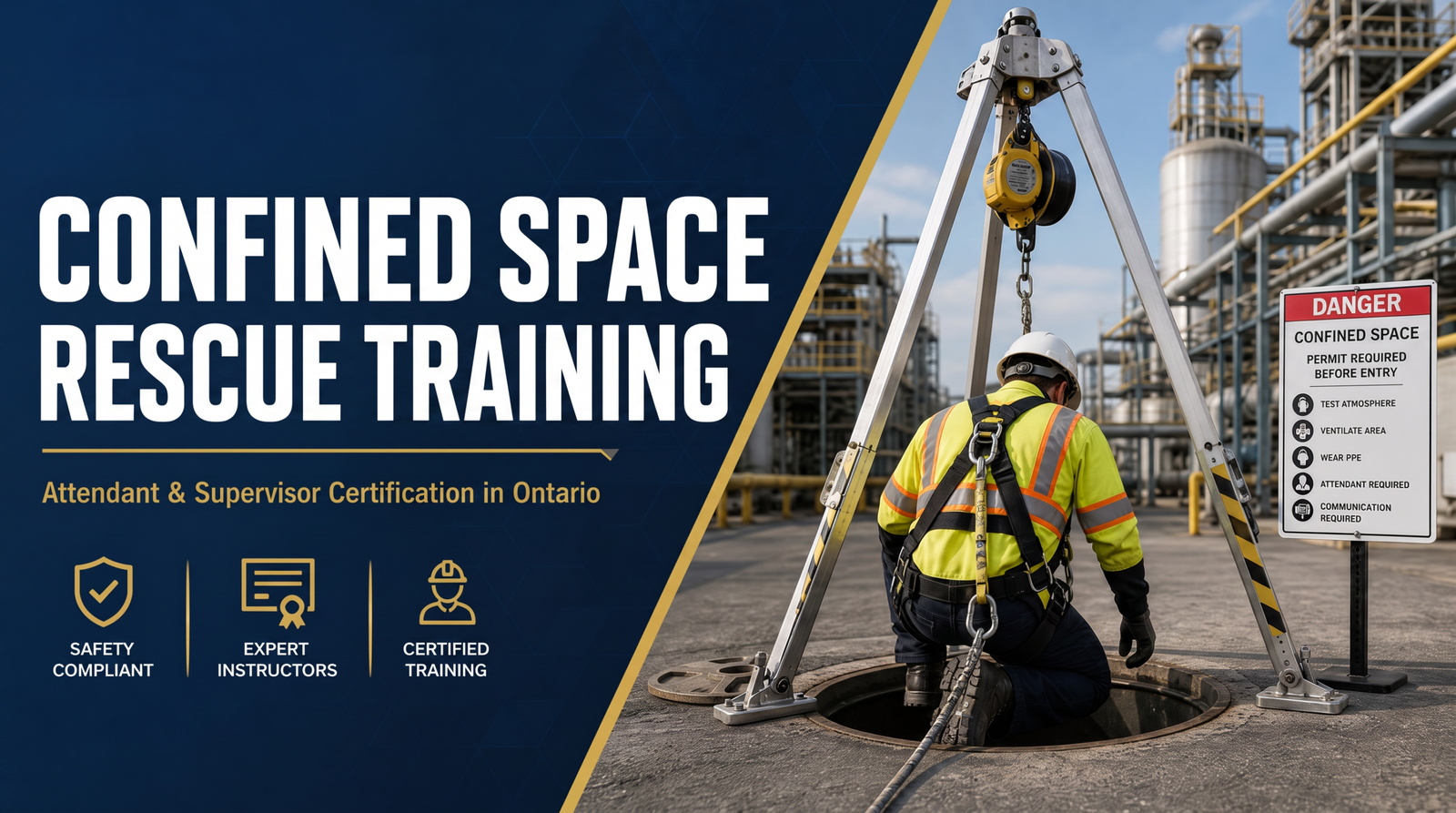
Non-entry rescue allows the team to retrieve a worker while keeping rescuers outside the confined space. The system may involve a full-body harness, retrieval line, winch, davit, tripod or another approved arrangement suited to the entry point.
The equipment must be selected and positioned before the entry. Once an emergency begins, the team needs to know how to operate the system, control the casualty’s movement and manage the transition through the opening.
Non-entry retrieval may be unsuitable when:
- The line can snag inside the space
- Internal structures block the casualty’s path
- Retrieval could worsen the worker’s injury
- The access route changes direction
- The casualty must be disconnected from equipment
- The entrant is not connected to a usable retrieval system
- The opening cannot accommodate the planned removal method
The employer’s hazard assessment and rescue procedure should address these limitations before workers enter.
Entry rescue
Entry rescue requires trained personnel to enter the confined space and reach the casualty. The rescuers may need to assess the worker, establish a secure connection, package the casualty and move the person toward the exit.
This approach exposes rescuers to the conditions inside the space. The team must account for atmospheric hazards, energy sources, access limitations, communication, rescuer accountability and the physical effort required to move the casualty.
Entry rescue should follow a planned procedure supported by adequate personnel and suitable equipment. Rescue workers must understand the limitations of their protective equipment and remain within the scope of the training they have received.
What Does Confined Space Rescue Course Covers
Course content is organized around the employer’s on-site rescue responsibilities and the practical actions expected from designated rescue personnel.
Topics may include:
- Ontario confined-space rescue requirements
- Review of the employer’s on-site rescue procedure
- Rescue-team roles and accountability
- Entry rescue and non-entry rescue selection
- Rescue hazard assessment
- Communication between the attendant, rescuers and supervisor
- Atmospheric hazards during a rescue
- Energy isolation and lockout considerations
- Rescue equipment inspection
- Harness and retrieval-system setup
- Safe operation of retrieval equipment
- Casualty access and handling
- Movement through confined-space openings
- Vertical and horizontal retrieval considerations
- Practical rescue scenarios
- Formal participant evaluation
- Post-exercise review
Rescue Equipment Setup and Inspection
Rescue equipment must match the space, opening, entry route, hazards and selected retrieval method.
Depending on the client’s rescue plan and training arrangements, equipment may include:
- Full-body harnesses
- Retrieval lines
- Tripods
- Davit systems
- Winches
- Approved anchors
- Pulleys and mechanical retrieval components
- Gas-monitoring equipment
- Ventilation equipment
- Communication devices
- Patient-packaging equipment
- Required personal protective equipment
Participants need to understand how the components work together. A suitable harness can still create problems when the connection point, line direction or access opening has not been considered.
Equipment must also be inspected before use. Under Ontario Regulation 632/05, rescue equipment must be kept readily available and in good working order. A person with adequate knowledge, training and experience must inspect it as often as necessary and at least once annually. The employer must keep a written record of the most recent inspection.
The practical exercise does not replace the manufacturer’s instructions or equipment-specific training. The employer remains responsible for ensuring that workers can safely use the exact equipment assigned to them.
Formal Practical Evaluation
Participants complete a formal practical evaluation during the course.
The evaluation measures whether each person can perform the assigned rescue tasks safely and in the correct sequence. Depending on the exercise and participant’s role, the instructor may assess the ability to:
- Explain the assigned rescue responsibility
- Identify hazards that could affect the response
- Inspect equipment before use
- Set up the retrieval system
- Select the planned rescue method
- Maintain communication
- Follow atmospheric-monitoring requirements
- Operate retrieval equipment under control
- Establish a secure connection to the casualty
- Manage casualty movement through the opening
- Protect rescuers from additional exposure
- Follow the employer’s rescue procedure
- Respond appropriately when conditions change
A participant who cannot demonstrate an assigned skill may need further instruction and reassessment before the employer authorizes that person to perform the rescue duty.
The Record of Training documents course completion. The employer determines workplace authorization based on the worker’s assigned role, demonstrated competency, equipment training and knowledge of the site-specific procedure.
What the Employer Should Prepare Before Training
Achieve Safety will need enough information to plan exercises that suit the client’s workplace and rescue team.
The employer should be prepared to discuss:
- Training location
- Number of participants
- Participant roles
- Type and configuration of the confined space
- Known atmospheric and physical hazards
- Current hazard assessment
- Confined-space plan
- Written on-site rescue procedure
- Entry and casualty-removal routes
- Rescue equipment available
- Equipment inspection status
- Atmospheric-testing equipment
- Ventilation arrangements
- Communication systems
- Energy-isolation procedures
- Required PPE
- First aid and emergency arrangements
- Suitability of the proposed practical training area
Equipment responsibilities should be confirmed while booking. The client and Achieve Safety should establish which rescue, retrieval and monitoring equipment will be available before the course date.
Employers preparing for confined-space work can also use the Ontario Confined Space Entry Compliance Checklist to review documentation, permits and pre-entry controls.
Confined Space Rescue Training Prerequisites
Rescue personnel need enough background knowledge to participate safely in the practical exercises and understand how the rescue procedure connects with routine entry controls.
Relevant preparation may include:
- Confined-space entry training
- Familiarity with the employer’s confined-space plan
- Knowledge of the assigned rescue role
- Equipment-specific instruction
- Required personal protective equipment
- Respirator fit testing when respiratory protection is involved
- Fall-protection training where the rescue exposure requires it
- Medical clearance where required by the employer’s program
Ontario requires rescue personnel to receive training in first aid and cardiopulmonary resuscitation. The employer must ensure these qualifications are in place for the workers assigned to carry out the rescue procedure.
Specific prerequisites and participant requirements should be confirmed with Achieve Safety before the training date.
Confined Space Entry Training Vs Rescue Training
Entry training and rescue training support different workplace responsibilities.
| Entry, Attendant and Supervisor Training | Confined Space Rescue Training |
|---|---|
| Prepares workers for planned confined-space work | Prepares designated personnel to respond when an entrant cannot exit |
| Covers hazard assessments, entry plans, permits and testing | Covers rescue procedures, retrieval systems and casualty movement |
| Explains entrant, attendant and supervisor duties | Develops rescue-team roles and coordination |
| Covers emergency recognition and evacuation | Covers practical entry and non-entry rescue |
| Does not qualify participants as confined-space rescuers | Includes a formal practical rescue evaluation |
Workers assigned to a rescue team generally need a sound understanding of confined-space entry controls. Rescue training builds on that foundation by focusing on emergency access, retrieval and team performance.
Record of Training and Employer Responsibilities
Participants who successfully complete the course receive an Achieve Safety Record of Training.
Course completion forms part of the employer’s confined-space training records. It does not function as a government-issued rescuer licence or provide automatic authorization to perform every type of rescue.
The employer must still ensure that each rescue worker:
- Understands the workplace’s on-site rescue procedure
- Can perform the assigned role
- Has been trained on the equipment being used
- Holds required first aid and CPR training
- Understands the hazards of the specific space
- Uses the required PPE and respiratory protection
- Participates in suitable practice exercises
- Receives updated instruction when procedures, hazards or equipment change
- Remains capable of completing the assigned rescue tasks
The employer must also ensure that enough trained personnel are available to implement the procedure immediately whenever confined-space entry occurs.
Does Confined Space Rescue Training Expire?
Ontario does not establish one universal expiry period for every confined-space rescue training record.
The employer must review confined-space training whenever changes could affect worker safety. Where the regulation applies, the training program must also be reviewed at least annually. This annual review does not automatically mean every worker must repeat the full course once a year.
Refresher instruction or practical reassessment may be appropriate when:
- The rescue procedure changes
- New equipment is introduced
- Rescue-team assignments change
- A drill reveals a performance problem
- Workers have not practised the procedure for an extended period
- The confined space or its hazards change
- An incident or near miss identifies a competency gap
The distinction between certificate dates, annual program reviews and workplace retraining is explained in Confined Space Training Expiry in Ontario.
Frequently Asked Questions
Is confined-space rescue training mandatory in Ontario?
Employers must have written on-site rescue procedures before confined-space entry begins. Enough properly trained rescue personnel must be available to implement those procedures immediately. The required training must cover the rescue procedure, first aid and CPR, and the rescue equipment identified in the plan.
How long is the Achieve Safety rescue course?
The Confined Space Rescue Training course takes eight hours.
How much does confined-space rescue training cost?
Course pricing starts from $185. Final pricing and booking arrangements may depend on the number of participants, training location, equipment and practical exercise requirements.
Where is the course delivered?
Training is delivered at the client’s facility. The location and proposed exercise area should be discussed before booking.
Does the course cover entry rescue?
Yes. Participants receive instruction and practical training related to entry rescue.
Does the course include non-entry rescue?
Yes. The course covers retrieval methods that allow a casualty to be removed without sending another person into the confined space.
Do participants complete a practical evaluation?
Yes. Participants complete a formal practical evaluation based on the skills and rescue duties taught during the course.
Can confined-space rescue training be completed entirely online?
The practical rescue exercises and formal evaluation require in-person participation. Online-only instruction cannot assess a participant’s ability to set up equipment, work with the rescue team and perform casualty retrieval.
Do rescue personnel need first aid and CPR training?
Yes. Ontario’s confined-space regulation requires rescue personnel to be trained in first aid and CPR. Employers must confirm that the people assigned to the rescue procedure meet this requirement.
Can an attendant perform the rescue?
The attendant activates the emergency procedure and continues the monitoring and communication duties assigned by the confined-space plan. An attendant should not leave the post to attempt an improvised entry rescue. A worker trained for both roles can join the rescue response only when the plan ensures that attendant duties remain covered.
Is calling 911 enough for a confined-space rescue plan?
No. Ontario’s guidance on on-site rescue procedures states that calling 911 alone is not considered an adequate on-site rescue plan. Any outside emergency service included in the response must be assessed and coordinated before entry begins.
Is this an NFPA confined-space rescue technician course?
The eight-hour program is workplace-focused training based on the agreed course scope and the client’s on-site rescue needs. It should not be treated as an NFPA technician credential unless that qualification is expressly identified in the training proposal and completion record.
Does confined-space rescue training expire?
ario does not prescribe one expiry date for every training record. Employers must review training when safety-related circumstances change and at least annually where the regulation requires it. Refresher training or reassessment may be needed based on workplace conditions and demonstrated competency.