- What Are the WHMIS Training Requirements in Ontario?
- Is WHMIS Training Mandatory in Ontario?
- Is an Online WHMIS Certificate Valid in Ontario?
- Who Pays for WHMIS Training in Ontario?
- Who Needs WHMIS Training in Ontario?
- How Often Is WHMIS Training Required in Ontario?
- What Is the Difference Between General WHMIS Education and Workplace-Specific Training?
- What Must WHMIS Training Cover Under Ontario Regulation 860?
- What Are an Ontario Employer’s Responsibilities Under WHMIS?
- How Can Employers Check Whether WHMIS Training Was Effective?
- Is Online WHMIS Training Enough in Ontario?
- How Often Must WHMIS Training Be Reviewed in Ontario?
- Does WHMIS Training Transfer to a New Employer?
- Do All Hazardous Products Require WHMIS Labels and Training?
- What Should Ontario Employers Check Following the WHMIS Regulatory Transition?
- What WHMIS Training Records Should Ontario Employers Keep?
- Illustrative training record, not a government-prescribed template.
- Ontario WHMIS Compliance Checklist for Employers
- Frequently Asked Questions About WHMIS Training in Ontario
- Arrange WHMIS Training for Your Ontario Workplace
- Current 2026 WHMIS Compliance Note
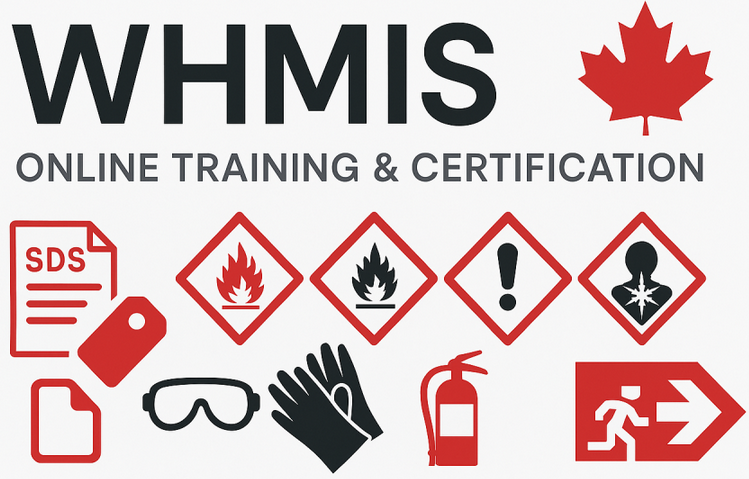
WHMIS training is required in Ontario for workers who work with hazardous products or may be exposed to them during their duties. Employers must provide general education about the Workplace Hazardous Materials Information System (WHMIS) and instruction that addresses the hazardous products, exposure risks and safe procedures at their workplace.
Under Ontario’s Occupational Health and Safety Act (OHSA) and Regulation 860, employers must provide WHMIS training to any worker who works with or may be exposed to hazardous products.
Compliant training requires two mandatory parts: generic WHMIS education (pictograms, supplier labels, and 16-section Safety Data Sheets) and workplace-specific training covering your facility’s actual chemicals, storage rules, and emergency procedures. While WHMIS certificates have no set expiry date, Ontario employers must review their WHMIS program with the health and safety committee at least once a year and retrain workers whenever new hazards or products are introduced
An online WHMIS certificate can demonstrate that a worker completed general education. It does not automatically establish that the worker knows how to handle chemicals, respond to spills or use the protective measures required at a particular workplace.
This guide explains the legal requirements, who needs training, what workers must learn and how employers can assess whether their WHMIS program is effective.
What Are the WHMIS Training Requirements in Ontario?
Ontario employers must provide appropriate WHMIS education and instruction to workers who work with hazardous products or may be exposed to them at work.
The employer must ensure the instruction addresses the hazards and safe procedures relevant to those workers. Employers must also assess whether workers can use the information to protect their health and safety, so far as reasonably practicable.
| Requirement | Ontario rule or expectation |
|---|---|
| Legal framework | OHSA sections 42 and 43; Regulation 860 |
| Who needs training | Workers who work with or may be exposed to hazardous products |
| General education | Understanding labels, safety data sheets and WHMIS hazard information |
| Workplace-specific instruction | Safe use, handling, storage, disposal and emergency procedures |
| Training duration | No universal minimum number of hours prescribed |
| Delivery | Internal or external instruction may be used |
| Online certificates | May support general education but do not automatically satisfy workplace-specific requirements |
| Annual review | Worker familiarity with the training and instruction must be reviewed at least annually |
| Annual retraining | No universal requirement to repeat the entire course every year |
| Training records | No specific universal WHMIS training-record format is prescribed by Regulation 860 |
The central question is not simply whether a worker has a certificate. It is whether the worker understands the hazards and knows how to work safely with the products they may encounter.
Legal references: Ontario Regulation 860 and Ontario’s WHMIS employer guidance.
Is WHMIS Training Mandatory in Ontario?
Yes. WHMIS is part of Canada’s national hazard communication system and is implemented in Ontario through provincial occupational health and safety requirements.
Ontario employers must provide education and training when workers:
- Work directly with hazardous products
- Handle, store or dispose of hazardous products
- May be exposed during normal operations
- May be exposed while performing maintenance or cleaning
- Supervise workers who handle hazardous products
- Participate in emergency or spill response
- Work near processes that could release a hazardous substance
The training requirement is not limited to workers who pour, mix or apply chemicals.
A maintenance worker could be exposed while opening equipment. A cleaner may handle concentrated products. A warehouse worker may respond to damaged containers. A supervisor may need to direct workers during a leak or spill.
Each of these roles may require WHMIS education and workplace-specific instruction.
Is an Online WHMIS Certificate Valid in Ontario?
Yes. An online WHMIS certificate can be accepted in Ontario, but completing an online course alone does not automatically satisfy all workplace-specific WHMIS training requirements.
Ontario’s WHMIS requirements involve two complementary components:
-
General WHMIS education: Understanding hazard classes, pictograms, supplier labels, workplace labels, safety data sheets (SDSs) and basic chemical safety principles.
-
Workplace-specific instruction: Learning about the hazardous products used at a particular workplace, their exposure risks, safe handling procedures, protective measures and emergency response requirements.
An online course can provide general WHMIS education. It may also support workplace-specific instruction if the employer incorporates the actual products, hazards and procedures workers encounter.
For example, a warehouse employee may complete an online WHMIS course covering flammable liquids. Their employer must still ensure they understand how flammable products are stored at the facility, which precautions apply and what to do if a container leaks.
Ontario does not require every WHMIS certificate to come from a government-approved commercial training provider. Employers are responsible for ensuring the instruction meets applicable requirements and workers understand how to protect themselves.
Who Pays for WHMIS Training in Ontario?
Ontario employers are responsible for providing the WHMIS education and instruction required for their workers to perform their duties safely. Workers should not be required to purchase mandatory WHMIS training as a condition of receiving the instruction their employer is legally obligated to provide.
Under section 42 of Ontario’s Occupational Health and Safety Act and Ontario Regulation 860, employers must ensure affected workers receive appropriate information and instruction about hazardous products.
In practice, this means employers should arrange and cover the cost of required WHMIS training, whether delivered internally, online or through an external provider.
Who Needs WHMIS Training in Ontario?
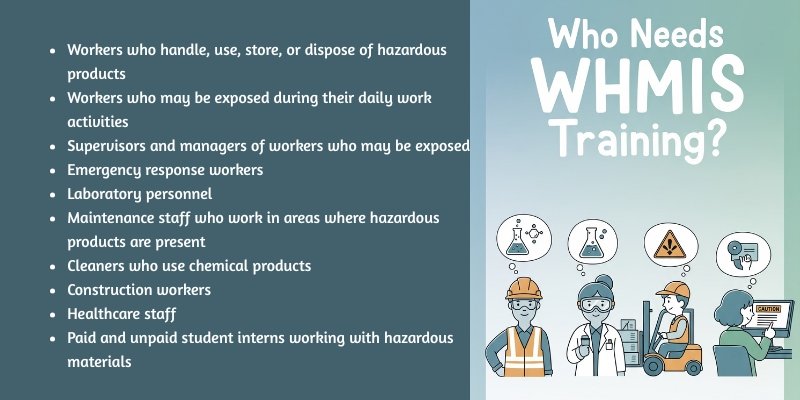
WHMIS education and training are required for workers who work with hazardous products or may be exposed to them through their work.
The requirement is not limited to employees who directly mix, pour or apply chemicals.
For example, a warehouse worker transporting containers of hazardous products may need instruction on damaged packages and spill procedures. A maintenance employee opening a chemical process line may face exposure to substances that are normally contained within equipment.
Workers who commonly require WHMIS instruction include production employees, laboratory technicians, cleaners, warehouse workers, maintenance personnel and others whose duties create potential exposure.
Supervisors also need suitable knowledge when their responsibilities involve directing work with hazardous products or responding to related hazards.
Does Every Employee Need the Same WHMIS Training?
No. WHMIS instruction should reflect the worker’s duties and potential exposure.
A receptionist who does not work with or face occupational exposure to hazardous products will not necessarily require the same product-specific instruction as an industrial cleaner handling concentrated chemicals.
However, employers should assess actual work conditions rather than relying on job titles alone.
An employee who rarely handles chemicals may still need instruction if their duties involve receiving damaged containers, entering chemical storage areas or responding to an emergency.
The employer should identify which products a worker may encounter, how exposure could occur and what precautions are necessary.
Do Workers Have to Retake WHMIS Training When Changing Jobs in Ontario?
Workers do not automatically need to repeat an entire general WHMIS course every time they change employers. However, the new employer must ensure they receive the workplace-specific instruction necessary for their new duties.
How Often Is WHMIS Training Required in Ontario?
Ontario employers must review workers’ familiarity with WHMIS education and instruction at least once a year, but this does not mean every employee must repeat a complete WHMIS training course annually.
Under section 42(3) of Ontario’s Occupational Health and Safety Act (OHSA), employers must review the training and instruction provided to workers, in consultation with the Joint Health and Safety Committee (JHSC) or health and safety representative, if any.
The review must take place at least annually, or more frequently when workplace conditions change or new hazard information becomes available.
The purpose is to determine whether workers still understand the hazardous products they encounter, the precautions required to prevent exposure and the procedures they must follow during an emergency.
Employers should distinguish between three activities:
| Activity | When is it required? |
|---|---|
| Initial WHMIS education and instruction | When workers need information about hazardous products they work with or may be exposed to |
| Annual WHMIS review | At least annually, to assess worker familiarity with the training and instruction |
| Additional WHMIS training or instruction | When necessary to address new hazards, changed procedures or gaps in worker understanding |
An annual review may establish that existing instruction remains adequate. Where the review identifies gaps, employers must take appropriate steps to address them.
Does a WHMIS Certificate Expire in Ontario?
WHMIS certificates do not have a universal expiry date prescribed by Ontario’s WHMIS legislation. A certificate showing that an employee completed WHMIS education two or three years ago does not automatically become invalid because a particular period has passed.
However, a valid certificate and compliance with workplace WHMIS requirements are not the same thing.
A worker may have completed general WHMIS education but lack the instruction necessary to safely handle hazardous products at their current workplace.
Some training providers assign expiry dates to their certificates, often based on their own renewal policies. Employers may also establish internal refresher schedules. These dates should not be confused with a universal legal requirement to renew WHMIS certification annually.
For example, an employee who completed WHMIS education in 2024 may not need to repeat the entire course in 2026 if their knowledge remains current and the employer has met its ongoing training obligations.
However, if the employee begins working with a newly introduced corrosive chemical, additional product-specific instruction may be necessary regardless of the certificate’s age.
For a detailed explanation, see our guide to WHMIS training expiry and refresher requirements in Ontario.
What Triggers Mandatory WHMIS Retraining vs. the Annual Program Review?
The annual WHMIS review is a recurring legal obligation. Additional training becomes necessary when workers no longer have the knowledge or instruction needed to protect themselves from hazardous products.
Ontario Regulation 860 requires employers to ensure, so far as reasonably practicable, that workers can use the information and instruction provided to protect their health and safety.
Several workplace changes may create a need for additional instruction.
| Workplace situation | What the employer should do |
|---|---|
| Annual WHMIS review is due | Review worker familiarity and determine whether existing instruction remains adequate |
| A new hazardous product is introduced | Assess its hazards and provide relevant instruction before workers are exposed |
| An existing product receives an updated SDS | Determine whether the changes affect hazards, precautions or safe work procedures |
| Chemical handling or storage procedures change | Explain the revised procedures to affected workers |
| A worker is assigned new duties involving hazardous products | Provide instruction relevant to the new tasks and exposure risks |
| A spill or incident reveals a knowledge gap | Investigate the deficiency and provide corrective instruction where necessary |
| Workers cannot explain essential safety precautions | Provide additional instruction and reassess their understanding |
Not every change requires employees to repeat a complete WHMIS course. The employer should determine what information is missing and provide instruction appropriate to the hazard.
What Is the Difference Between General WHMIS Education and Workplace-Specific Training?
WHMIS education teaches workers how Canada’s hazardous product communication system works. Workplace-specific instruction explains how to apply that information to the products and procedures used at their job.
Both are important.
General WHMIS Education
General education helps workers understand:
-
WHMIS hazard classes, categories and pictograms
-
Supplier labels and workplace labels
-
Signal words, hazard statements and precautionary statements
-
The purpose and structure of safety data sheets
-
Basic principles of chemical exposure prevention
-
Worker, employer and supplier responsibilities
A worker can apply much of this knowledge across different workplaces.
Workplace-Specific WHMIS Training
Workplace-specific instruction addresses the actual products, equipment and conditions a worker encounters.
For example, an employee using an industrial cleaning chemical should understand the product’s hazards, how it is diluted or dispensed, the required protective equipment, incompatible substances and what to do following accidental exposure.
Workers should also know where to find the product’s safety data sheet and how to access emergency assistance.
Example: WHMIS Training for a Warehouse Employee
Consider a warehouse employee who moves drums containing hazardous products.
General WHMIS education teaches the employee how to recognize hazard pictograms and read supplier labels.
Workplace-specific training explains what to do if a drum is damaged, which areas are designated for chemical storage, how to report a leak and whether the employee is authorized to respond to a spill.
A certificate from an online course may demonstrate general knowledge. It does not confirm that the employee understands those particular warehouse procedures.
What Must WHMIS Training Cover Under Ontario Regulation 860?
Section 7(1) of Ontario Regulation 860 identifies six subjects that must be addressed through the worker education and instruction program.
The precise instruction depends on the hazardous products and activities present in the workplace.
| Prescribed subject | What workers need to learn |
|---|---|
| Labels | The required label information and its purpose and significance |
| Safety data sheets | The required SDS information and how workers use it |
| Safe handling procedures | Safe use, storage, handling and disposal of hazardous products |
| Products in process systems | Safe procedures involving hazardous products in pipes, vessels, tanks and similar systems |
| Fugitive emissions | Procedures to follow when hazardous products escape unintentionally from equipment or processes |
| Emergency procedures | What workers must do during emergencies involving hazardous products |
The requirements concerning process systems and fugitive emissions are sometimes overlooked in general training materials.
They are particularly relevant in industrial facilities where chemicals may be transferred through piping, stored in process vessels or released during equipment failures.
How Should Workers Be Trained to Read WHMIS Labels?
Workers should understand the information provided on supplier labels, including product identifiers, hazard pictograms, signal words and precautionary statements.
They should also understand when workplace labels are required and how their employer handles damaged or missing labels.
A useful exercise is to show employees a label from a product they actually use and ask them to identify the main hazards and protective measures.
This helps connect the WHMIS symbols to practical decisions.
What Must Workers Know About Safety Data Sheets?
Safety data sheets (SDSs) provide detailed information about a hazardous product’s properties, hazards and recommended precautions.
Workers should know how to locate the relevant SDS and find information about first aid, exposure controls, safe handling, storage and emergency response.
Canadian supplier SDSs follow a standardized 16-heading structure, making it easier to locate the same type of information across different products.
Workers do not need to memorize every SDS. They need to know where the information is available and how to use it when necessary.
For more detail, employers can consult the CCOHS guide to WHMIS safety data sheets.
What Should Training Cover About Safe Handling and Emergency Procedures?
Product-specific instruction should address the procedures workers need to follow during normal operations and foreseeable emergencies.
This may include chemical storage, ventilation, transfer procedures, personal protective equipment, spill reporting and emergency evacuation.
Training should also clarify what workers are not authorized or equipped to do.
For example, an employee who recognizes a corrosive substance through its WHMIS label should not assume they are qualified to clean a large chemical spill.
The employer must establish appropriate response procedures and ensure workers understand their assigned responsibilities.
What Are an Ontario Employer’s Responsibilities Under WHMIS?
Providing training is one part of an employer’s WHMIS responsibilities.
Employers must also ensure workers have access to the hazard information and protective measures necessary for their duties.
Provide Information About Hazardous Products
Under section 42 of the OHSA, employers must provide workers with applicable hazard information received from suppliers and information about hazardous products that the employer knows or ought to know.
This includes hazards that may arise from the way products are used, stored or handled at the workplace.
A hazardous-product inventory is a useful way to organize this information. Although a single prescribed inventory format is not established by Regulation 860, an accurate inventory can help employers identify missing SDSs, new products and employees who require instruction.
Maintain Labels and Safety Data Sheets
Employers must ensure hazardous products are appropriately labelled and that required safety data sheets are available.
A digital SDS system can be practical, provided workers can readily access the information when needed.
For example, a warehouse that stores SDSs on an internal computer system should consider whether employees working overnight can access the documents and what happens if the network becomes unavailable.
Consult the Joint Health and Safety Committee
Ontario’s WHMIS requirements involve consultation with the joint health and safety committee (JHSC) or health and safety representative, if one exists.
This consultation is relevant when developing and implementing worker education and instruction programs and reviewing worker familiarity with the training.
Employees and their representatives may identify hazards or training gaps that are not obvious from written course materials.
Evaluate Whether Workers Understand the Training
Section 7(3) of Regulation 860 requires employers to ensure, so far as reasonably practicable, that workers can use the information and instruction to protect their health and safety.
An employer may evaluate understanding through written questions, verbal discussions, practical demonstrations or observation of workplace procedures.
Attendance alone does not establish that a worker understands how to respond to a chemical hazard.
How Can Employers Check Whether WHMIS Training Was Effective?
A practical assessment should test whether workers can apply WHMIS information to the products they encounter.
Ontario’s WHMIS guidance identifies four useful questions.
Four questions every worker should be able to answer
-
What are the hazards of this product?
-
How do I protect myself?
-
What should I do in an emergency?
-
Where can I find the safety data sheet or additional information?
For example, an employer could ask a worker to identify the hazards of a cleaning chemical, demonstrate how to locate its SDS and explain the procedure for reporting a spill.
If the employee cannot answer these questions, additional instruction may be necessary.
Employers should select assessment methods suited to the workers, tasks and hazards involved. A written examination is not the only way to demonstrate understanding.
Is Online WHMIS Training Enough in Ontario?
Online WHMIS training in Ontario can satisfy the general education component when it covers the applicable requirements.
However, an online certificate alone does not automatically establish full WHMIS compliance.
The employer must still ensure the worker understands the hazardous products, procedures and protective measures at their workplace.
A practical training process may include:
-
General WHMIS education delivered online or in person.
-
Instruction on the hazardous products used at the workplace.
-
Review of relevant supplier labels and safety data sheets.
-
Explanation or demonstration of safe handling procedures.
-
Assessment of worker understanding.
Employers can use internal personnel or a qualified external training provider to deliver appropriate instruction.
Ontario does not require every employer to purchase WHMIS training from a particular commercial provider.
How Often Must WHMIS Training Be Reviewed in Ontario?
Ontario employers must review workers’ familiarity with WHMIS training and instruction at least annually, in consultation with the JHSC or health and safety representative, if any, under OHSA section 42(3).
An annual review does not automatically require every worker to repeat the entire WHMIS course each year.
Additional education or instruction may be necessary when:
-
New hazardous products are introduced.
-
Product classifications or hazard information change.
-
Workers begin unfamiliar tasks.
-
Safe handling procedures or protective measures change.
-
Incidents or assessments reveal gaps in worker understanding.
For example, a facility that replaces one cleaning chemical with another may need to explain new handling precautions, even if employees completed general WHMIS education several months earlier.
Employers should assess whether the change affects the instruction workers need.
For a detailed explanation of certificates, expiry dates and retraining, see WHMIS Training Expiry and Refresher Requirements in Ontario.
Does WHMIS Training Transfer to a New Employer?
General WHMIS knowledge may remain useful when a worker changes employers.
However, the new employer must determine whether the worker understands the hazardous products and procedures at the new workplace.
A worker who previously handled automotive chemicals may understand WHMIS pictograms but still need instruction on the industrial solvents used at a manufacturing facility.
Employers may assess existing knowledge and provide additional instruction where necessary.
Previous course completion does not remove the new employer’s responsibility to provide appropriate workplace-specific training.
Do All Hazardous Products Require WHMIS Labels and Training?
Not every hazardous substance encountered at work is subject to the same WHMIS supplier label and SDS requirements.
Certain products are excluded from some or all federal WHMIS supplier requirements because they are regulated under other legislation.
Examples include some consumer products, cosmetics, drugs, pest-control products and explosives. The applicable treatment depends on the product category and the specific legal provision.
These distinctions matter because an exemption from WHMIS supplier requirements does not mean the product is safe or that the employer has no duty to protect workers.
For example, a concentrated cleaning product sold for consumer use may still present serious exposure risks when used frequently in a workplace.
Employers should assess the product’s hazards and provide appropriate instruction under applicable occupational health and safety requirements.
Employers should not assume that every product without a WHMIS supplier label is harmless.
What Should Ontario Employers Check Following the WHMIS Regulatory Transition?
Regulatory update | November 2026
Amendments to Canada’s federal Hazardous Products Regulations were introduced in December 2022, with the three-year supplier transition period ending on December 15, 2025.
The amendments aligned parts of Canada’s hazard communication system with updated provisions of the Globally Harmonized System of Classification and Labelling of Chemicals.
For Ontario employers, the practical concern is whether updated supplier information has been incorporated into workplace procedures and worker instruction.
A post-transition review should check whether:
-
Revised supplier SDSs have been received where applicable.
-
Hazard classifications and label information have changed.
-
Workplace procedures reflect updated hazard information.
-
Workers understand any new or revised precautions.
-
Superseded documents have been identified and managed appropriately.
An updated SDS does not automatically mean every employee must repeat a full WHMIS course. Employers should assess whether the new information changes the hazards or precautions workers need to understand.
Reference: Health Canada: Workplace Hazardous Materials Information System.
What WHMIS Training Records Should Ontario Employers Keep?
Ontario Regulation 860 does not prescribe one universal format for WHMIS training records.
Nevertheless, maintaining documentation is a sensible way to demonstrate that education and instruction have been provided and that worker understanding has been assessed.
A practical training record may contain the following information:
| Record field | Example |
|---|---|
| Employee | Sample employee, warehouse department |
| General education | WHMIS course completed, October 2026 |
| Workplace-specific instruction | Chemical storage and spill procedures |
| Products covered | Relevant hazardous products handled in the department |
| Instructor | Designated internal trainer |
| Assessment | Verbal questions and SDS identification exercise |
| Follow-up | Additional instruction required, if applicable |
Illustrative training record, not a government-prescribed template.
Employers may also retain course materials, training attendance, assessment results, program review notes and records of consultation with the JHSC or health and safety representative.
Documentation should reflect what actually occurred rather than merely recording that an employee received a certificate.
Ontario WHMIS Compliance Checklist for Employers
Before assigning workers to tasks involving hazardous products, employers should confirm that:
-
Relevant hazardous products and potential exposures have been identified.
-
Required supplier and workplace labels are available.
-
Required safety data sheets are readily accessible.
-
Workers have received suitable general WHMIS education.
-
Workplace-specific hazards and procedures have been explained.
-
Appropriate protective measures and emergency procedures are understood.
-
Worker understanding has been evaluated.
-
The annual review of worker familiarity is scheduled and consultation requirements are addressed.
-
Additional instruction is provided when hazards or working conditions change.
This checklist is a practical review tool. It does not replace the requirements of the OHSA, Regulation 860 or other legislation applicable to the workplace.
Frequently Asked Questions About WHMIS Training in Ontario
Does WHMIS training expire in Ontario?
No, WHMIS certificates do not have a legislated expiry date under Ontario law, but employers must review their overall WHMIS program annually and retrain workers whenever products or workplace conditions change.
If I change employers in Ontario, do I need to retake WHMIS?
Your generic WHMIS education is portable between jobs, side-stepping a full retake if your new employer accepts it, though every new employer is legally required to train you on their specific workplace chemicals and procedures.
Is an online WHMIS certificate valid in Ontario?
Yes, an online course satisfies the generic education component, provided the employer supplements it with hands-on, workplace-specific training for the exact products on-site.
Who pays for WHMIS training in Ontario?
The employer must pay for all WHMIS instruction and ensure workers complete the training during paid working hours at no personal cost.
What language must WHMIS training be delivered in?
Ontario employers must deliver WHMIS instruction in a language and manner that workers genuinely understand, verifying comprehension through demonstrations or questioning rather than just handing out English pamphlets.
Arrange WHMIS Training for Your Ontario Workplace
WHMIS training should help workers do more than recognize hazard pictograms. Employees need to understand the hazardous products they encounter and the precautions required to handle them safely.
Achieve Safety and compliance helps Ontario employers build practical workplace safety trainings that connects WHMIS labels and safety data sheets to the products and procedures workers use every day.
For WHMIS training or help reviewing your workplace safety program, contact Achieve Safety at (647) 523-7554.
Current 2026 WHMIS Compliance Note
Federal Hazardous Products Regulations were amended in December 2022. Suppliers received a three-year transition period ending in December 2025 to update affected classifications, labels and safety data sheets.
Ontario employers should now confirm that their hazardous-product inventory reflects current supplier information.
A practical 2026 review should include:
- Checking whether updated SDSs have been received
- Comparing current labels with SDS product identifiers
- Reviewing revised hazard classifications
- Updating training when new hazard information appears
- Removing superseded documents from active systems
- Confirming workers understand any changed precautions
This is especially important for employers that have not completed a full WHMIS inventory and program review since the transition ended.
NOTES:
- General education covers WHMIS concepts and hazard classes, while training covers workplace procedures for use, storage, spills, disposal and emergencies.
- CCOHS identifies workers who use, store, handle or dispose of hazardous products, workers who may be exposed, supervisors and emergency responders as groups requiring education and training. It also states that employers remain legally responsible even when an outside provider delivers the course.
- The annual-review and refresher framework is based on CCOHS guidance that programs should be reviewed at least annually, with retraining triggered by new products, changed conditions, new hazards or updated safe-use information. Employers should also evaluate worker knowledge through tests, demonstrations or other suitable methods.
- The current-compliance section reflects the December 2022 Hazardous Products Regulations amendments and the transition period that ended December 15, 2025.
- Health Canada confirms that employers are responsible for worker education, product labels, workplace labels or SDSs when necessary, and appropriate protective controls.