- Ontario Workplace Washroom Requirements: Quick Answer
- What Changed Under Ontario’s 2026 Washroom Rules?
- Who Is Responsible for Workplace Washroom Cleanliness?
- What Does “Clean and Sanitary” Mean?
- How Often Must Workplace Washrooms Be Cleaned in Ontario?
- What Must a Workplace Washroom Cleaning Record Include?
- Where Must Washroom Cleaning Records Be Posted?
- How Should Workers Report an Unsanitary Washroom?
- What Role Does the JHSC or Health and Safety Representative Have?
- Cleaning Chemicals Must Also Be Managed Safely
- Workplace Washroom Compliance Checklist
- Common Washroom Compliance Mistakes
- FAQs About Ontario Workplace Washroom Requirements
- Keep Your Workplace Sanitary and Inspection-Ready
Ontario employers now have clearer legal duties for keeping worker washrooms clean, sanitary and properly documented.
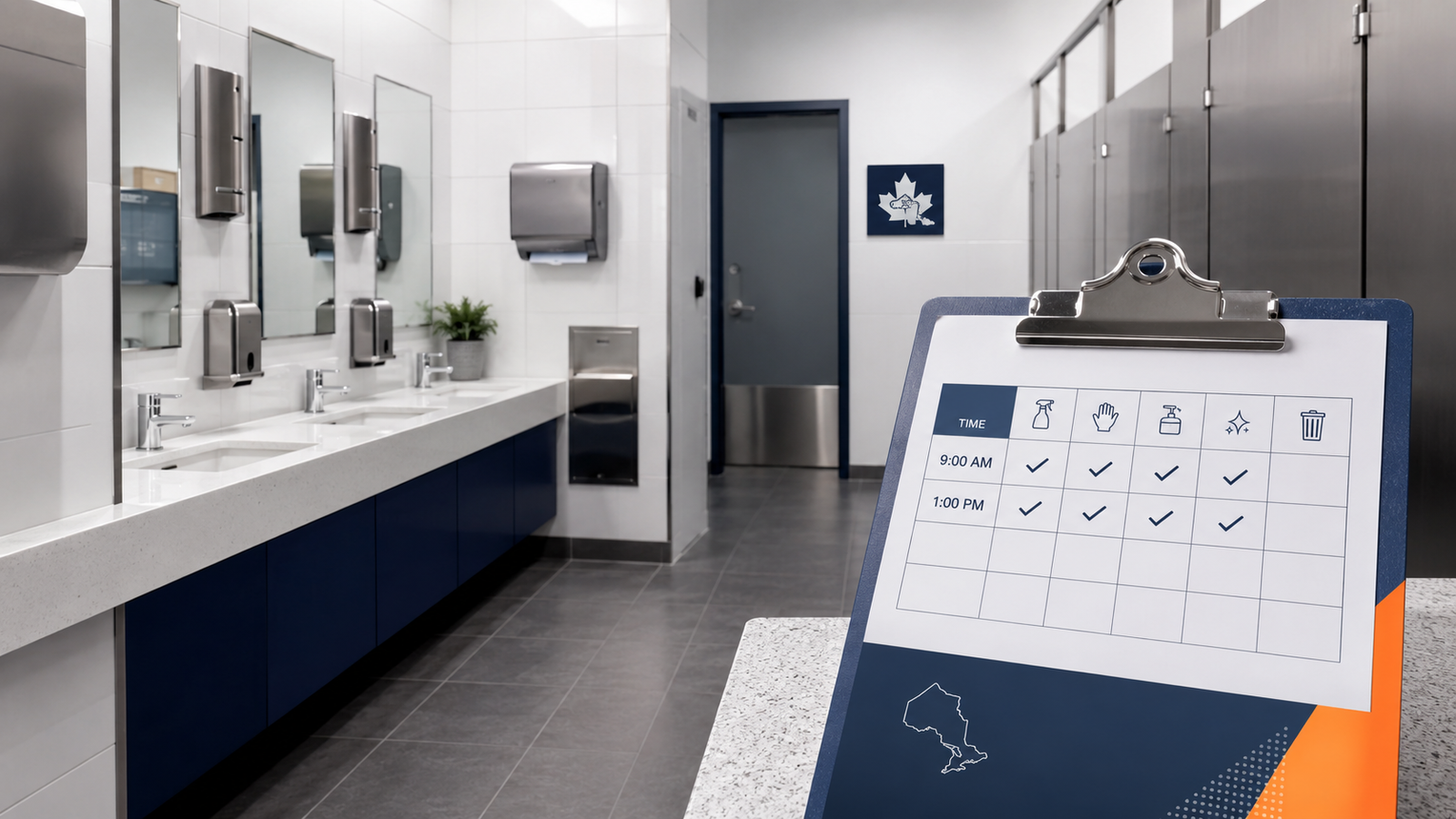
As of January 1, 2026, employers and constructors must make prescribed washroom cleaning records available to workers. Each record must identify the date and time of the two most recent cleanings for the washroom it covers.
The rule applies whether the employer uses a paper cleaning log or an electronic system. A record hidden in a manager’s office, contractor portal or inaccessible maintenance file will not satisfy the requirement if workers cannot reasonably access it.
The new documentation rule is only one part of compliance. Employers must still make sure the washroom itself remains clean and sanitary. A completed checklist cannot make up for overflowing waste, missing soap, contaminated surfaces or fixtures left in poor repair.
This guide explains Ontario’s 2026 workplace washroom requirements, who is responsible, what cleaning records must contain and how employers can build a practical system that works during regular operations and Ministry inspections.
Ontario Workplace Washroom Requirements: Quick Answer
Ontario’s workplace washroom rules now create two connected obligations.
Employers and constructors must:
- Keep washroom facilities they provide for workers in a clean and sanitary condition.
- Keep, maintain and make prescribed cleaning records available to workers.
The clean-and-sanitary duties under sections 23.1 and 25.3 of the Occupational Health and Safety Act took effect on July 1, 2025. The detailed cleaning-record requirements under Ontario Regulation 480/24 took effect on January 1, 2026.
For each washroom facility, the record must show:
- The date of the two most recent cleanings
- The time of the two most recent cleanings
- Which washroom the record covers
- Information that remains current and accessible to workers
The record must be made available in one of two ways:
- Posted in a conspicuous place in or near the applicable washroom where workers are likely to notice it
- Posted electronically where workers can access it, with directions explaining where and how to find the record
The regulation does not establish one cleaning schedule for every workplace. Cleaning frequency must be sufficient to keep the facility clean and sanitary under its actual conditions of use.
A lightly used office washroom may require a different schedule from a high-traffic restaurant, warehouse, manufacturing plant or construction project. Employers must assess what is happening in their own workplace rather than treating one daily signature as automatic compliance.
What Changed Under Ontario’s 2026 Washroom Rules?
Ontario introduced the washroom amendments through the Working for Workers Five Act, 2024.
Before these amendments, washroom and hygiene requirements appeared in several sector-specific regulations. Construction projects, mines, health-care facilities and other regulated workplaces could already have detailed sanitation requirements.
The amendments added broader duties directly to the Occupational Health and Safety Act.
Clean and sanitary washrooms became an express OHSA duty
Section 25.3 requires an employer to ensure that washroom facilities provided by the employer for workers are maintained in a clean and sanitary condition.
A similar duty applies to constructors under section 23.1 when washroom facilities are provided on a construction project.
These provisions took effect on July 1, 2025.
This change matters because washroom cleanliness is no longer only an informal housekeeping expectation. It is an express occupational health and safety responsibility that can be reviewed during a workplace inspection.
Cleaning records became mandatory in 2026
Ontario Regulation 480/24 came into force on January 1, 2026. It establishes what washroom cleaning records must show and how workers must be able to access them.
The record for each applicable washroom must include the date and time of its two most recent cleanings.
Employers and constructors can satisfy the availability requirement by:
- Posting a current record in or near the washroom
- Providing an electronically accessible record and telling workers where and how to access it
The purpose is not to create paperwork for its own sake. The record gives workers, supervisors and inspectors a simple way to determine whether cleaning is actually occurring.
Employers can review Ontario’s official guidance on maintaining clean washroom facilities for workers and the complete requirements in Ontario Regulation 480/24.
Who Is Responsible for Workplace Washroom Cleanliness?
Responsibility depends on who provides the washroom and the type of workplace involved.
Employer responsibilities
When an employer provides washroom facilities for its workers, the employer is responsible for ensuring those facilities remain clean and sanitary.
This responsibility does not disappear because the cleaning is performed by:
- A janitorial employee
- An external cleaning company
- A building-maintenance contractor
- A property manager
- Another person assigned to workplace housekeeping
An employer may delegate the cleaning task, but it must still ensure the required result is achieved. That includes checking the condition of the facility, confirming records are updated and correcting problems when the cleaning arrangement fails.
A service agreement with a cleaning contractor should therefore identify:
- Which washrooms are covered
- Expected cleaning and inspection frequency
- Who updates the cleaning record
- Who replenishes consumable supplies
- How urgent deficiencies are reported
- Who provides coverage when regular cleaners are absent
- How supervisors verify that the work was completed
The employer should not discover during an inspection that both the cleaning contractor and site supervisor assumed the other person was maintaining the record.
Constructor responsibilities
On a construction project, the constructor has the corresponding OHSA duty for washroom facilities it provides to workers.
Construction projects also have additional requirements under Ontario Regulation 213/91. These rules address matters such as toilets, urinals, clean-up facilities, access, servicing and sanitation.
As of January 1, 2026, a constructor must meet both:
- The general record-availability requirements under Ontario Regulation 480/24
- The construction-specific servicing, cleaning and sanitizing record requirements
The construction record must cover all applicable services during the previous six months or the duration of the project, whichever period is shorter. This is more extensive than merely displaying the two most recent cleanings to workers.
Supervisor responsibilities
Supervisors should make sure the washroom procedure is followed during each shift they oversee.
That can include:
- Checking whether the facility is usable
- Confirming the cleaning log is current
- Responding to worker complaints
- Arranging additional cleaning after spills or contamination
- Escalating broken toilets, sinks, ventilation or plumbing
- Confirming workers can access electronic records
- Preventing a temporary problem from becoming an ongoing health hazard
A supervisor does not need to personally clean the facility unless that task has been assigned. The supervisor does need to respond when an unsanitary condition is reported or observed.
What Does “Clean and Sanitary” Mean?
Ontario’s regulation does not reduce “clean and sanitary” to a single universal checklist.
The practical test is whether the washroom is maintained in a condition that protects workers and allows the facility to be used hygienically.
A compliant washroom should be reasonably free from:
- Accumulated dirt and grime
- Bodily fluids
- Offensive waste
- Mould or persistent moisture damage
- Overflowing garbage
- Pest activity
- Slip hazards
- Contamination that could expose workers to illness
- Strong odours that indicate a sanitation, drainage or ventilation problem
Employers should also check that essential fixtures and supplies remain available, including:
- Functioning toilets and urinals
- Working sinks or required clean-up facilities
- Soap or an appropriate hand-cleaning method
- Toilet paper
- Paper towels, hand dryers or another required drying method
- Waste containers
- Sanitary-product disposal receptacles where required
- Suitable lighting and ventilation
- Doors, locks and privacy features in good repair
A washroom can look tidy while still being unsanitary. Wiping a counter does not correct contaminated touchpoints, an overflowing disposal container, a broken toilet or the absence of handwashing supplies.
The cleaning procedure should distinguish between:
- Routine inspection: checking supplies, fixtures and visible conditions
- Cleaning: removing dirt, waste and unwanted material
- Sanitizing: reducing microorganisms on a cleaned surface
- Repair: correcting defective plumbing, fixtures, flooring, ventilation or privacy features
Signing a cleaning log should mean the required work was actually performed. It should not become a scheduled signature placed on a form regardless of the washroom’s condition.
How Often Must Workplace Washrooms Be Cleaned in Ontario?
Ontario Regulation 480/24 does not say that every workplace washroom must be cleaned once per day, once per shift or at another fixed interval.
The employer or constructor must clean often enough to maintain a clean and sanitary condition.
Appropriate frequency depends on factors such as:
- Number of workers using the facility
- Number and length of shifts
- Visitor or public use
- Type of work performed
- Presence of dust, grease, chemicals or biological contaminants
- Indoor versus portable facilities
- Seasonal conditions
- Previous complaints or recurring deficiencies
- Availability of ventilation and running water
- Time required to obtain emergency cleaning
A small office washroom used by a few employees may need less frequent service than a washroom serving a busy production floor. A portable construction toilet exposed to mud, heat and continuous use may require more frequent inspection, cleaning and servicing.
The safest approach is to set an initial schedule, monitor the actual condition and increase cleaning when the schedule does not keep the facility sanitary.
High-use workplaces should consider:
- Inspections at defined intervals
- Cleaning at least once per shift where conditions warrant it
- Immediate response after contamination
- A method for workers to report missing supplies or unsanitary conditions
- Backup cleaning coverage for evenings, weekends and absences
- Supervisor review of missed or incomplete records
The cleaning schedule should respond to real conditions. It should not be treated as proof that a washroom was sanitary between scheduled visits.
What Must a Workplace Washroom Cleaning Record Include?
Ontario Regulation 480/24 establishes a short list of mandatory information.
The record must include the date and time of the two most recent cleanings of the washroom facility.
The record must also relate clearly to the washroom where it is posted or accessed. This becomes important in workplaces with several floors, departments, buildings or portable facilities.
A compliant record could identify a washroom as:
- First-floor employee washroom
- Warehouse washroom 2
- Production area washroom
- North portable toilet
- Construction trailer washroom
- Second-floor accessible washroom
Employers should avoid vague records that cannot be connected to a specific facility.
Required information versus useful information
The regulation specifically requires the dates and times of the two most recent cleanings. Employers can include additional information to make the system easier to manage and verify.
| Record information | Status |
|---|---|
| Date of the most recent cleaning | Required |
| Time of the most recent cleaning | Required |
| Date of the second-most-recent cleaning | Required |
| Time of the second-most-recent cleaning | Required |
| Washroom identification or location | Practically necessary when multiple facilities exist |
| Cleaner’s name or initials | Recommended |
| Supplies checked and replenished | Recommended |
| Fixtures inspected | Recommended |
| Deficiencies found | Recommended |
| Corrective action taken | Recommended |
| Supervisor verification | Recommended for higher-risk or high-use facilities |
Where Must Washroom Cleaning Records Be Posted?
Employers and constructors have two options.
Option 1: Post a physical cleaning record
A paper record can be posted in or near the washroom facility.
The location must be conspicuous and likely to bring the record to workers’ attention. Suitable locations may include:
- Inside the washroom entrance
- On the wall beside the washroom door
- Near the sinks
- On a designated workplace information board immediately outside the facility
Posting one master log in a distant maintenance room would not give workers meaningful access to the record for the washroom they use.
Paper records are simple, but they require active maintenance. The employer should protect them from water damage, remove outdated sheets and make sure each entry remains legible.
Option 2: Provide an electronic cleaning record
The record can also be posted electronically where workers can access it.
Workers must receive directions explaining:
- Where the electronic record is located
- How to access it
- Which record applies to each washroom
Electronic access might be provided through:
- A QR code posted near the washroom
- A worker intranet
- A shared digital health and safety system
- A workplace tablet or kiosk
- A facility-management platform accessible to workers
Digital access must work in the actual workplace.
How Should Workers Report an Unsanitary Washroom?
Workers should report washroom problems as soon as they notice them. A clear reporting method allows the employer to correct the condition before it affects more people.
Workers should be able to report:
- Bodily-fluid contamination
- Overflowing toilets or waste containers
- Missing soap, toilet paper or hand-drying supplies
- Broken sinks or toilets
- Water leaks
- Blocked drains
- Strong sewage odours
- Mould or persistent moisture
- Insects or rodents
- Unsafe flooring
- Broken door locks or privacy features
- A missing or outdated cleaning record
- Inaccessible electronic records
The reporting process might use a supervisor, facility contact, maintenance number, digital form or QR code. The method should be available on all shifts.
Workers should not have to tolerate an unsanitary condition until the next scheduled cleaning. Some problems require immediate isolation, cleaning, repair or temporary closure of the affected facility.
What Role Does the JHSC or Health and Safety Representative Have?
A Joint Health and Safety Committee or health and safety representative can help determine whether the washroom system works beyond the paperwork.
During workplace inspections, the worker representative can review:
- General cleanliness
- Availability of supplies
- Condition of toilets, sinks and fixtures
- Slip and trip hazards
- Ventilation and odours
- Accessibility of cleaning records
- Recurring worker complaints
- Missed cleanings
- Whether corrective actions were completed
Repeated deficiencies may indicate that the cleaning schedule, staffing level or contractor arrangement is inadequate.
The committee or representative can recommend improvements, but the employer remains responsible for compliance. Washroom maintenance should be incorporated into the organization’s broader Ontario health and safety program requirements rather than treated as an isolated janitorial task.
Cleaning Chemicals Must Also Be Managed Safely
Washroom cleaning can introduce chemical hazards of its own.
Some disinfectants, descalers, drain cleaners and concentrated cleaning products may be hazardous products under WHMIS. Workers who use or may be exposed to these products require appropriate information and workplace-specific instruction.
Employers should verify:
- Products are correctly labelled
- Current safety data sheets are available
- Workers understand dilution and application instructions
- Incompatible chemicals are stored separately
- Required gloves, eye protection or other PPE are available
- Ventilation is adequate
- Spill and first aid procedures are understood
- Products are never mixed unless the manufacturer specifically permits it
Mixing bleach with acids or ammonia-containing products can release dangerous gases. Transferring chemicals into an unlabelled spray bottle can also create an avoidable exposure risk.
A general course provides important hazard-communication knowledge, but workers also need instruction on the actual products and procedures used at their location. Ontario employers should account for this distinction when arranging workplace-specific WHMIS training.
Workplace Washroom Compliance Checklist
Ontario employers can use the following checklist to review their current system.
Facility condition
- Washrooms are clean and sanitary
- Toilets, urinals and sinks work properly
- Plumbing leaks are repaired
- Floors are dry and safe
- Waste containers are emptied
- Soap and toilet paper are available
- Hand-drying supplies or equipment are working
- Required disposal receptacles are available
- Lighting, ventilation, doors and locks are functional
- Workers can use the facility without unreasonable delay or restriction
Cleaning process
- Every worker washroom has been identified
- Cleaning frequency reflects actual use
- High-traffic periods and shifts are covered
- A responsible person or contractor is assigned
- Backup coverage exists for absences
- Cleaning duties are clearly defined
- Contamination receives an immediate response
- Deficiencies are reported and corrected
- Supervisors periodically verify the completed work
Record keeping
- Each record identifies the applicable washroom
- The two most recent cleaning dates are shown
- The two most recent cleaning times are shown
- Entries are accurate and legible
- Physical records are posted conspicuously in or near the facility, or
- Electronic records are accessible to workers
- Workers know where and how to access digital records
- Construction records cover the required servicing, cleaning and sanitizing period
Worker protection
- Cleaning products have appropriate labels
- Safety data sheets are accessible
- Cleaning staff receive product-specific instruction
- Required PPE is available and used correctly
- Workers know how to report sanitation problems
- The JHSC or representative reviews washroom conditions
- Complaints and corrective actions are documented
Employers who are unsure whether their procedures meet current Ontario requirements can include washroom sanitation and cleaning records in a broader workplace safety audit.
Common Washroom Compliance Mistakes
Treating one daily cleaning as automatically sufficient
The law does not establish one schedule for every workplace. Cleaning must occur often enough to maintain sanitary conditions under the actual level and type of use.
Signing the record before cleaning is completed
The time on the record should represent a real cleaning. Pre-filling entries weakens the reliability of the system and may leave workers with misleading information.
Keeping the log in a manager’s office
Workers must be able to access the record. A file that is technically retained but not meaningfully available does not meet the posting requirement.
Using one unidentified record for several washrooms
Each record should be clearly associated with the washroom it covers. A generic log can create confusion and make verification difficult.
Assuming the cleaning contractor handles compliance
A contractor can perform the work and update the record. The employer or constructor should still verify that the required condition and documentation are maintained.
Confusing an inspection with a cleaning
Checking the room and signing a form does not necessarily mean surfaces were cleaned, waste was removed or supplies were replenished.
Ignoring evening and weekend shifts
A system designed only for regular office hours may fail workers on later shifts. Cleaning, reporting and record access should reflect the workplace’s complete operating schedule.
Focusing on the form while ignoring the facility
The legal duty covers the condition of the washroom, not only the record. A current log beside an unsanitary facility signals that the procedure is not working.
FAQs About Ontario Workplace Washroom Requirements
Do Ontario employers have to keep washroom cleaning records in 2026?
Yes. As of January 1, 2026, Ontario Regulation 480/24 requires employers and constructors to make prescribed washroom cleaning records available to workers.
What information must the cleaning record contain?
The record must include the date and time of the two most recent cleanings of the washroom facility.
Does the cleaner’s name have to appear on the record?
Ontario Regulation 480/24 specifically requires the dates and times of the two most recent cleanings. Including the cleaner’s name or initials is a useful accountability measure, but it is not one of the two information fields expressly identified in the regulation.
Does the cleaning log have to be posted inside the washroom?
Not necessarily. A physical record can be posted in or near the washroom, provided it is conspicuous and likely to come to workers’ attention.
Can the cleaning record be digital?
Yes. An electronic record is permitted when workers can access it and are given directions explaining where and how to find it.
Does Ontario require washrooms to be cleaned every day?
The regulation does not establish one universal daily cleaning rule. Employers and constructors must clean often enough to keep the facility clean and sanitary. High-use or higher-contamination workplaces may require cleaning several times per day or shift.
Do construction projects follow the same rules?
Constructors must satisfy the general two-cleaning access requirement and the additional construction record requirements. The construction record covers servicing, cleaning and sanitizing during the previous six months or the project’s duration, whichever is shorter.
Can an employer hire a cleaning company to manage the washroom?
Yes. Cleaning can be assigned to an external contractor, but the employer should verify that the facility remains sanitary and that the required records are accurate and accessible.
What should a worker do if the washroom is unsanitary?
The worker should report the condition to a supervisor, employer, maintenance contact, JHSC member or health and safety representative. Urgent contamination, overflowing waste or failed plumbing may require immediate cleaning, repair or temporary closure.
Can workers be restricted from using the washroom?
Employers can manage reasonable workplace operations, but workers should not face unreasonable restrictions that prevent timely access to necessary washroom facilities. Health needs, the nature of the work and applicable accommodation duties may also affect what is reasonable.
Keep Your Workplace Sanitary and Inspection-Ready
The 2026 cleaning-record rule makes washroom maintenance more visible, but the real obligation goes beyond posting a log.
Ontario employers need a system that keeps facilities sanitary, records current and workers informed. That system should assign responsibility, cover every shift, respond to unexpected contamination and account for the safe use of cleaning chemicals.
Achieve Safety and Compliance helps Ontario employers review workplace procedures, develop health and safety programs, train workers and identify gaps before they become inspection findings.
For support reviewing your workplace washroom procedure or broader OHSA compliance program, contact Achieve Safety and Compliance at (647) 523-7554.