If your Working at Heights certification is about to expire, the key question is simple:
What exactly will you learn in the WAH refresher course, and is it enough to keep you compliant and safe?
Quick Answer
Working at Heights refresher training in Ontario focuses on updating your knowledge, reinforcing safe work practices, and ensuring you remain compliant with current regulations. It revisits critical fall protection concepts, hazard awareness, and real-world safety scenarios rather than teaching everything from scratch.
Core Topics Covered in WAH Refresher Training
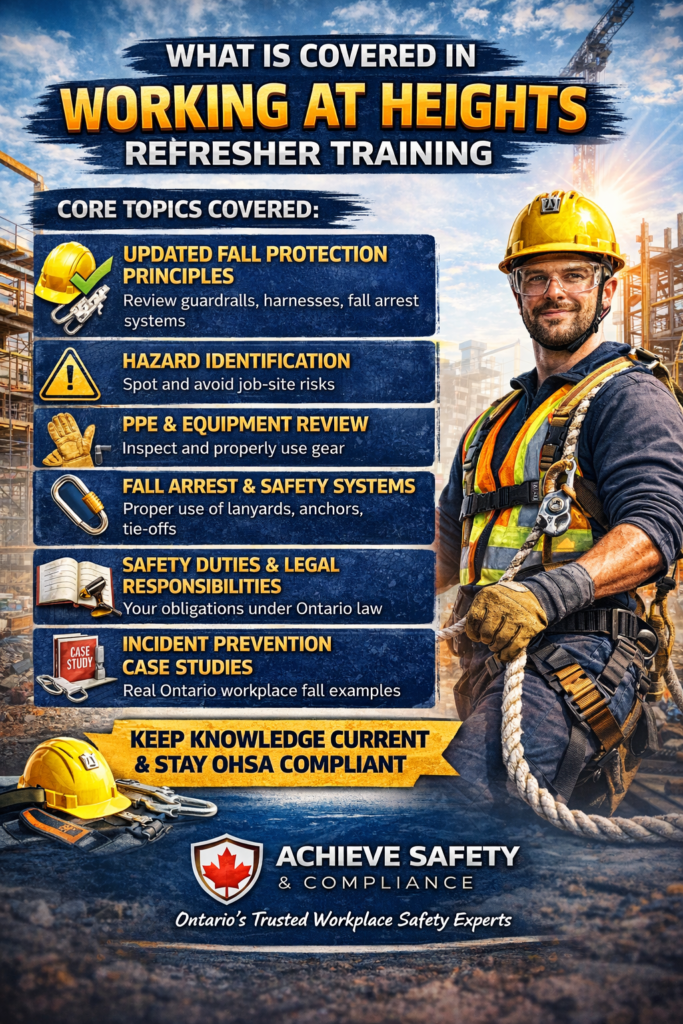
The refresher is designed to reinforce competency, not just repeat theory. It targets the areas where most workplace incidents still occur.
1. Updated Fall Protection Principles
You revisit the fundamentals, but with a stronger focus on real application.
- Types of fall hazards in construction and industrial settings
- Hierarchy of controls for fall prevention
- When to use guardrails, travel restraint, or fall arrest systems
This ensures workers don’t just “know” safety rules but apply them correctly on-site.
2. Hazard Identification & Risk Awareness
One of the most critical sections.
Workers are trained to:
- Recognize evolving job-site hazards
- Identify unsafe work conditions before incidents occur
- Assess risk levels based on environment and task
This section reflects real Ontario job site conditions, not textbook scenarios.
3. Personal Protective Equipment (PPE) Review
Refresher training reinforces proper PPE use because misuse is still a leading cause of injuries.
Key focus areas:
- Full body harness inspection and fit
- Lanyards, lifelines, and connectors
- Anchor point selection and limitations
Workers often realize here that they were using equipment incorrectly.
4. Fall Arrest & Safety Systems
This section focuses on how systems behave in real situations, not just definitions.
You’ll cover:
- How fall arrest systems actually stop a fall
- Swing fall hazards and clearance requirements
- System limitations and failure points
This is where theory connects directly to life-saving outcomes.
5. Safe Work Practices & Procedures
Refresher training emphasizes doing the job safely every time.
Includes:
- Ladder and elevated platform safety
- Working near edges and openings
- Weather-related risks (ice, wind, rain)
- Site-specific safety procedures
This section bridges training with daily job execution.
6. Roles, Responsibilities & Legal Duties
Many workers overlook this, but it’s critical for compliance.
You’ll review:
- Worker responsibilities under Ontario WAH safety laws
- Employer obligations
- Supervisor accountability
This ensures everyone understands who is responsible for what on-site.
7. Incident Prevention & Real Case Scenarios
Modern refresher courses include real-world examples.
- Common causes of falls in Ontario workplaces
- What went wrong in actual incidents
- How proper training could have prevented them
This makes the training practical and memorable.
8. Knowledge Check & Practical Validation
To complete the refresher, you must demonstrate understanding.
- Short assessment or quiz
- Instructor-led discussions
- Practical validation of safe practices
This confirms that workers remain competent, not just certified.
What Makes Refresher Training Different from Full Training?
Refresher training is:
- Faster and more focused
- Based on prior knowledge
- Centered on updates, reinforcement, and real-world application
It is not meant for beginners. It is designed for workers who already completed the full Working at Heights training course in Ontario.
Why This Training Matters More Than Most People Think
Many workers assume refresher training is just a formality.
It is not.
Most fall-related incidents happen because:
- Safety steps were skipped
- Equipment was misused
- Hazards were overlooked
Refresher training directly targets these gaps.
Who Should Take This Course?
You need Working at Heights refresher training if:
- Your certification is approaching the 3-year expiry
- You want to stay compliant with Ontario safety standards
- You are actively working at heights in construction or industrial environments
Final Takeaway
Working at Heights refresher training is not about repeating old lessons.
It is about making sure you can still recognize risks, use equipment correctly, and make safe decisions in real job site conditions.
For those who are not certified yet, Get Certified with a CPO approved Working at Heights certification designed for fast completion and full compliance
That is what keeps workers compliant.
That is what prevents injuries.