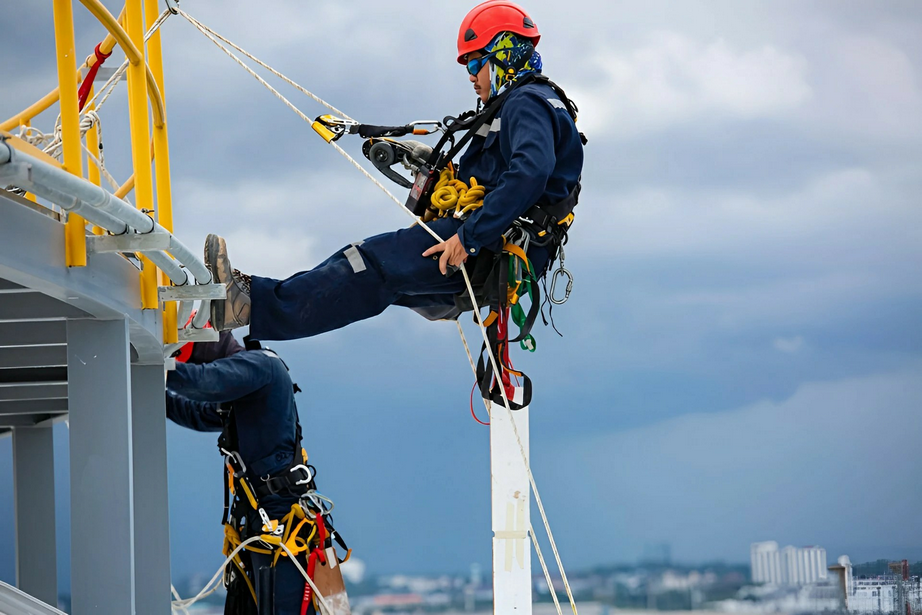
Working at heights is one of the most hazardous activities in construction, and Ontario has strict laws to protect workers from falls.
Under Ontario’s Occupational Health and Safety Act (OHSA), specialized Working at Heights (WAH) training is mandatory for many workers.
In this post, we provide an authoritative overview of Ontario’s working-at-heights training requirements – who must be certified, what the law says (including the 3-metre rule), employer obligations for training and record-keeping, and the penalties for non-compliance.
By understanding these laws, construction owners, safety managers, and HR professionals can keep their teams safe and compliant. (For additional guidance or to arrange certification, see Achieve Safety’s CPO Approved Ontario working at heights training page.)
You will get answers to below questions such as .
-
Is working at heights training mandatory?
-
What does Ontario law require?
-
What is the 3-metre rule?
-
What regulations apply?
What is Working at Heights Training?
Working at Heights training is a province-wide standardized safety program that teaches workers how to prevent falls and use fall protection equipment properly.
In Ontario, this training is approved by the Chief Prevention Officer (CPO) of the Ministry of Labour, meaning it meets strict government standards.
A typical WAH course covers both classroom theory and hands-on practice.
Workers learn about fall hazards, their legal duties and rights, the proper use and inspection of personal protective equipment (like harnesses and lanyards), how to set up travel restraint and fall arrest systems, and what to do in emergencies (including rescue procedures).
This comprehensive approach ensures that anyone working at heights understands how to do so safely and in compliance with Ontario law.
WAH training is not just a one-time lecture – it involves a practical component where workers put on harnesses and simulate using fall protection systems under a trainer’s guidance.
The goal is to give workers first-hand experience with the equipment and safety procedures before they ever face heights on the job.
By the end of the course, workers must pass a written test and a practical evaluation to earn a CPO-issued working at heights certificate in Ontario. This certificate proves they have the core competencies required to work at heights safely.
Why Ontario Mandates Working at Heights Training
Ontario introduced mandatory working-at-heights training to reduce falls, which are a leading cause of workplace injuries and fatalities. Falls from heights – even relatively low heights – are one of the most frequent causes of serious injuries in Ontario workplaces.
In construction especially, tasks often take place on roofs, scaffolds, or ladders where a momentary slip can be deadly.
Prior to the WAH training mandate, lack of proper fall protection training was a common factor in fall incidents. Ontario’s Chief Prevention Officer noted that standardized training was needed across the province to ensure all at-height workers know how to protect themselves.
By making WAH training mandatory, the government aims to create a baseline of knowledge and skill for everyone who works at elevations.
Workers learn why falls happen and how to prevent them, rather than relying solely on personal experience or ad-hoc on-site instruction.
This training helps instill a safety-first attitude. It covers real-life case studies of falls and reinforces the use of appropriate fall protection methods (guardrails, travel restraint, fall arrest devices, etc.).
The end result is a workforce that is more aware of hazards and better equipped to use safety equipment correctly – which directly saves lives and prevents injuries.
When Is Working at Heights Training Legally Required in Ontario?
Working at heights training is legally required in Ontario when specific conditions are met. The requirement is not based on job title. It is based on risk, height, and the type of work being performed.
Under Ontario law, training becomes mandatory when all three elements below are present.
1. The Work Is a Construction Project
Working at heights training is mandatory when the work falls under Ontario’s definition of a construction project.
This includes, but is not limited to:
- New construction
- Renovations and repairs
- Roofing work
- Building maintenance performed as part of a construction project
- Residential, commercial, and industrial construction sites
If the work is governed by the Construction Projects Regulation, the working at heights training requirement applies when fall hazards are present.
2. There Is a Risk of Falling 3 Metres or More
The 3-metre threshold is the key legal trigger.
Training is required when a worker may fall:
- More than 3 metres from an unprotected edge
- Through an opening
- From a roof, platform, scaffold, or similar surface
This applies even if the work is short-term or performed infrequently. Duration of exposure does not remove the requirement.
If the fall risk exists, the training requirement exists.
3. A Fall Protection System Is Required or Used
Working at heights training is legally required when a worker may use any of the following fall protection systems:
- Travel restraint systems
- Fall restricting systems
- Fall arrest systems
- Safety nets
- Work belts or safety belts
If a task requires fall protection under Ontario regulations, the worker must complete approved working at heights training before performing the work.
This is one of the most common enforcement triggers during inspections.
Key Takeaway for Employers
Working at heights training is legally required in Ontario when:
- The work is a construction project
- There is a risk of falling 3 metres or more
- Fall protection systems are required or used
If these conditions are met, training is not optional.
Ensuring workers complete approved working at heights training is one of the most effective ways to meet legal obligations, protect workers, and avoid enforcement action.
Situations Where Training Is Required – Common Working at height hazards
Training is legally required in many everyday construction activities, including:
- Roofing work with exposed edges
- Installing or servicing equipment on elevated surfaces
- Working on mezzanines or open floors
- Using ladders where fall protection is required
- Accessing elevated platforms without full guardrails
- Temporary work at height during renovations
If fall protection is required to perform the task safely, training is required.
Situations That Often Cause Confusion
Some employers incorrectly assume training is not required in these situations:
- Short duration tasks
- Experienced workers
- Heights just over 3 metres
- Occasional or one-time work
Ontario law does not provide exemptions based on experience, seniority, or task duration. The requirement is based on hazard exposure, not worker confidence.
Construction vs Non-Construction Work
For construction projects, the requirement is clear and strictly enforced.
In non-construction workplaces, such as warehouses or industrial facilities, working at heights training under the construction regulation may not be mandatory. However, employers are still required to ensure workers are trained and competent to use fall protection equipment.
In practice, many employers apply the same training standard across all workplaces to demonstrate due diligence.
What Inspectors Look For
During inspections by the Ontario Ministry of Labour, officers commonly verify:
- Whether workers exposed to fall hazards completed approved training
- Whether training is still valid
- Whether training records are available
- Whether workers understand fall protection systems in use
If a fall hazard exists and training cannot be verified, orders or penalties may follow.
Ontario’s Legal Requirements for Working at Heights Training
Who Needs to Be Trained (The 3-Metre Rule)
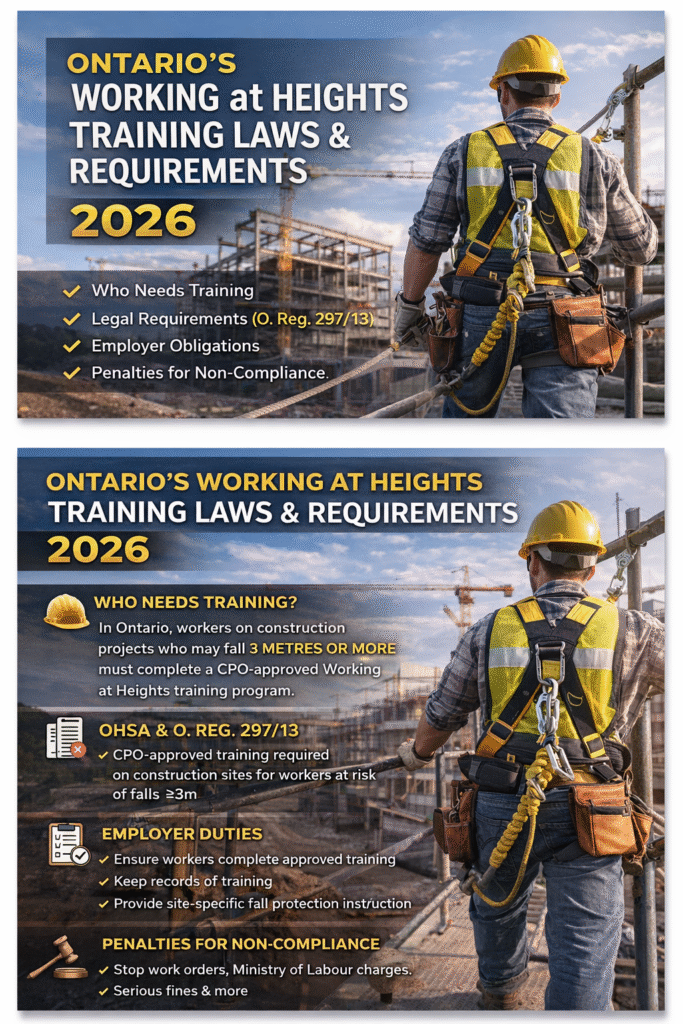
Ontario’s regulations make it crystal clear who must have working-at-heights training. In general, any worker on a construction project who could fall more than 3 metres (approximately 10 feet) is required by law to complete WAH training.
The 3-metre threshold is the trigger point in Ontario’s Construction Projects Regulation (O. Reg. 213/91) for when fall protection is required – and thus when WAH training becomes mandatory.
Practically speaking, this includes most workers who work on roofs, open-edge floors, scaffolding, boom lifts, or any elevated platform above 3 m where a fall hazard exists.
Ontario’s Occupational Health and Safety Awareness and Training Regulation (O. Reg. 297/13) specifically mandates working-at-heights training for these situations.
The law states that an “employer shall ensure that workers on construction projects successfully complete a working at heights training program” if those workers are required to use certain fall protection systems.
In other words, if a worker will be wearing a harness or other fall protection equipment to protect against falls >3m, they must be WAH certified by completing an approved course.
Ontario’s regulation even spells out the types of fall protection methods that trigger the training requirement.
If a worker may use any of the following systems, they need WAH training:
- Travel restraint system – e.g. a leash/lanyard that keeps a worker from reaching a roof edge.
- Fall restricting system – e.g. equipment that limits a fall (often used on ladders).
- Fall arrest system – e.g. a full body harness, lifeline, and anchor that arrests a fall after it begins.
- Safety net – nets set up to catch a falling worker.
- Work belt or safety belt – old-style belts (though in practice, full harnesses are now standard).
If a worker will use ANY of the above on a construction project at heights above 3m, Ontario law says they must be trained.
It’s important to note that this requirement isn’t limited to construction trades like roofers or steelworkers – it can include electricians, HVAC installers, window washers, or general laborers on construction sites if they are exposed to fall hazards.
The key is the nature of the work (construction project) and the fall risk >3m.
(Aside: In other Ontario industries, such as manufacturing or warehousing, WAH training per O. Reg. 297/13 is not explicitly mandated. However, those employers still must provide appropriate fall protection training under other regulations (e.g. Industrial Establishments Reg. 851) if workers use fall arrest equipment. Many companies choose to have their workers complete the same WAH course for consistency, even if not legally required, because it’s considered best practice.)
What the Law Requires (O. Reg. 297/13 and OHSA)
Ontario’s Occupational Health and Safety Act (OHSA) sets the general duty that employers must protect workers and ensure they are trained on any equipment or protective device they use.
The specific Working at Heights training requirement comes from O. Reg. 297/13, which is a regulation under the OHSA focusing on training.
This regulation was introduced in 2015 to formalize WAH training after a high number of fall incidents.
Here are the key legal requirements spelled out:
- Employers must ensure workers complete an approved WAH training program before they perform work at heights. Specifically, “an employer shall ensure that a worker who may use a fall protection system… successfully completes a working at heights training program” approved by the Chief Prevention Officer. In plain terms, you cannot send a worker up on a roof or other high work area (3m+) with a harness unless they’ve taken this training. The training must be completed prior to the worker using fall protection equipment or being exposed to heights.
- The training program must be CPO-approved and delivered by an approved provider. Employers cannot do “DIY” working-at-heights training or simply show workers a video and consider them certified. The program has to meet the government’s Working at Heights Training Program Standard and be taught by a training provider who is approved by Ontario’s Chief Prevention Officer. This ensures consistency and quality. A list of approved WAH training providers is maintained by the Ministry, and Achieve Safety is proud to be among those helping workers get properly certified.
- Training includes both theory and practical components, and typically results in a wallet card or certificate issued to the worker upon successful completion. Employers should keep a copy of this proof.
- WAH training is valid for 3 years. Ontario built in an expiry to ensure workers stay up-to-date. After a worker completes the initial working at heights course, their training expires after three years, and they must take a WAH refresher course to remain certified. The refresher is a shorter course (usually half-day) that reviews key topics and updates workers on any new safety developments. Employers are responsible for tracking when each worker’s WAH certification will expire and ensuring they attend refresher training before that date. If a worker’s training expires and they haven’t done the refresher, they would no longer be considered trained – meaning the employer would be in violation if that person continues to work at heights.
- Employers must maintain training records. Under the law, the employer must keep a record of each worker’s working-at-heights training and be ready to show it to a government inspector on request. In practice, this means you should file copies of the WAH training certificates or cards for all your workers. Good record-keeping is essential: if an inspector visits your site and asks for proof that your crew has valid WAH training, you need to produce it immediately. Failing to provide records can result in orders or penalties. (It’s wise to also record the expiry dates so you can proactively send workers for refresher training every 3 years.)
- Site-specific instruction is also required. The standardized WAH course provides general knowledge, but Ontario regulations also demand that employers give workers site-specific training and instructions about fall hazards at their particular job site. This means even after a worker has their WAH certificate, the employer/supervisor must: identify the specific fall hazards on that project, review the fall protection equipment and procedures that will be used there, and ensure the worker understands how to work safely in that environment. Think of it as an on-site orientation or toolbox talk focusing on fall safety. For example, if a certified worker is going to work on a unique scaffold or anchor system, you must train them on those specifics. The WAH law doesn’t replace this duty – it complements it. Both the general WAH training and the site-specific training are required for full compliance.
In summary, Ontario law requires employers to proactively ensure all at-risk workers are trained and competent in fall prevention.
Below is a checklist of employer obligations under the working at heights training laws:
- Provide CPO-Approved Training: Make sure any worker who may work at heights >3m successfully completes a CPO-approved Working at Heights training program before they start such work. Only use approved training providers.
- Use Approved Providers: Verify that the training provider is approved by Ontario’s Chief Prevention Officer to deliver the WAH program (as required by law).
- Maintain Proof of Training: Keep records of each worker’s WAH training (copies of certificates or ID cards and training dates). You must produce these records to an OHSA inspector on demand.
- Enforce the 3-Year Refresher: Track expiry dates and ensure every worker retakes an approved WAH refresher course every 3 years. Refreshers extend their certification for another three years. (If a worker’s training lapses, pull them off any heights work until they are re-certified.)
- Provide Site-Specific Training: In addition to the generic course, train workers on the specific fall hazards, equipment, and procedures at your job site. For each project, conduct a fall hazard assessment and review the fall protection plan with workers (e.g. where the anchor points are, how to use the particular lifeline system, rescue plan, etc.). Document this training as well.
- Supervise and Enforce Safe Practices: Ensure that trained workers actually use the fall protection equipment and methods as they were taught. Training is only effective if followed; supervision and enforcement of safety rules (like always wearing the harness and tying off at 100% tie-off) are part of the employer’s legal obligation under OHSA.
By following the above, employers will fulfill the core requirements of Ontario’s WAH training laws and significantly reduce the risk of falls at their worksites.
Updates to Training Standards (2024)
Ontario continuously evaluates its training programs to make sure they remain effective. In fact, recent updates were made to the Working at Heights training standards, effective April 1, 2024.
After a five-year review of the program, the Ministry announced enhancements to both the content of the training and the qualifications for providers.
Some of the key changes in the 2024 WAH Program Standard include added emphasis on ladders and skylights as fall hazards, inspection of damaged equipment, and ensuring training is delivered in an inclusive, accessible way.
The WAH Training Provider Standard was also updated (e.g. stricter instructor qualifications and integrating anti-racism and inclusivity principles for trainers).
For Ontario employers, the main takeaway is that any new WAH training after April 1, 2024 will include this updated content, and new providers must meet the updated criteria.
Workers with existing valid training are not immediately affected – their training is still good until it expires. When they take their 3-year refresher or a new worker takes the course, it will be to the 2024-upgraded standard.
Achieve Safety stays up-to-date with these changes, ensuring that our trainings reflects the latest requirements. The periodic updates to the standard underscore Ontario’s commitment to keeping workers safe through relevant education.
Penalties for Non-Compliance of WAH
The legal consequences for failing to comply with Ontario’s working-at-heights training requirements can be severe – both for individuals and for businesses. The OHSA is enforced by the Ministry of Labour, and inspectors have strong powers to address non-compliance.
If a worker is found working at heights without proper training or fall protection, an inspector can issue stop-work orders on the spot, shutting down part or all of the job until the issue is fixed. They can also issue orders requiring the employer to comply (e.g. to train the worker) before work resumes.
More seriously, violating the OHSA or its regulations (like O. Reg. 297/13 or the Construction Reg. 213/91) is an offence that can lead to prosecution in court.
Both the employer (as a corporation) and individuals (such as a supervisor or director, or even a worker) can be charged. Convictions carry heavy fines and even jail time under the Act.
As of recent updates, Ontario has some of the stiffest OH&S penalties in Canada. Here are the maximum penalties upon conviction:
- Individual (e.g. business owner, supervisor, or worker): Up to $500,000 fine per offence and/or up to 12 months imprisonment. (The fine for individuals was increased from $100k to $500k in 2022 to deter safety violations.)
- Corporation (employer company): Up to $2,000,000 fine per offence. (This maximum was raised from $1.5 million to $2 million in late 2023, reflecting Ontario’s zero tolerance for companies that neglect safety.)
These are the upper limits; actual fines for a given case depend on factors like the severity of the violation, whether it resulted in injury or death, and any prior convictions.
But even “routine” fall protection violations often result in five- or six-figure fines, especially if someone is hurt.
For example, in one recent case, an Ontario home renovation company pleaded guilty after a worker without fall protection or training fell to their death, and the court imposed a $100,000 fine on the employer.
In that tragedy, the worker had not completed the mandatory WAH training, and the employer had failed to ensure the use of fall protection at over 3 metres – a clear breach of the law.
Besides fines, being convicted under OHSA can damage a company’s reputation and morale. Company directors and officers can face personal fines or jail in egregious cases (for instance, if a lack of training or safety measures leads to a fatality, a director can be fined up to $1.5 million in a special category of offence). Ministry of Labour prosecutors and judges are increasingly emphasizing that corners-cutting on training and safety will not be tolerated.
It’s also worth noting that the Ministry of Labour conducts proactive enforcement blitzes focusing on falls and training compliance. Inspectors do unannounced field visits and check if workers at heights have their training.
In 2025, for example, the Ministry ran a campaign targeting residential construction (housing and re-roofing sites) and specifically looked at whether workers had valid WAH training and were using ladders and fall protection properly.
This means you might be following up a roof one day and see an inspector on site asking to see your credentials or training records. If you’re not in compliance, you could face immediate orders to halt work, along with tickets or charges.
In short: non-compliance is not worth the risk, financially or morally. The cost of training is minor compared to the cost of a serious accident or a legal penalty.
Stay Safe and Compliant
Ontario’s working at heights training requirements are designed to save lives – and as an employer or supervisor, it’s your legal duty to comply.
By ensuring every worker who needs fall protection is properly trained and certified, you’re not only obeying the law but also investing in a safer workplace culture.
Remember the key points: anyone working at heights over 3 metres on a construction project must have WAH training, the training must be CPO-approved, and it must be kept up-to-date every 3 years. As we’ve outlined, failing to meet these requirements can lead to steep penalties and, far worse, exposes workers to deadly risk.
The good news is that help is available. Ontario has many approved training providers ready to deliver quality working-at-heights courses.
Achieve Safety is committed to helping businesses meet and exceed these safety requirements. Our team brings first-hand expertise – we’ve worked on construction sites and understand the real-world challenges.
We offer guidance on when training is needed, how to schedule it, and how to keep proper records so you’re always prepared for an inspector visit.
Ontario’s laws are clear and actively enforced, but with the right training partner, compliance is straightforward. By prioritizing working at heights training, you protect your employees and your business.
Sources:
-
Occupational Health and Safety Act, R.S.O. 1990, and O. Reg. 297/13 (Occupational Health and Safety Awareness and Training) – Ontario’s regulations mandating working at heights training.
-
O. Reg. 213/91 (Construction Projects), s.26.2 – Requirement that workers >3m have fall protection and training.
-
Infrastructure Health & Safety Assn. – Mandatory WAH training overview (CPO-approved training, 3-year refresher).
-
Workers Health & Safety Centre – Case study of fall fatality and training lapse (legal outcome).
-
Ministry of Labour News Release / Hicks Morley Update – 2024 changes to WAH training standards.
-
Littler LLP – OHSA penalty increases (effective 2022) – fines up to $500k for individuals.
-
IHSA Safety Bulletin – OHSA penalty increases (2023) – fines up to $2M for corporations.