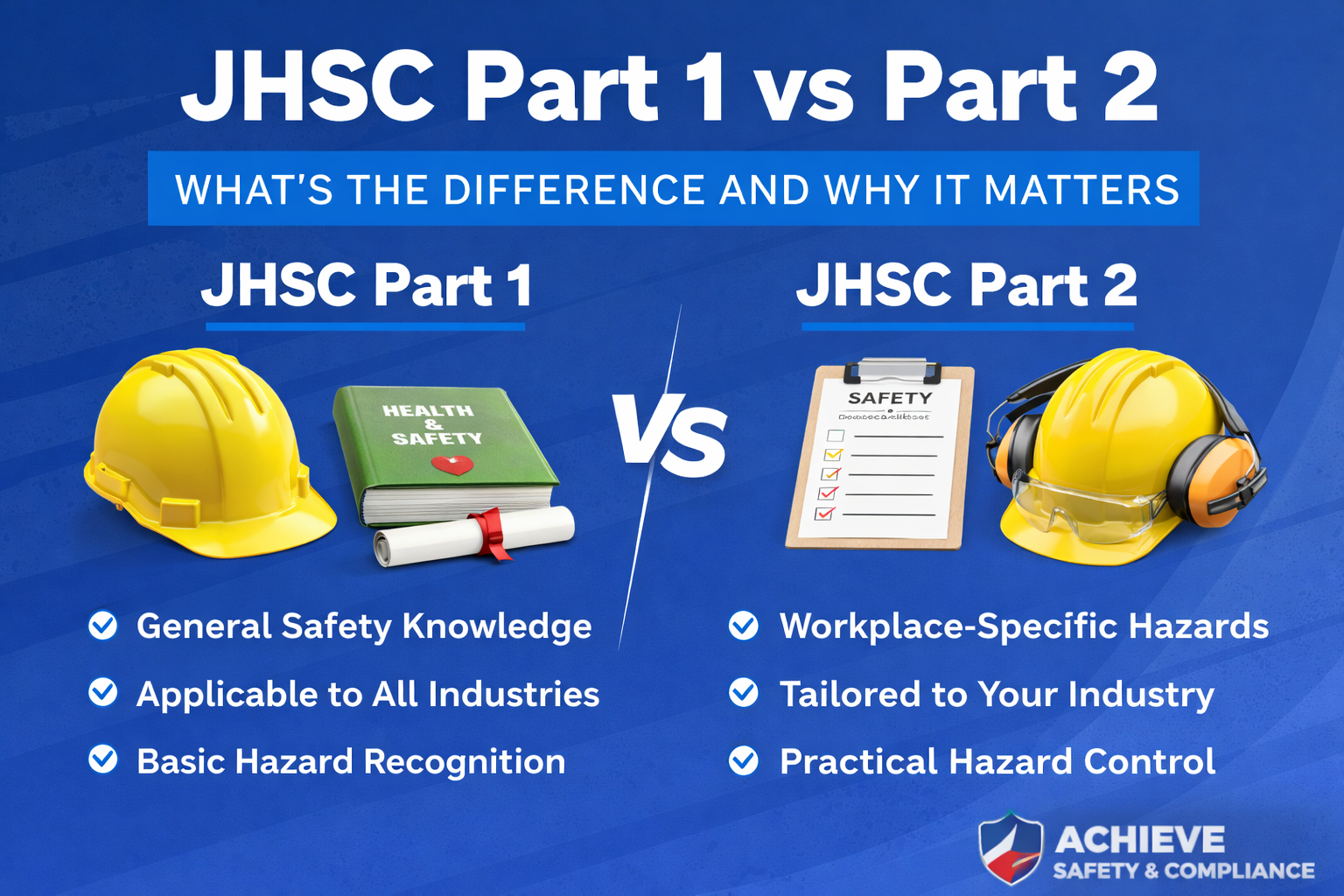
If you are trying to understand JHSC training in Ontario, this is where most confusion happens.
Many employers assume Part 1 is enough.
Others delay Part 2 because they do not fully understand what it covers.
The reality is simple:
JHSC certification in Ontario is a two-step process.
Both Part 1 and Part 2 are required to become a fully certified Joint Health and Safety Committee member.
If you skip one, you are not compliant.
- What Is JHSC Part 1 Training?
- What Part 1 Covers
- What Is JHSC Part 2 Training?
- What Part 2 Covers
- JHSC Part 1 vs Part 2 (Side-by-Side Comparison)
- Real Workplace Examples (Where the Difference Becomes Clear)
- Example 1: Warehouse Environment
- Example 2: Construction Site
- Example 3: Manufacturing Facility
- When Is Each Training Required?
- Part 1 Requirements
- Part 2 Requirements
- Important Compliance Note
- Why the Difference Actually Matters
- If You Stop at Part 1
- When You Complete Part 2 Properly
- Common Mistakes Employers Make
- 1. Delaying Part 2 Training
- 2. Choosing Generic Training
- 3. Treating Training as a One-Time Task
- 4. Selecting the Wrong Committee Members
- Final Takeaway
What Is JHSC Part 1 Training?
JHSC Part 1 is the foundation of certification.
It focuses on general workplace safety principles that apply across all industries.
Think of it as the “why and how” of workplace safety.
What Part 1 Covers
- Overview of the Occupational Health and Safety Act (OHSA)
- Roles and responsibilities of employers, supervisors, and workers
- The Internal Responsibility System
- Hazard recognition basics
- Types of workplace hazards
- Basic risk control methods
- How JHSC committees function
- Workplace inspections and reporting
Part 1 gives committee members the ability to recognize hazards and understand their role in the system.
What Is JHSC Part 2 Training?
JHSC Part 2 builds on Part 1.
It is workplace-specific and focused on real hazards your team actually deals with.
Think of it as the “application” stage.
What Part 2 Covers
- Industry-specific hazards
- Equipment-related risks
- Workplace-specific procedures
- Advanced hazard controls
- Real-world case scenarios
- Applying hazard assessment in your environment
Part 2 turns theory into practical decision-making skills.
JHSC Part 1 vs Part 2 (Side-by-Side Comparison)
| Category | JHSC Part 1 Training | JHSC Part 2 Training |
|---|---|---|
| Purpose | General safety knowledge | Workplace-specific application |
| Focus | Laws, roles, hazard basics | Real hazards in your workplace |
| Scope | Applies to all industries | Tailored to your industry |
| Skills Developed | Hazard recognition | Hazard control and decision-making |
| Timing | First step in certification | Completed after Part 1 |
| Requirement | Mandatory | Mandatory for full certification |
| Outcome | Foundational knowledge | Practical safety competence |
Real Workplace Examples (Where the Difference Becomes Clear)
Understanding the difference is easier when you look at real situations.
Example 1: Warehouse Environment
Part 1 Insight
A worker learns that forklifts are a hazard and understands general safety responsibilities.
Part 2 Application
The same worker now identifies:
- blind spots in aisles
- unsafe stacking practices
- pedestrian and forklift interaction risks
They can now recommend specific control measures, not just identify the problem.
Example 2: Construction Site
Part 1 Insight
A committee member understands fall hazards and legal responsibilities.
Part 2 Application
They assess:
- improper harness use
- anchor point issues
- ladder positioning on uneven ground
They move from awareness to active prevention.
Example 3: Manufacturing Facility
Part 1 Insight
Workers learn machinery can create pinch points and crush hazards.
Part 2 Application
They evaluate:
- specific machine guarding gaps
- lockout/tagout failures
- maintenance procedures
They now help prevent incidents before they occur.
Insight from Tyler Di Cristofaro – Most workplaces already know what their hazards are. The real value of Part 2 is teaching people how to deal with them properly. That is where you start seeing actual safety improvements.
When Is Each Training Required?
Understanding timing is critical for compliance.
Part 1 Requirements
- Must be completed first
- Required for all certified JHSC members
- Provides the base knowledge needed to move forward
Part 2 Requirements
- Completed after Part 1
- Required to become fully certified
- Must reflect actual workplace hazards
Important Compliance Note
If a worker has only completed Part 1:
👉 They are not considered fully certified
Employers must ensure both parts are completed within a reasonable timeframe to meet Ontario requirements.
Why the Difference Actually Matters
Many employers treat JHSC training as a compliance task.
That is where problems start.
If You Stop at Part 1
- Committee members understand theory
- Hazard identification stays surface-level
- Recommendations lack detail
- Safety improvements stall
When You Complete Part 2 Properly
- Hazards are identified earlier
- Controls are more practical
- Inspections become more effective
- Incidents are reduced
Insight from Tyler Di Cristofaro – The gap between Part 1 and Part 2 is where most workplaces lose momentum. When both are done properly, the committee actually starts functioning the way it should.
Common Mistakes Employers Make
1. Delaying Part 2 Training
Leads to incomplete certification and compliance gaps.
2. Choosing Generic Training
Part 2 should reflect your workplace, not a generic environment.
3. Treating Training as a One-Time Task
Certification requires:
- Part 1
- Part 2
- Refresher every 3 years
4. Selecting the Wrong Committee Members
The effectiveness of training depends heavily on who takes it.
Final Takeaway
JHSC Part 1 and Part 2 are not interchangeable.
They work together.
- Part 1 builds understanding
- Part 2 builds capability
If you want a committee that actually improves safety, you need both.
Lets get started with part 1, book your JHSC Part 1 Certification course in Ontario at Achieve Safety Today.