
CSA B335-15 is one of the most misunderstood safety standards in Canadian workplaces. Many employers ask the same question:
Is CSA B335-15 mandatory, or is it just a best-practice guideline?
The short answer is this:
CSA B335-15 is not a regulation by itself, but in practice it functions as a mandatory compliance standard when pallet walkies are used in the workplace.
Understanding why requires looking at how Canadian workplace safety law actually works.
KEY POINTS:
-
Scope of CSA B335-15: Covers forklift operator training, safe practices, equipment inspections, and employer supervision for pallet walkies.
-
Technically “Best Practice”: The standard is not a law written into legislation but serves as the industry benchmark.
-
Performance-Based Law: Canadian safety laws require “every reasonable precaution”; CSA standards define what “reasonable” looks like.
-
The Benchmark for Inspectors: Ministry of Labour inspectors use the standard to evaluate if an employer has met their legal duty.
- What CSA B335-15 Covers
- Is CSA B335-15 a Law?
- How CSA B335-15 Fits Into Canadian Workplace Safety Law
- Why Inspectors Rely on CSA B335-15
- WHAT INSPECTORS EVALUATE
- Mandatory vs Recommended: The Practical Reality
- Employer Responsibilities Under CSA B335-15
- CSA B335-15 and Due Diligence
- Why Employers Treat CSA B335-15 as Required
- What This Means for Your Workplace
What CSA B335-15 Covers
CSA B335-15 is the Canadian Standards Association standard for low-lift and high-lift truck operator safety, including pallet walkies and similar powered pallet trucks.
The standard defines:
- Operator training and competency requirements
- Safe operating practices
- Equipment inspection expectations
- Employer responsibilities for supervision and instruction
It exists to reduce injuries related to pallet walkie operation, which are among the most common causes of foot injuries, struck-by incidents, and warehouse collisions.
Is CSA B335-15 a Law?
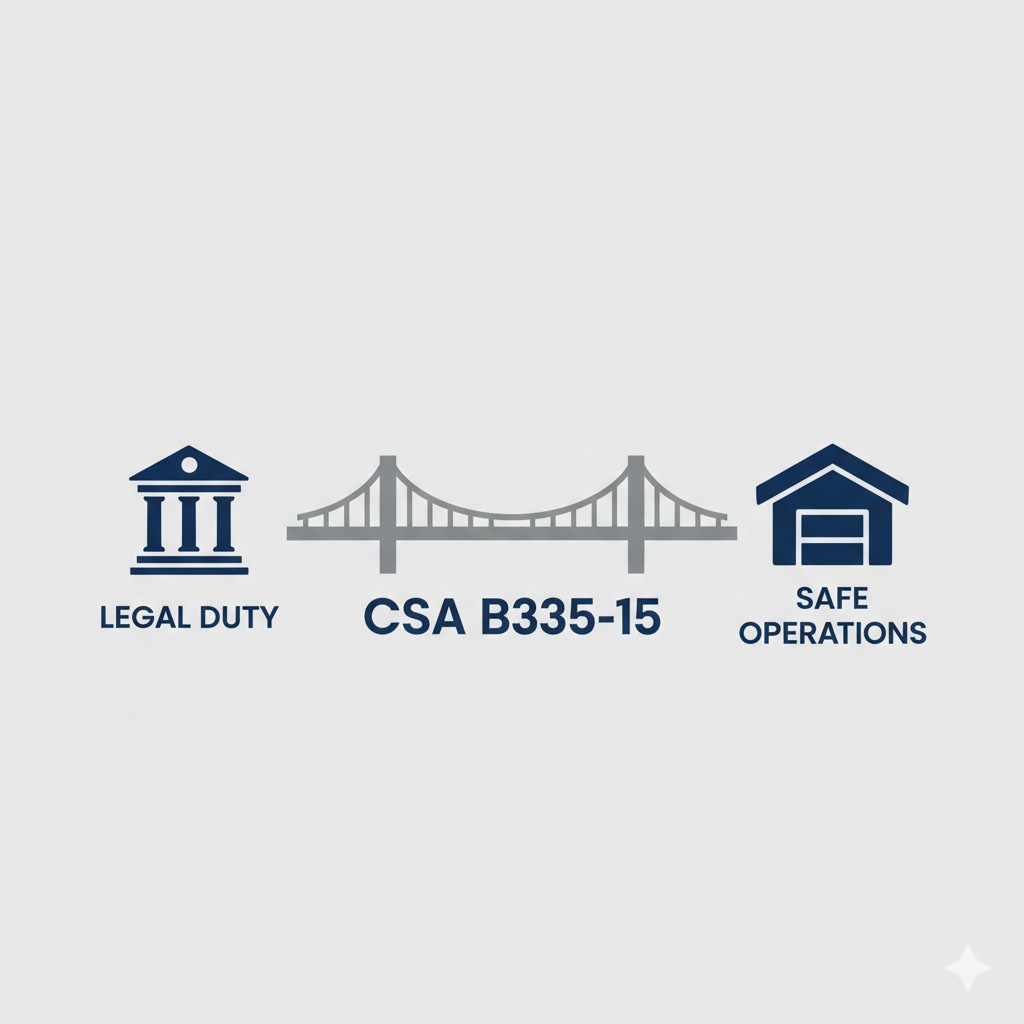
No. CSA B335-15 is not a regulation written directly into legislation.
However, this does not mean employers can ignore it.
In Canada, most occupational health and safety laws work on a performance-based model, not a checklist model.
That distinction matters.
How CSA B335-15 Fits Into Canadian Workplace Safety Law
Canadian workplace safety law, including Ontario’s Occupational Health and Safety Act, does not list every specific training course or operating rule an employer must follow.
Instead, the law requires employers to:
- Take every reasonable precaution to protect workers
- Ensure workers are trained and competent to safely operate equipment
- Provide information, instruction, and supervision appropriate to the hazards
CSA standards exist to define what “reasonable precaution” actually looks like in practice.
When a recognized CSA standard exists for a specific hazard or piece of equipment, inspectors, courts, and safety professionals treat it as the expected benchmark.
In other words:
CSA B335-15 explains how an employer can prove they met their legal duty.
Why Inspectors Rely on CSA B335-15
During a Ministry of Labour inspection or investigation, inspectors typically ask:
- Were workers trained to operate the equipment safely?
- Was that training appropriate for the equipment used?
- Can the employer demonstrate due diligence?
CSA B335-15 provides a clear, nationally recognized answer to those questions.
If an incident occurs involving a pallet walkie and the employer cannot show training aligned with CSA B335-15, it becomes very difficult to defend the safety program.
This is why CSA B335-15 is commonly referenced in:
- Inspection orders
- Incident investigations
- Due diligence assessments
- Employer safety audits
WHAT INSPECTORS EVALUATE
A checklist showing inspection criteria: training records, competency proof, and documented equipment inspections.

Mandatory vs Recommended: The Practical Reality
From a legal and enforcement standpoint, CSA B335-15 operates in a grey area that employers must understand.
Technically:
- CSA B335-15 is recommended as a standard
Practically:
- Following CSA B335-15 is often the only defensible way to show compliance
If a worker is injured while operating a pallet walkie and the employer did not provide CSA-aligned training, the employer may still be found in violation of occupational health and safety law.
Courts and inspectors do not ask whether a CSA standard was legally mandated.
They ask whether the employer followed recognized industry standards.
CSA B335-15 is a standard for pallet walkies.
Employer Responsibilities Under CSA B335-15
Employers using pallet walkies should ensure the following are in place:
- Operators receive formal training aligned with CSA B335-15
- Training includes both theory and practical evaluation
- Operators are competent before operating independently
- Refresher training is provided when required
- Equipment inspections are documented
- Unsafe operation is corrected through supervision
Failing to meet these expectations may expose employers to enforcement action, even if no specific regulation mentions CSA B335-15 by name.
CSA B335-15 and Due Diligence
Due diligence is a legal defence under Canadian workplace safety law.
To rely on it, an employer must show they:
- Identified the hazard
- Implemented appropriate controls
- Trained workers properly
- Enforced safe work practices
CSA B335-15 helps employers demonstrate all four.
When training aligns with this standard, it becomes much easier to show that reasonable precautions were taken.
Without it, employers are often left relying on informal training or undocumented instruction, which rarely holds up during inspections or investigations.
Why Employers Treat CSA B335-15 as Required
Most safety professionals, insurers, and auditors treat CSA B335-15 as the baseline for pallet walkie operation.
Reasons include:
- Consistency across provinces
- Clear expectations for training content
- Alignment with inspector enforcement practices
- Reduced liability exposure
This is why many organizations make CSA-aligned pallet walkie training a non-negotiable internal requirement, even if the standard itself is not written into law.
What This Means for Your Workplace
If your workplace uses pallet walkies, the question is not whether CSA B335-15 is mandatory.
The real question is:
Can you justify not following it if something goes wrong?
For most employers, the answer is no.
Providing training that aligns with CSA B335-15 is one of the clearest ways to protect workers, demonstrate due diligence, and reduce risk.