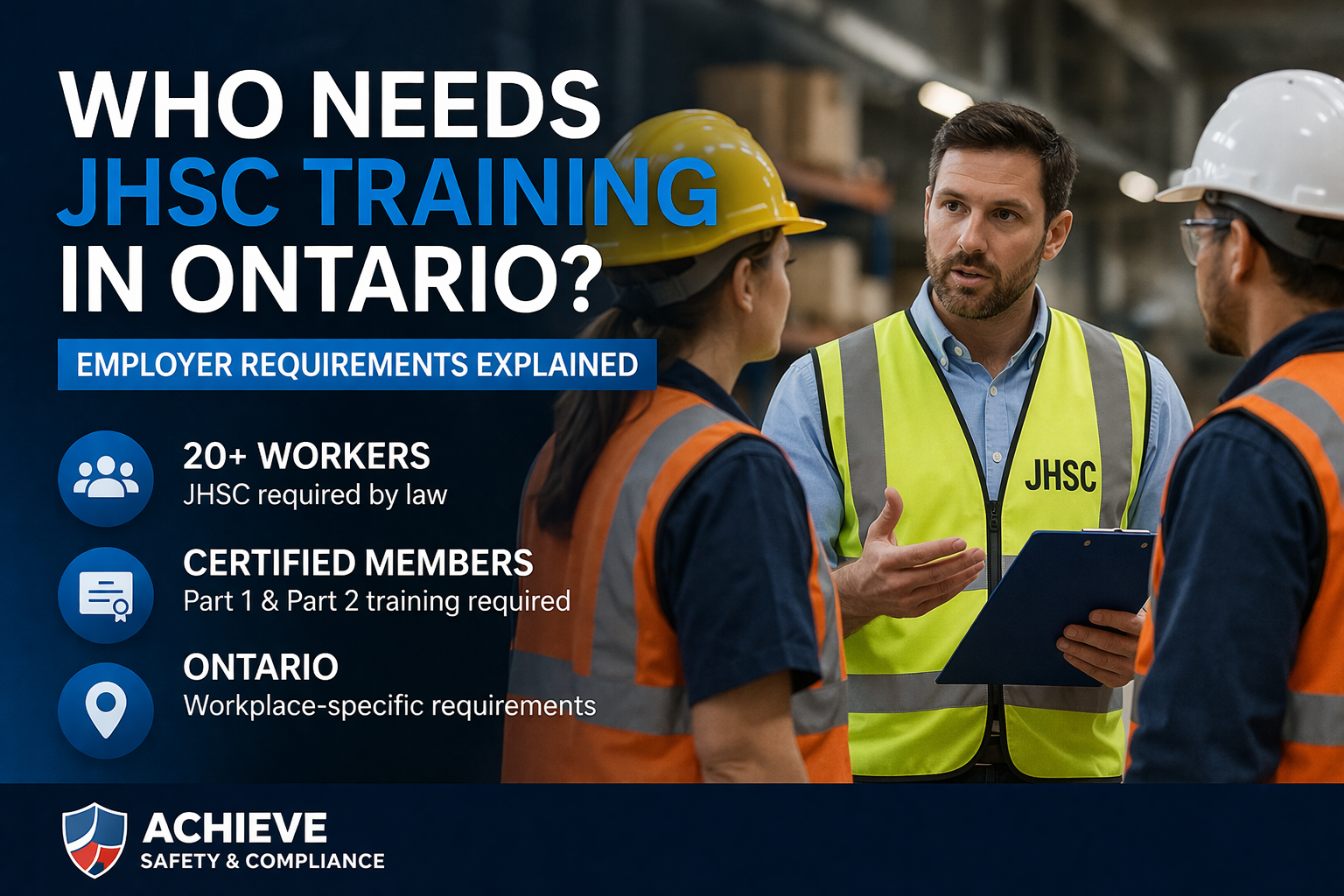
- Understanding Joint Health and Safety Committees (JHSC) in Ontario
- What is a JHSC and Why is it Important?
- Employer Obligations: What the Law Requires
- What “Certified JHSC Member” Actually Means
- Industries Where JHSC Training Is Commonly Required
- Real Workplace Scenarios
- When JHSC Training Becomes Mandatory
- What Happens If You Don’t Comply?
- How to Stay Compliant (Simple Checklist)
- Why This Matters Beyond Compliance
If you are running a business in Ontario, one question comes up quickly once your team grows:
Do we need JHSC training, or not yet?
This is where many employers get it wrong.
Some assume safety training is optional. Others delay it until an inspection forces the issue. The reality is more direct:
JHSC training in Ontario is not optional once your workplace meets certain size and risk thresholds.
Understanding exactly where your business fits is the first step to staying compliant and avoiding unnecessary risk.
Understanding Joint Health and Safety Committees (JHSC) in Ontario
A safe workplace is a shared responsibility. In Ontario, the Joint Health and Safety Committee (JHSC) is a vital mechanism that embodies this principle, fostering collaboration between workers and management to proactively identify and address health and safety concerns. Understanding what a JHSC is and why it’s legally mandated is the first step for any employer aiming to create a safer work environment.
What is a JHSC and Why is it Important?
A Joint Health and Safety Committee (JHSC) is a committee composed of both worker and management representatives from a specific workplace. Its primary function is to provide a structured forum for employees and employers to work together on health and safety issues. By bringing diverse perspectives to the table,
JHSCs help to:
- Identify Hazards: Proactively identify potential dangers and risks in the workplace before incidents occur.
- Recommend Solutions: Develop practical recommendations for preventing workplace injuries and illnesses.
- Promote Safety Culture: Foster a workplace culture where health and safety are prioritized by everyone.
- Improve Communication: Enhance communication channels between workers and management on health and safety matters.
- Ensure Compliance: Help the workplace adhere to Ontario’s Occupational Health and Safety Act (OHSA).
The collaborative nature of a JHSC is its strength. Worker members bring first hand knowledge of workplace conditions, while management members have the authority to implement changes. This partnership is crucial for effective risk management and creating a truly safe environment for all employees.
Legal Basis: Ontario’s Occupational Health and Safety Act (OHSA)
The requirement for Joint Health and Safety Committees and their certified members is enshrined in Ontario’s Occupational Health and Safety Act (OHSA). Specifically, Section 9 of the Act mandates the establishment of JHSCs in certain workplaces, and Section 7 outlines the composition and functions. Further regulations, such as Regulation 854, specify the composition and requirements for JHSCs.
The introduction of Bill 127 in recent years further underscored the importance of these committees and the necessity of certified training for their members, reinforcing the legal obligation for employers to establish and maintain these vital safety bodies. Compliance with these regulations is not just a legal requirement; it’s a fundamental aspect of protecting your workforce and avoiding significant penalties.
Employer Obligations: What the Law Requires
As an employer in Ontario, ensuring a safe workplace is a legal duty. Establishing and supporting a Joint Health and Safety Committee (JHSC) is a critical component of meeting these obligations. Understanding when a JHSC is required, its proper composition, and the necessity of certified training is paramount.
Establishing a JHSC (When is it Mandatory?)
The OHSA mandates that employers establish a JHSC based on the size of their workforce:
- Workplaces with 20 or more workers: A JHSC must be established.
- Workplaces with 6 to 19 workers: A health and safety representative (or representatives) from the workers must be designated. While not a full committee, they have specific duties related to health and safety.
- Workplaces with fewer than 6 workers: The employer must ensure that health and safety of workers is discussed at a meeting between the employer and the worker(s) at least three times a year.
Note: Specific industries may have additional or slightly different requirements. Always refer to the latest OHSA regulations and guidance from the Ministry of Labour, Immigration, Training and Skills Development (MLITSD) for the most current information.
Committee Membership Requirements
Once established, a JHSC must have a specific composition:
- Representation: The committee must have at least two members.
- Worker and Management Representation: At least half of the members must be worker representatives who are employees of the workplace and not management. The remaining members must be management representatives who are appointed by the employer.
- Certified Members: Crucially, for most workplaces requiring a JHSC, at least one worker member and at least one management member must be certified JHSC members. This certification requires successful completion of an approved JHSC Certification Training Program, which includes both Part 1 and Part 2.
The Role of JHSC Certification Training
Employer obligation extends beyond just forming a committee; it includes ensuring that committee members receive the proper, legally recognized training. The JHSC Certification Training Program is designed to equip committee members with the knowledge and skills to effectively identify hazards, recommend controls, and contribute to a safer workplace. Employers are responsible for:
- Ensuring Training: Arranging for and paying for JHSC Certification Training (Part 1 and Part 2) for at least one worker and one management member.
- Record Keeping: Maintaining records of JHSC member certifications.
- Supporting Committee Function: Allowing JHSC members time to perform their duties (inspections, meetings) and implementing their recommendations where feasible.
Failure to comply with JHSC establishment and training requirements can result in significant penalties, including orders to comply, and substantial fines.
Insight from Tyler Di Cristofaro – Most employers don’t run into issues because they ignore safety. They run into issues because they don’t realize when their legal obligations change as they grow.
What “Certified JHSC Member” Actually Means
This is where confusion usually happens.
A certified member is not just someone listed on a committee.
They must complete:
- JHSC Part 1 Training
- JHSC Part 2 Training
- Refresher training every 3 years
Without all three, the member is not fully certified.
Industries Where JHSC Training Is Commonly Required
While the rule is based on worker count, certain industries almost always require JHSC training due to size and risk level.
High Priority Industries
- construction
- manufacturing
- warehousing and logistics
- transportation
- food production
- industrial operations
Growing Businesses That Often Overlook It
- property maintenance companies
- landscaping crews
- service-based businesses scaling past 20 employees
- retail or distribution operations
These businesses often cross the 20-worker threshold without realizing the compliance shift
Real Workplace Scenarios
Scenario 1: Growing Construction Company
A company expands from 15 to 25 workers.
- Before: health and safety representative
- After: full JHSC required
If they do not update their structure:
Scenario 2: Warehouse Scaling Operations
A warehouse hires seasonal staff and exceeds 20 workers.
- JHSC now required
- Certified members must be trained
Scenario 3: Multi-Location Business
A company has:
- 10 workers at one location
- 15 at another
Each workplace is assessed separately.
When JHSC Training Becomes Mandatory
JHSC training becomes required when:
- your workplace has 20 or more workers
- you must have a JHSC
- you must have certified members on that committee
This triggers the need for:
- JHSC Part 1 training
- followed by Part 2 training
What Happens If You Don’t Comply?
Ignoring JHSC requirements creates real risk.
Potential Consequences
- Ministry of Labour inspections
- orders to comply
- fines and penalties
- increased liability after incidents
- weakened due diligence defense
Hidden Risk Most Employers Miss
Even without fines:
- incident investigations become harder to defend
- documentation gaps appear
- safety systems become inconsistent
How to Stay Compliant (Simple Checklist)
If you want a quick way to assess your situation:
Step 1
Confirm total worker count at each workplace
Step 2
Determine if JHSC is required
Step 3
Select:
- worker representative
- management representative
Step 4
Enroll them in:
- JHSC Part 1
- JHSC Part 2
Step 5
Track certification expiry (3-year refresher)
Get in touch with Achieve Safety and compliance experts for OHSA compliance , audits & safety net packages. Ensure full WHMIS, OHSA compliance with Achieve Safety’s detailed audits & gap assessments for Ontario workplaces.
Why This Matters Beyond Compliance
JHSC training is not just a legal requirement.
When done properly, it improves:
- hazard identification
- communication between workers and management
- inspection quality
- incident prevention
- overall workplace safety culture
Insight from Tyler Di Cristofaro
The goal isn’t just to meet requirements. It’s to build a system where safety issues are identified early and handled properly. That’s where training actually pays off.