- What is Working at Heights Refresher Training?
- Working at Heights Renewal Checklist (Ontario)
- When Is Working at Heights Refresher Training Required?
- What Is Working at Heights Recertification?
- What Does the Working at Heights Refresher Course Include?
- What Happens If Working at Heights Certification Is Not Renewed?
- Can You Work While Waiting for Refresher Training?
- Employer Risks of Failing to Renew Working at Heights Training
- When Should Employers Schedule Refresher Training?
- Renew Your Certification Through a CPO-Approved Working at Heights Refresher Course
- Frequently Asked Questions: Working at Heights Refresher & Renewal
- Compliance Takeaway
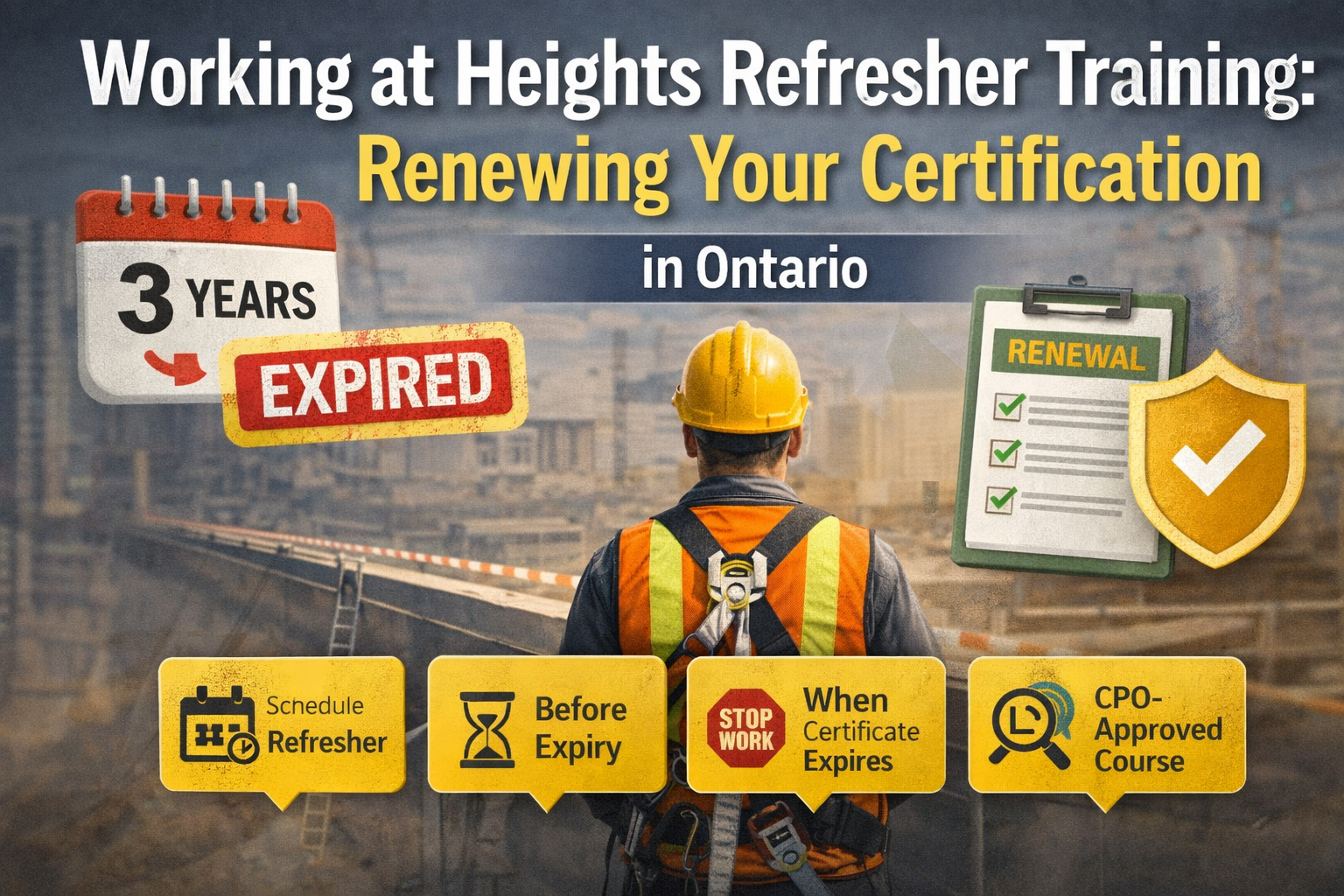
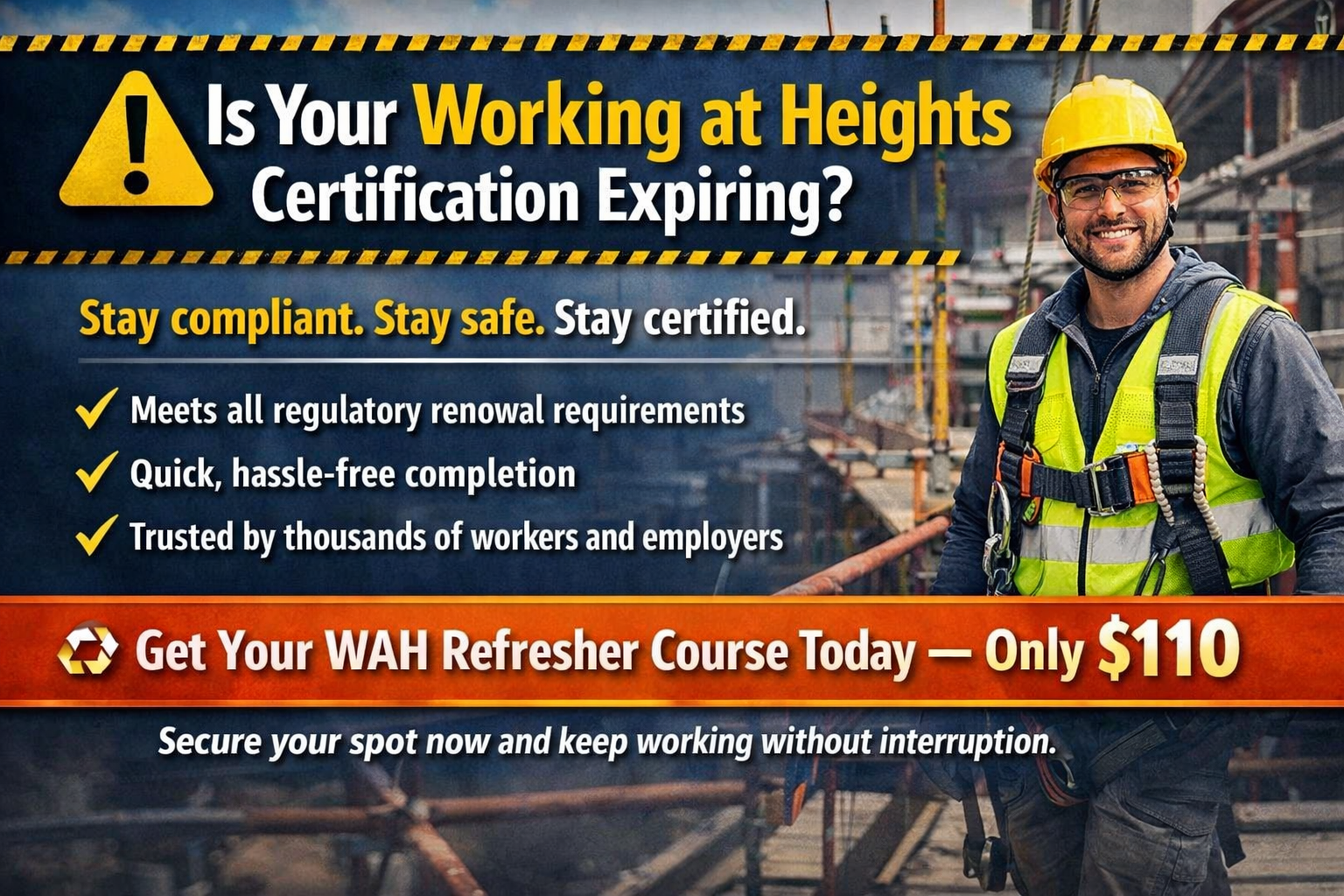
Working at Heights certification in Ontario is valid for three years. Before the certificate expires, workers must complete a CPO-approved refresher course to remain legally compliant on construction projects. If certification expires, workers must stop working at height until refresher training is completed.
What is Working at Heights Refresher Training?
Working at Heights certification does not last indefinitely. In Ontario, certification expires after three years, and refresher training is required to maintain compliance.
Many employers complete initial training but overlook renewal timelines. Expired certification can lead to work stoppages, inspection orders, and project delays.
WAH Refresher course ensures workers remain legally authorized to perform work at height on construction projects.
Working at Heights Renewal Checklist (Ontario)
To remain compliant, employers should confirm the following:
- Certification was completed through a CPO-approved provider
- The three-year validity period has not expired
- Refresher training is scheduled before expiry
- Workers with expired certification are removed from work at height
- Updated certificates are accessible during inspections
- Training records are maintained and monitored
Failure to meet any of the above may result in non-compliance.
When Is Working at Heights Refresher Training Required?
Refresher training is required:
- Before the three-year certification expiry date
- When certification has expired
- When an employer requires updated compliance verification
There is no grace period after expiry. If the certificate expires, the worker must not perform work at height until refresher training is completed.
Under Ontario construction regulations, employers are responsible for tracking expiry dates and ensuring workers maintain valid certification.
What Is Working at Heights Recertification?
Working at Heights recertification refers to completing the mandatory refresher course required to renew certification before or after the three-year expiry.
Recertification is not the same as retaking the full initial 8-hour course. Instead, it is a focused refresher program designed to:
- Reinforce key fall protection principles
- Review regulatory responsibilities
- Address updates in safety standards or enforcement expectations
- Reconfirm practical competency
Only a CPO-approved provider may deliver valid refresher training and issue updated certification.
What Does the Working at Heights Refresher Course Include?
The Working at Heights refresher course is shorter than the initial training but remains structured and mandatory.
The refresher program typically includes:
- Review of Ontario construction fall protection requirements
- Reinforcement of hazard recognition and risk assessment
- Review of employer, supervisor, and worker responsibilities
- Practical re-evaluation of fall protection equipment use
- Confirmation of safe work practices
The refresher ensures that workers maintain competency and remain aligned with current regulatory expectations.
Completion results in renewed certification valid for another three years.
What Happens If Working at Heights Certification Is Not Renewed?
If refresher training is not completed before expiry:
- Certification becomes invalid
- The worker must stop performing work at height
- The employer must remove the worker from elevated tasks
- Project scheduling may be disrupted
Expired certification is treated as non-compliant during inspections.
There is no partial validity once the three-year period has passed.
Can You Work While Waiting for Refresher Training?
No. Workers cannot legally perform work at height on construction projects once certification has expired.
Even if refresher training is scheduled:
- Work must not continue until training is completed
- Proof of updated certification must be available
- Employers remain responsible for compliance
Continuing work with expired certification increases enforcement risk.
Employer Risks of Failing to Renew Working at Heights Training
Allowing expired certification creates multiple risks:
- Stop-work orders during inspections
- Project delays
- Financial penalties
- Increased liability following an incident
- Difficulty demonstrating due diligence
Inspectors from the Ontario Ministry of Labour commonly verify expiry dates during site visits.
Renewal is not optional. It is part of ongoing compliance management.
When Should Employers Schedule Refresher Training?
Best practice is to schedule refresher training:
- Several weeks before the expiry date
- During slower project periods
- As part of annual safety planning
Waiting until the certificate has expired increases operational disruption and inspection risk.
Tracking expiry dates should be part of every employer’s safety program.
Renew Your Certification Through a CPO-Approved Working at Heights Refresher Course
To remain compliant, refresher training must be completed through a CPO-approved provider.
If your certification is approaching expiry, enroll in a working at heights refresher course before the three-year deadline to avoid disruption.
Refresher training protects both worker authorization and employer compliance.
Frequently Asked Questions: Working at Heights Refresher & Renewal
How often is Working at Heights refresher training required in Ontario?
Working at Heights refresher training is required every three years. Certification expires three years after course completion, and workers must complete refresher training before the expiry date to remain compliant.
What is WAH training renewal?
WAH training renewal refers to completing the mandatory refresher course required to extend Working at Heights certification for another three-year period. It is not a new full course but a focused review and re-evaluation.
Is Working at Heights recertification mandatory?
Yes. Recertification through refresher training is mandatory once the three-year validity period ends. Without renewal, workers are not legally permitted to perform work at height on construction projects.
What happens if refresher training is not completed?
If refresher training is not completed before expiry:
- Certification becomes invalid
- The worker must stop working at height
- Employers may face inspection orders or enforcement action
Expired certification is treated as non-compliant.
Can refresher training be taken after expiry?
Yes, but workers must not perform work at height until refresher training is completed and certification is renewed.
Who approves Working at Heights refresher training in Ontario?
Refresher training must be delivered by a Chief Prevention Officer (CPO)–approved provider. Only approved providers may issue valid renewed certification recognized during inspections.
Compliance Takeaway
Working at Heights certification in Ontario:
- Expires every three years
- Requires mandatory refresher training
- Must remain valid while work at height is performed
- Is subject to verification during inspections
Refresher training is part of ongoing compliance management, not a one-time requirement.
Maintaining valid certification protects both workers and employers from operational disruption and enforcement risk.