
- Working at Heights vs Fall Protection vs Fall Arrest: What’s the Difference?
- What Is Working at Heights Training?
- What Is Fall Protection?
- What Is Fall Arrest?
- Working at Heights vs Fall Protection vs Fall Arrest (Quick Comparison)
- Why Fall Protection Training Is Not a Substitute for Working at Heights Training
- How Ontario Inspectors Assess Compliance
- Why This Matters for Employers
- Compliance Takeaway for Ontario Employers
- Final Note for Employers and Supervisors
TL:DR
Working at heights training, fall protection, and fall arrest are not the same.
In Ontario construction, Working at Heights training is legally required for workers exposed to fall hazards of 3 metres or more. Fall protection refers to the systems used to prevent or limit falls, while fall arrest is one specific type of fall protection that stops a fall after it begins. Fall protection training alone does not replace mandatory Working at Heights certification.
Working at Heights vs Fall Protection vs Fall Arrest: What’s the Difference?
These three terms are often used interchangeably on job sites, in training discussions, and even in safety documentation. That confusion creates risk.
Each term refers to a different part of fall safety, and in Ontario construction, mixing them up can lead to non-compliance.
Understanding the difference is critical for employers, supervisors, and workers.
What Is Working at Heights Training?
Working at Heights training is one of the mandatory safety training programs in Ontario construction for workers who may be exposed to fall hazards of 3 metres or more.
This training is not equipment-specific. It is a legally required foundation course that teaches workers how to recognize fall hazards and apply fall protection safely.
What Working at Heights Training Includes
CPO Approved Working at Heights training covers both theory and practical evaluation, including:
- Identifying fall hazards on construction sites
- Understanding Ontario fall protection laws
- Selecting appropriate fall protection methods
- Proper use of ladders, guardrails, and access equipment
- Hands-on harness fitting and fall arrest system use
- Safe work planning and hazard awareness
Workers must successfully complete the course and evaluation to be considered trained.
Why It Is Mandatory
In Ontario construction, Working at Heights training is required before a worker may use fall protection systems.
It is enforced through:
- Construction safety regulations
- Ministry of Labour inspections
- Employer due diligence requirements
This training is valid for three years and must be renewed through a refresher course.
What Is Fall Protection?
Fall protection is the broad category of systems and controls used to prevent falls or reduce the severity of a fall.
It is not a training program. It is the physical and procedural protection put in place on a job site.
Common Types of Fall Protection
Fall protection includes, but is not limited to:
- Guardrails
- Travel restraint systems
- Fall restricting systems
- Fall arrest systems
- Safety nets
- Covers over openings
- Barricades and warning lines
Some fall protection methods prevent workers from reaching a fall hazard, while others are designed to stop or limit a fall if it occurs.
Important Clarification
Fall protection describes what is used.
Working at heights training describes how and when it must be used safely.
Using fall protection equipment without proper training is one of the most common compliance failures during inspections.
What Is Fall Arrest?
Fall arrest is a specific type of fall protection system designed to stop a worker after a fall has already begun.
It does not prevent the fall.
It limits the distance and force of the fall to reduce serious injury or death.
Fall arrest systems are commonly used when:
- Guardrails are not possible
- Travel restraint cannot be set up
- Workers must access exposed edges
Components of a Fall Arrest System
A complete fall arrest system typically includes:
- Full body harness
- Shock-absorbing lanyard or self-retracting lifeline
- Approved anchor point
- Connector hardware
Each component must be compatible, properly rated, and inspected before use.
Why Fall Arrest Is High Risk
Fall arrest systems carry greater risk than other fall protection methods because:
- A fall still occurs
- Improper setup can cause serious injury
- Rescue is required after a fall
- Suspension trauma becomes a concern
Because of this, Ontario regulations require workers using fall arrest systems to be properly trained before use.
This is where confusion often happens.
Fall arrest requires training, but fall arrest training alone does not replace Working at Heights training in Ontario construction.
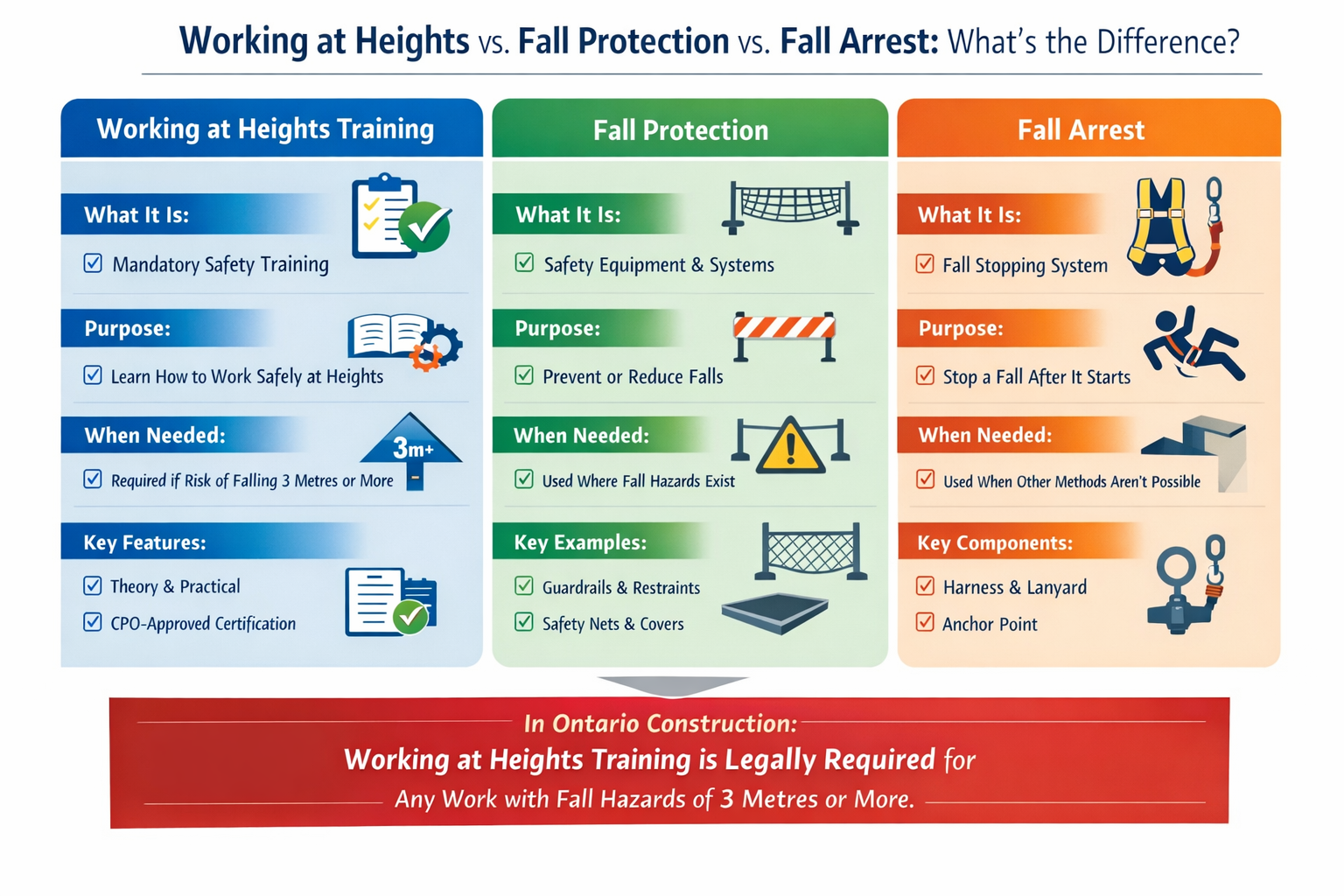
Working at Heights vs Fall Protection vs Fall Arrest (Quick Comparison)
Below is a simplified comparison to clearly separate these concepts.
Key Differences at a Glance
Working at Heights Training
- What it is: Mandatory safety training program
- Purpose: Teach hazard recognition and safe use of fall protection
- Applies when: Workers may fall 3 metres or more on construction projects
- Legal status in Ontario: Required by law
- Includes: Theory + hands-on practical evaluation
Fall Protection
- What it is: Safety systems and controls
- Purpose: Prevent or reduce the risk of falling
- Applies when: Fall hazards exist
- Legal status in Ontario: Required when hazards are present
- Includes: Guardrails, restraint systems, fall arrest systems
Fall Arrest
- What it is: One type of fall protection
- Purpose: Stop a fall after it begins
- Applies when: Other fall prevention methods are not feasible
- Legal status in Ontario: Permitted only with proper training
- Includes: Harness, lanyard, anchor, connectors
Why This Difference Matters
Many employers assume that providing fall arrest equipment or basic fall protection instruction satisfies legal requirements.
In Ontario construction, it does not.
If a worker may need fall protection, Working at Heights training is the required foundation.
Why Fall Protection Training Is Not a Substitute for Working at Heights Training
This is where many Ontario employers get caught off guard.
Fall protection training and Working at Heights training are not interchangeable.
Fall protection training usually focuses on:
- How to wear a harness
- How to connect to an anchor
- How specific equipment works
That type of training can be useful, but on its own it does not meet Ontario’s legal requirements for construction work.
The Legal Distinction Employers Must Understand
In Ontario construction, Working at Heights training is the mandatory baseline when workers may be exposed to fall hazards of 3 metres or more.
Fall protection training:
- May be equipment-specific
- May be informal or internal
- Often varies in depth and quality
Working at Heights training:
- Must be CPO-approved
- Must follow a provincial training standard
- Includes both theory and practical evaluation
- Is recognized during inspections and investigations
If a worker has only received fall protection or harness training, inspectors may still determine that the worker is not properly trained for work at heights.
This is a common reason for orders, stop-work directions, and penalties.
How Ontario Inspectors Assess Compliance
During a on-site inspection, compliance is not evaluated based on good intentions.
Inspectors from the Ontario Ministry of Labour typically assess three things together:
1. Is a Fall Hazard Present?
Inspectors look for:
- Unprotected edges
- Ladder use at height
- Roof work
- Elevated platforms
- Openings or skylights
If a fall hazard exists, enforcement attention increases immediately.
2. Is Fall Protection Being Used or Required?
Inspectors assess:
- Whether fall protection systems are in place
- Whether those systems are appropriate for the task
- Whether equipment appears properly set up
If fall protection is required, training requirements follow automatically.
3. Are Workers Properly Trained?
This is where documentation matters.
Inspectors commonly ask:
- Have workers completed CPO approved Working at Heights training?
- Is the training still valid?
- Can the employer produce training records on request?
- Do workers understand the systems they are using?
If workers cannot demonstrate training or records are missing, enforcement action may follow even if equipment is present.
Why This Matters for Employers
Providing equipment without proper training does not meet legal expectations.
In Ontario construction, training, equipment, and supervision must work together.
Working at Heights training forms the foundation.
Fall protection systems support it.
Fall arrest systems are used only when appropriate and with proper competency.
Compliance Takeaway for Ontario Employers
In Ontario construction, these terms are not interchangeable.
-
Working at Heights training is the mandatory legal foundation when workers may fall 3 metres or more.
-
Fall protection refers to the systems used to control fall hazards.
-
Fall arrest is one specific fall protection method that stops a fall after it begins.
Providing fall protection equipment or basic harness instruction does not replace approved Working at Heights training. Inspectors assess hazards, equipment, and training together.
If fall protection is required for the task, CPO approved Working at Heights training is required for the worker.
Understanding and applying this distinction is a key part of meeting Ontario compliance expectations and demonstrating due diligence.
Final Note for Employers and Supervisors
Fall-related incidents are rarely caused by a single failure. They usually involve a combination of unrecognized hazards, improper equipment use, and gaps in training.
Clear understanding of working at heights requirements helps prevent those gaps.
When employers align training, equipment, and supervision with Ontario standards, they reduce risk, improve inspection outcomes, and create safer job sites for everyone involved.
For workplaces where fall hazards exist, clarity is not optional. It is a responsibility.