Is Working at Heights training required below 3 metres in Ontario? Learn about the 3m rule, exemptions, fall protection requirements, and employer responsibilities.
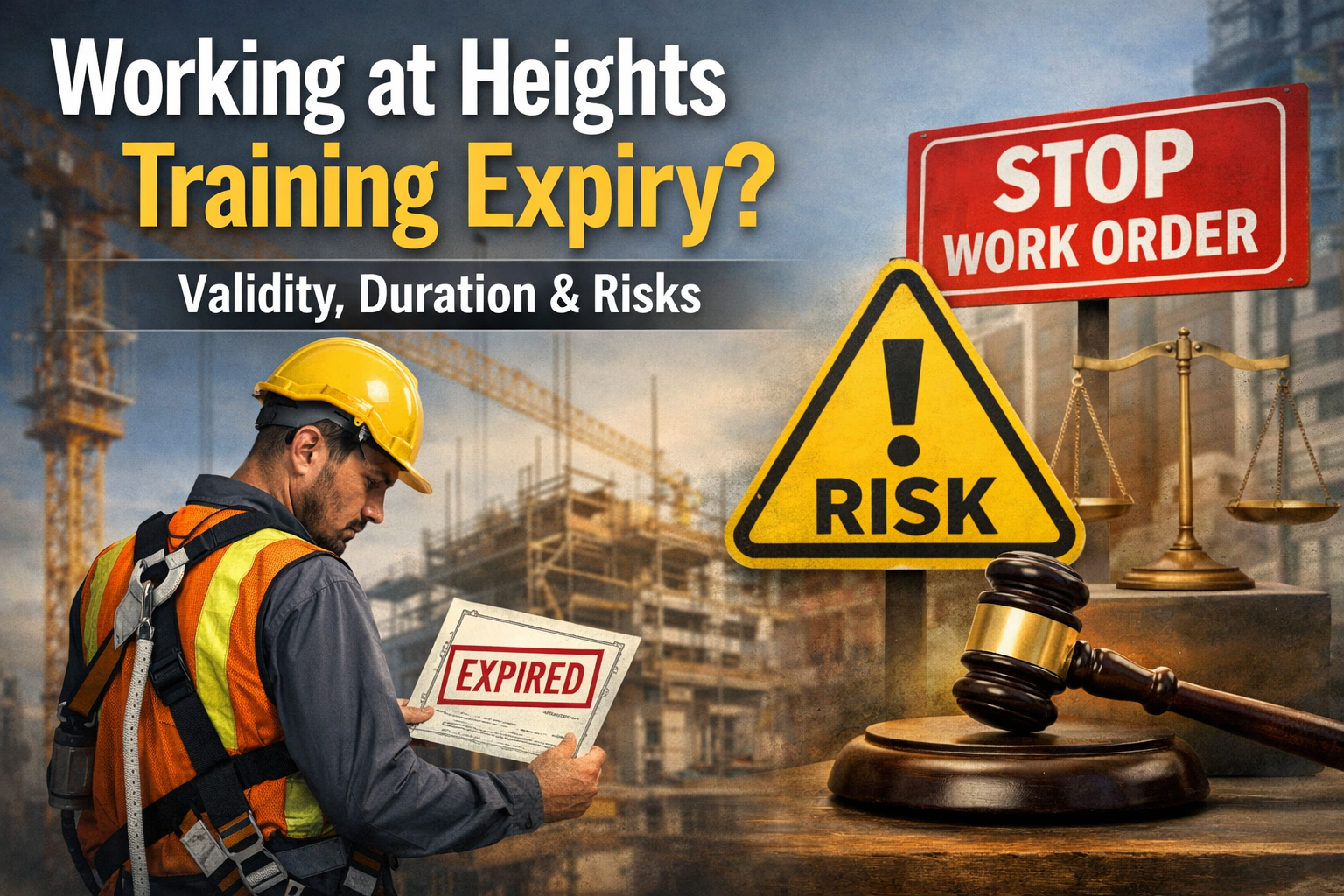
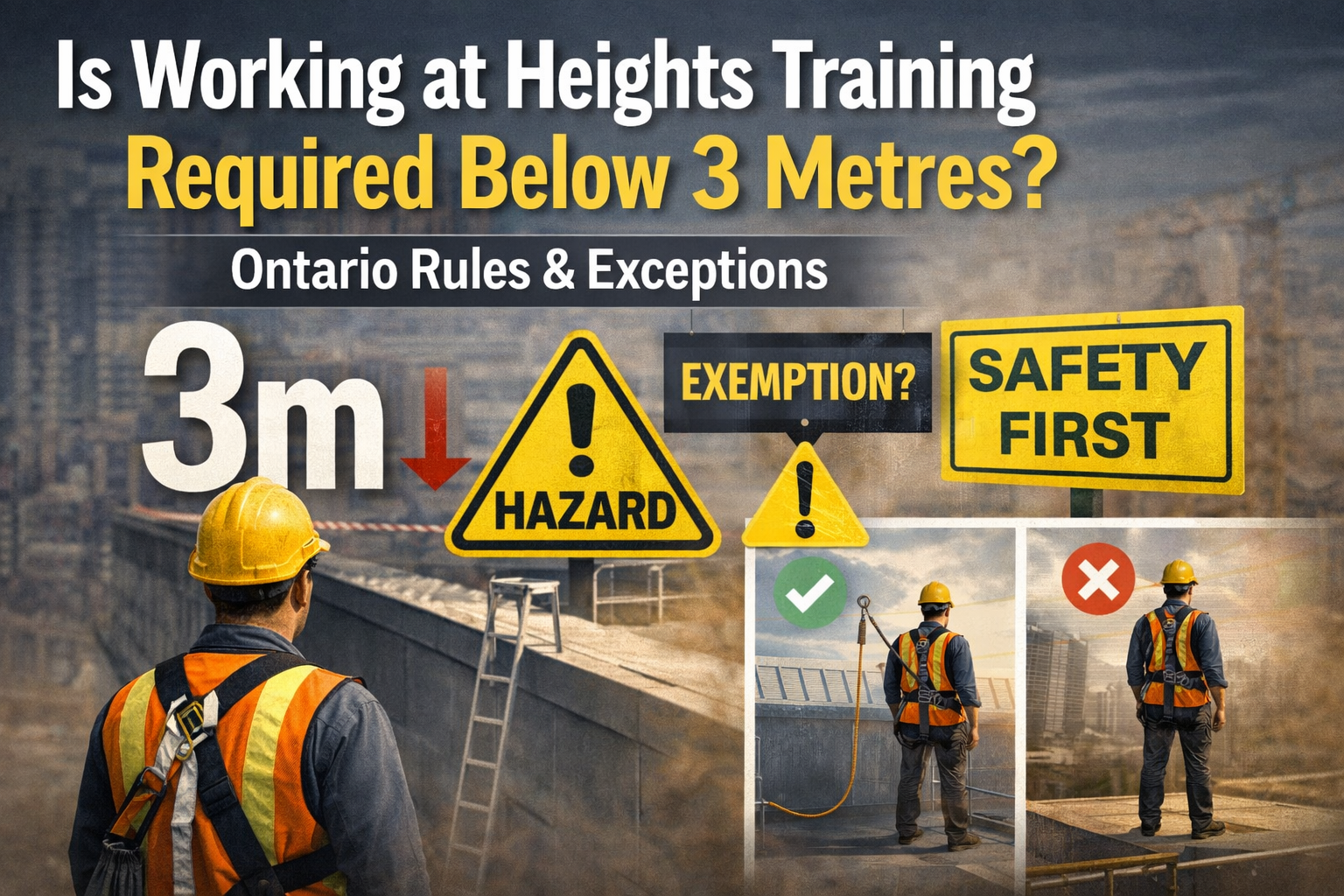
Working at Heights training in Ontario is generally required on construction projects when workers are exposed to fall hazards of 3 metres or more or when fall protection systems are required. Work performed below 3 metres may not automatically trigger the training requirement, but employers must still assess hazards and implement appropriate safety controls.
- Is Working at Heights Training Required Below 3 Metres in Ontario?
- The 3-Metre Threshold Explained
- What About Working at Heights Under 3 Metres?
- Situations Where Training May Still Be Required Below 3 Metres
- Construction Projects vs. Other Workplaces
- Why Falls Below 3 Metres Still Matter
- Employer Responsibilities Below 3 Metres
- Quick Decision: Is Working at Heights Training Required?
- Frequently Asked Questions: Working at Heights Under 3m
- Is Working at Heights training required under 3 metres in Ontario?
- Are there exemptions to Working at Heights training in Ontario?
- Can someone fall seriously from less than 3 metres?
- Who needs Working at Heights training in Ontario?
- Does the 3-metre rule apply outside construction?
- Final Takeaway
Is Working at Heights Training Required Below 3 Metres in Ontario?
The “3-metre rule” is one of the most misunderstood aspects of Working at Heights requirements in Ontario.
Many employers assume that if work is performed below 3 metres, no formal training or precautions are necessary. That assumption is not always correct.
Ontario’s construction regulations set clear thresholds for mandatory Working at Heights training, but hazard exposure and fall protection use are equally important factors.
The 3-Metre Threshold Explained
On construction projects in Ontario, Working at Heights training is generally required when:
- A worker may fall 3 metres or more, and
- A fall protection system may be required or used
This requirement is tied to Ontario construction regulations and enforced during inspections by the Ontario Ministry of Labour.
If a worker is exposed to a fall of 3 metres or more and fall protection is required, CPO-approved Working at Heights training in Ontario is mandatory.
What About Working at Heights Under 3 Metres?
If work is performed below 3 metres and no fall protection system is required, the specific Working at Heights training regulation may not be triggered.
However:
- The employer still has a duty under Ontario safety law to take every reasonable precaution
- Fall hazards can still cause serious injury below 3 metres
- Hazard assessments must still be completed
- Appropriate controls must still be implemented
The absence of the 3-metre trigger does not remove the employer’s responsibility to manage fall risk.
Ontario.
Situations Where Training May Still Be Required Below 3 Metres
The 3-metre threshold is not the only factor that determines whether Working at Heights training is required.
Training may still be necessary below 3 metres if:
- A fall protection system is required due to site conditions
- A worker is exposed to hazardous surfaces below (rebar, machinery, sharp materials)
- There is a risk of falling into operating equipment or water
- A guardrail or barrier is not in place where required
- The work is part of a construction project and fall protection systems are being used
In these situations, the hazard severity — not just the height — becomes the determining factor.
If a fall protection system is required, training is generally required.
Construction Projects vs. Other Workplaces
Working at Heights training requirements under Ontario regulations apply specifically to construction projects.
If work is not classified as construction under Ontario regulations, the formal Working at Heights training standard may not apply. However:
- Employers still have obligations under the Occupational Health and Safety Act
- Hazard assessments must still be conducted
- Appropriate safety measures must still be implemented
Even outside construction, fall hazards below 3 metres can cause serious injury.
The legal requirement may differ, but the duty to protect workers does not.
Why Falls Below 3 Metres Still Matter
Many serious injuries occur from falls under 3 metres.
Factors that increase injury severity include:
- Hard or uneven landing surfaces
- Confined work areas
- Obstructions during descent
- Improper ladder positioning
- Loss of balance while carrying materials
The absence of a regulatory trigger does not eliminate the physical risk.
Employers who focus only on minimum legal thresholds may overlook real exposure.
Employer Responsibilities Below 3 Metres
When work is performed under 3 metres, employers must still:
- Identify and assess fall hazards
- Implement appropriate control measures
- Provide supervision and instruction
- Ensure equipment is safe and properly used
Depending on the task, this may include:
- Ladder safety training
- Fall protection awareness training
- Safe work procedures
- Guardrails or barriers
Training may not be legally mandatory under the 3-metre rule in every scenario, but risk management remains mandatory.
Quick Decision: Is Working at Heights Training Required?
Use the framework below to determine whether Working at Heights training is required in Ontario.
Training is required when:
- The work is a construction project
- A worker may fall 3 metres or more
- A fall protection system is required or used
Training may not be required when:
- The work is below 3 metres
- No fall protection system is required
- The task is not classified as construction
However, even when formal Working at Heights certification is not triggered, employers must still assess hazards and implement appropriate safety controls.
The legal threshold is not the same as the safety threshold.
Frequently Asked Questions: Working at Heights Under 3m
These answers are structured for clear retrieval and direct response.
Is Working at Heights training required under 3 metres in Ontario?
Not automatically. The formal Working at Heights training requirement typically applies when a worker may fall 3 metres or more on a construction project. Work performed below 3 metres may not trigger the regulation, but employers must still assess and control fall hazards.
Are there exemptions to Working at Heights training in Ontario?
The 3-metre threshold functions as a general trigger for mandatory training on construction projects. However, if a fall protection system is required — even below 3 metres due to hazardous conditions — training may still be necessary. Employers must evaluate risk, not just height.
Can someone fall seriously from less than 3 metres?
Yes. Falls from less than 3 metres can result in fractures, head injuries, or long-term disability, especially when landing surfaces are hard or obstructed. The absence of a regulatory trigger does not eliminate injury risk.
Who needs Working at Heights training in Ontario?
Workers on construction projects who may be exposed to fall hazards of 3 metres or more and who may use fall protection systems must complete CPO-approved Working at Heights training before performing elevated work.
Does the 3-metre rule apply outside construction?
The specific Working at Heights training standard applies to construction projects. Other workplaces may be governed by different regulations, but employers remain responsible for hazard assessment and fall protection under the Occupational Health and Safety Act.
Final Takeaway
Working at Heights training in Ontario is generally required at 3 metres or more on construction projects, or whenever fall protection systems are required.
Work performed below 3 metres may not always trigger mandatory certification, but fall hazards still exist and must be controlled.
Understanding the difference between regulatory thresholds and real-world risk helps employers protect workers while maintaining compliance.
| # | Citation | Key Focus |
|---|---|---|
| 1 | Ontario Ministry of Labour, Immigration, Training and Skills Development (MLITSD). Training for Working at Heights. | Official government portal detailing the mandatory CPO-approved training requirements under O. Reg. 297/13 for construction projects. |
| 2 | Government of Ontario. O. Reg. 213/91: Construction Projects (Section 26). | The primary regulation establishing the 3-metre (10 feet) threshold for mandatory fall protection and the specific equipment triggers for training. |
| 3 | Infrastructure Health & Safety Association (IHSA). Working at Heights (V001). | Technical guide from Ontario’s health and safety association explaining the 3-metre rule and the risk factors that necessitate fall protection. |
| 4 | Achieve Safety (2026). Ontario Working at Heights Training Requirements and Laws. | Authoritative industry analysis of O. Reg. 213/91, clarifying that training is required if a worker may fall 3 metres or more, regardless of current height. |
| 5 | Canadian Centre for Occupational Health and Safety (CCOHS). Fall Protection – Legislation. | National summary of fall protection laws, confirming the 3-metre standard used across Ontario and other Canadian jurisdictions. |
| 6 | Holmes Safety Training (2024). The Complete Guide to Working at Heights Training in Ontario. | Detailed guide explaining that training may be required below 3 metres if the surface below poses a significant risk (e.g., open vats or machinery). |
| 7 | ScienceDirect (2020). Preventing fall-from-height injuries in construction: Effectiveness of a regulatory training standard. | Peer-reviewed research evaluating the impact of Ontario’s 2015 Working at Heights training standard on reducing workplace injuries. |