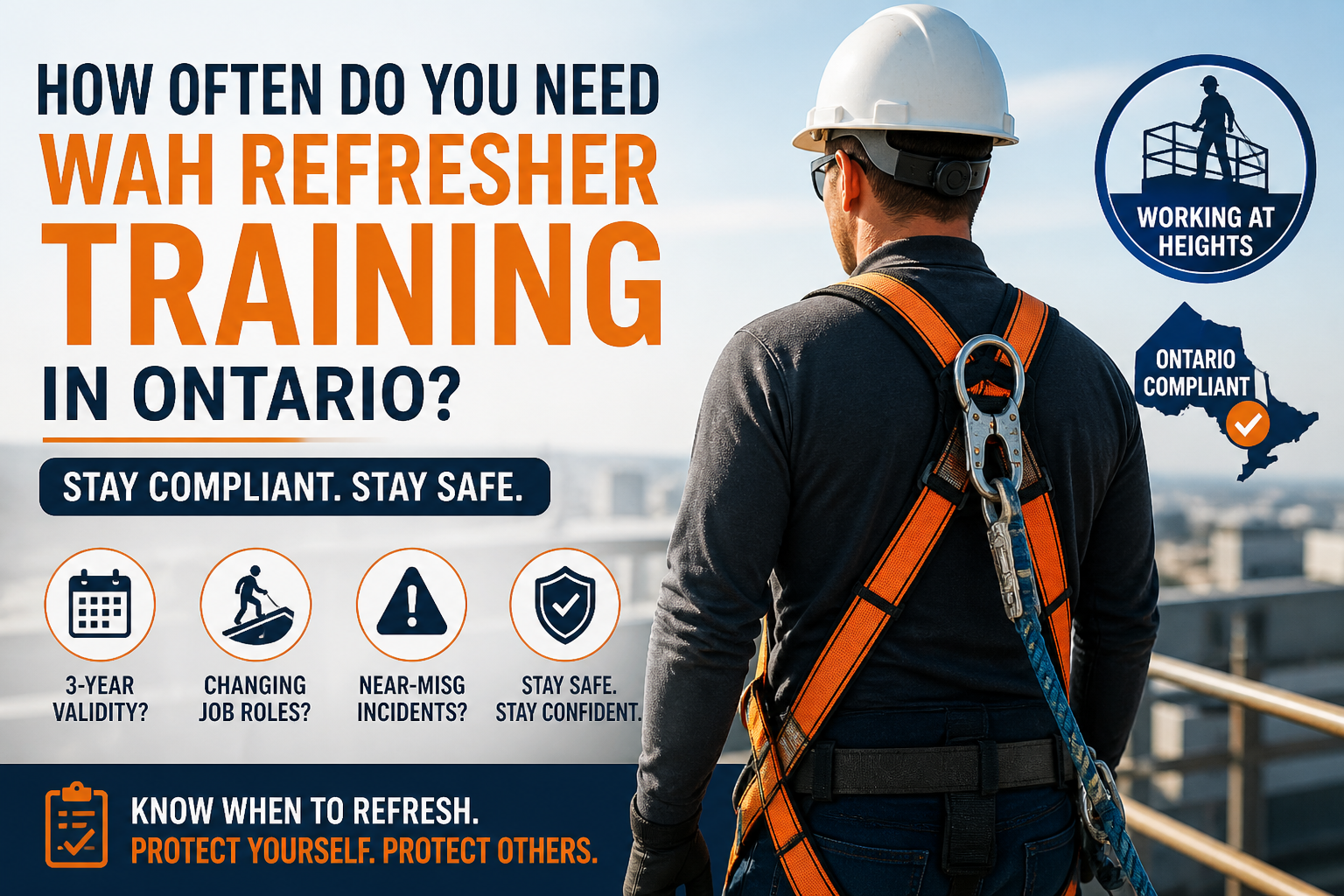
Do you really have to wait for your Working at Heights certificate to expire before taking refresher training?
No.
The legal rule gives you a deadline.
It does not always give you the safest timing.
In Ontario, refresher training is tied to standards under the Occupational Health and Safety Act and related working at heights regulations. Most workers know about the 3-year validity period.
But here’s what gets missed:
Waiting for expiry is the minimum.
Not always the safest choice.
This article explains when you actually need refresher training based on real work conditions, not just the calendar.
Official Expiry vs Real-World Practice
Let’s separate fact from practice.
What the Rule Says
- Working at Heights training is valid for 3 years in Ontario
- A refresher course is required before it expires
- Employers must ensure workers remain compliant
That is the legal baseline.
What Actually Happens on Job Sites
In real workplaces, training cycles are not always tied to expiry dates.
Why?
Because risk changes faster than certifications.
Situations where workers retrain earlier:
- Moving to a higher-risk environment
- Switching equipment or fall protection systems
- Returning after long gaps away from height work
In these cases, waiting for expiry creates a gap between:
- What you were trained on
- What you are actually doing now
That gap is where incidents happen.
The Real Question You Should Be Asking
Not:
“When does my certificate expire?”
But:
“Am I still fully confident and aligned with current job risks?”
If the answer is no, refresher training is already due.
When You Should Take Refresher Training Before Expiry
This is where most workers and employers get it wrong.
WAH Refresher training should be triggered by change, not just time.
Change in Work Environment
New site. New risks.
Examples:
- Transition from residential to commercial construction
- Working at greater heights than before
- Exposure to different edge protection systems
Each environment introduces different fall hazards.
New Equipment or Systems
Even small changes matter.
- Different harness systems
- New anchor types
- Updated lifeline setups
If you have not been trained on that exact setup, you are guessing.
Time Away From Working at Heights
Skills fade faster than expected.
If you have not worked at heights for a while:
- Muscle memory drops
- Inspection habits weaken
- Risk awareness slows down
Refresher training resets that.
Near-Miss or Unsafe Situation
This is the clearest signal.
If something almost went wrong:
- Improper tie-off
- Equipment misuse
- Loss of balance near edges
That is not “bad luck.”
It is a warning.
Training should follow immediately.
Lack of Confidence on Site
This one is simple and honest.
If you feel unsure about:
- Setting up fall protection
- Choosing anchor points
- Inspecting equipment
You are not ready to rely on your current training.
Confidence in this context means clarity, not comfort.
How Employers Decide Refresher Training Frequency
Not every company waits for the 3-year mark.
Smart employers base refresher timing on risk, role, and exposure, not just compliance deadlines.
Risk Level of the Work
Higher risk means shorter retraining cycles.
- Roofing, steel work, high-rise → more frequent refreshers
- Light maintenance or controlled environments → closer to standard cycle
The more severe the fall risk, the less room there is for outdated knowledge.
Type of Tasks Performed
Two workers can have the same certification but very different risk profiles.
- One installs guardrails occasionally
- Another works daily near open edges
Employers adjust training frequency based on how often workers are exposed to fall hazards.
Changes in Site Conditions
Construction and industrial environments evolve constantly.
- New structures
- Changing elevations
- Temporary setups
Each change can introduce new hazards that were not covered in previous training.
Internal Safety Policies
Many companies go beyond minimum legal requirements.
They build internal rules like:
- Mandatory refreshers every 1–2 years
- Retraining after any incident or near-miss
- Site-specific refresher briefings
Why?
Because prevention costs less than incidents.
Industry Best Practice vs Legal Minimum
There is a difference between being compliant and being safe.
Legal Minimum
- Refresher required every 3 years
- Meets requirements under the Occupational Health and Safety Act
Best Practice
High-performing safety programs do more:
- Retrain before risk increases
- Refresh knowledge after changes
- Reinforce practical skills regularly
These workplaces treat training as ongoing, not one-time.
What This Means for You
If you are relying only on expiry:
- You are technically compliant
- But potentially exposed to unnecessary risk
If you retrain based on real conditions:
- You stay aligned with actual job demands
- You reduce chances of error on site
Quick Decision Guide (Do You Need Refresher Training?)
Use this simple check:
- Changed job role recently → Yes
- Using new fall protection equipment → Yes
- Had a near-miss or unsafe moment → Yes
- Been away from working at heights → Yes
- Still doing same work, no changes, within 3 years → You can wait
If you answered “yes” to any of the first four, do not wait for expiry.
Stay Compliant and Confident on Site
Refresher training is not just about renewing a certificate.
It is about:
- Staying sharp
- Adapting to real job conditions
- Reducing risk before it turns into an incident
👉 Book your Working at Heights Refresher Training Course Certification in Ontario , if you are in Toronto you are good to go with our Working at heights training in Toronto as well.
Final Takeaway
Expiry dates set the minimum.
Real work conditions set the standard.
Do not wait for the clock if your environment, equipment, or confidence has changed.
That is how incidents are prevented.