- Step 1: Confirm CPO Approval
- Find CPO approved WAH training certification program here
- Why CPO Approval Matters
- Step 2: Evaluate Instructor Qualifications
- Step 3: Assess Practical Training Setup and Class Size
- Step 4: On-Site Training vs Facility-Based Training
- Step 5: Reputation, Reviews, and Industry Experience
- Step 6: Documentation and Administrative Support
- What the Best Working at Heights Training Providers Have in Common
- Questions to Ask Before Booking
- What a Strong WAH Training Provider Looks Like in Practice
- FAQs: Choosing a Working at Heights Training Provider
Learn how to choose a CPO-approved Working at Heights training provider in Ontario. What approval means, instructor standards, and how to verify legitimacy.
Summary
To choose a legitimate Working at Heights training provider in Ontario, confirm the provider is approved by the Chief Prevention Officer (CPO). Only CPO-approved providers can issue valid certification under Ontario construction regulations. Employers should also evaluate instructor qualifications, practical training setup, class size, and documentation support.
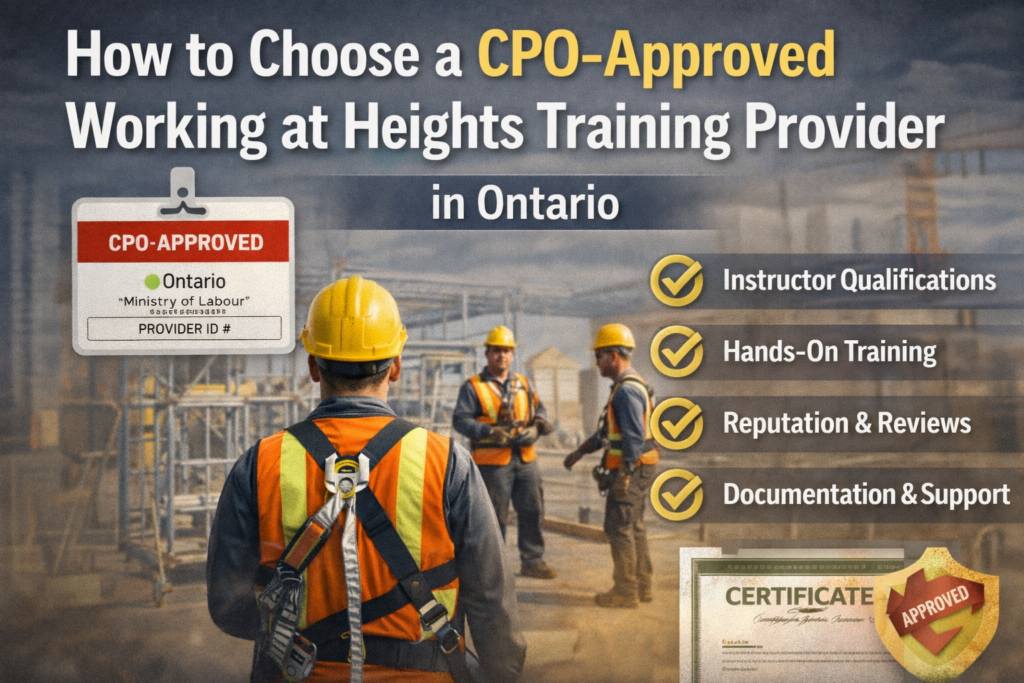
Not all Working at Heights training is equal.
In Ontario, only Chief Prevention Officer (CPO)–approved training providers are legally authorized to deliver Working at Heights training and issue valid certification for construction projects.
Choosing the wrong provider can result in invalid certificates, inspection failures, and costly retraining.
Selecting the right provider requires more than comparing prices.
Step 1: Confirm CPO Approval
The most important requirement is CPO approval.
Under Ontario’s Working at Heights Training Program Standard, only providers approved by the Chief Prevention Officer may:
- Deliver the mandatory Working at Heights course
- Conduct practical evaluations
- Issue valid certification
- Register training completion records
Certificates issued by non-approved providers may not be accepted during inspections.
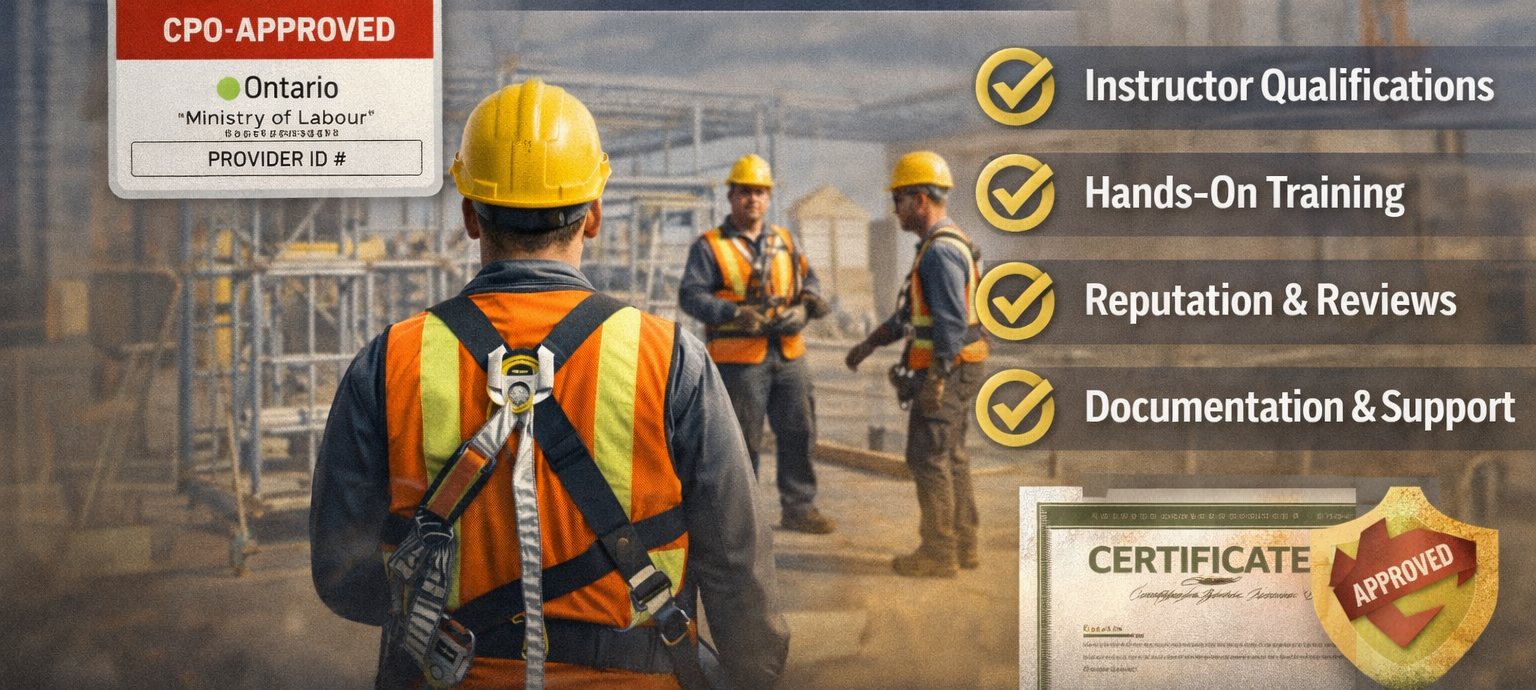
Achieve Safety appears in the ontario.ca official list of CPO approved providers as seen below. It can also be vaerified by searching for Achieve Safety and Compliance on Ontario’s official website
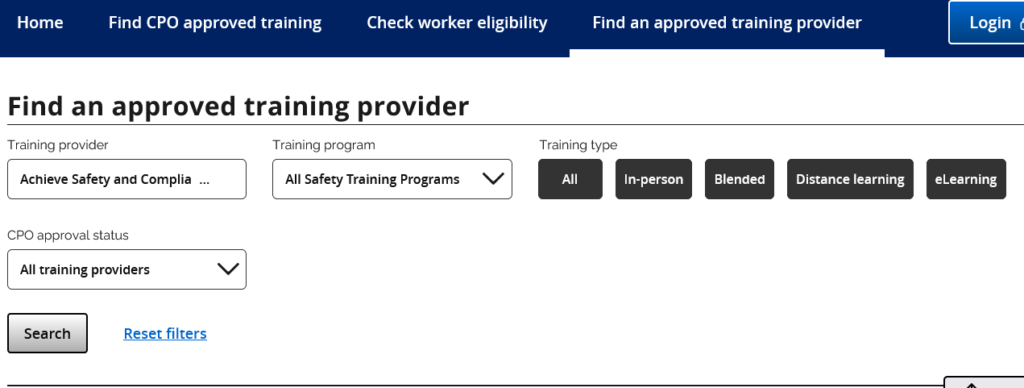
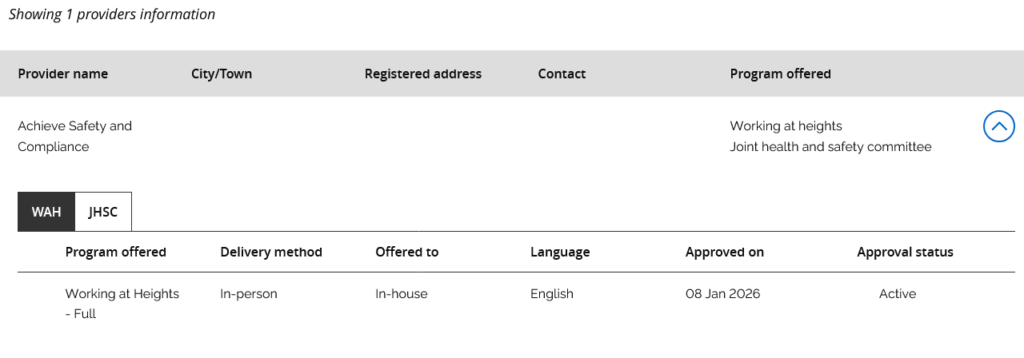
Find CPO approved WAH training certification program here
Before enrolling, employers should:
- Verify the provider appears on Ontario’s official CPO approval list
- Request the provider’s approval number
- Confirm the course meets current Ministry standards
CPO approval ensures the training content, evaluation methods, and instructors meet provincial regulatory requirements.
Why CPO Approval Matters
CPO approval is not a marketing designation. It is a regulatory authorization.
To obtain approval, providers must demonstrate:
- Compliance with Ontario’s Working at Heights Training Standard
- Qualified instructors who meet Ministry criteria
- Proper course structure and practical evaluation procedures
- Record management systems that meet compliance requirements
Providers are subject to oversight and audit.
If a provider loses approval status, certificates issued afterward may not be valid.
Employers should never assume a provider is approved without verification.
Step 2: Evaluate Instructor Qualifications
CPO approval sets minimum standards, but instructor quality still matters.
Working at Heights instructors should have:
- Direct construction or safety experience
- Strong understanding of Ontario’s Occupational Health and Safety Act
- Practical fall protection knowledge
- Adult education or instructional skills
In 2024, Ontario strengthened oversight around training delivery and instructor requirements. Providers must ensure instructors are competent not only in safety content but also in delivering structured evaluation and practical assessment.
When evaluating a provider, consider:
- Do instructors have real-world construction safety backgrounds?
- Can they explain inspection expectations clearly?
- Do they conduct meaningful hands-on evaluations?
An experienced instructor improves learning outcomes and reduces on-site risk.
Step 3: Assess Practical Training Setup and Class Size
Working at Heights training is not purely classroom-based. It includes mandatory practical evaluation.
A reputable provider should have:
- Safe, properly constructed anchor and fall protection demonstration setups
- Real harnesses, lanyards, connectors, and inspection examples
- Clear practical evaluation procedures
- Controlled class sizes to allow proper supervision
Large class sizes can reduce hands-on time and compromise evaluation quality.
Ask:
- How many participants per session?
- How is practical competency assessed?
- Is the setup compliant and professionally maintained?
Training quality depends on both instruction and environment.
Step 4: On-Site Training vs Facility-Based Training
Many employers prefer on-site training for crews.
A strong provider should be able to:
- Deliver training at the employer’s location when appropriate
- Ensure practical evaluation standards are still met
- Adapt to site-specific hazards
- Maintain compliance documentation regardless of location
On-site training can reduce scheduling disruption, but it must still meet full CPO program requirements.
Flexibility should never compromise compliance.
Step 5: Reputation, Reviews, and Industry Experience
Beyond regulatory approval, reputation matters.
Consider:
- Online reviews
- Testimonials from construction employers
- Years of experience in Ontario safety training
- Whether the provider specializes in construction compliance
An established provider with deep industry experience is more likely to:
- Stay current with regulatory updates
- Deliver consistent training quality
- Provide reliable administrative support
Experience translates into smoother compliance management.
Step 6: Documentation and Administrative Support
Working at Heights compliance does not end when the course finishes.
Employers must maintain:
- Valid certificates
- Expiry tracking
- Accessible training records
A quality provider should:
- Issue certificates promptly
- Maintain digital training records
- Assist with documentation verification when requested
- Provide clear guidance on refresher timelines
Administrative support reduces compliance risk.
What the Best Working at Heights Training Providers Have in Common
The best providers share several characteristics:
- Verified CPO approval seal
- Experienced instructors with real-world safety backgrounds
- Structured practical evaluation
- Clear documentation systems
- Strong reputation within the construction community
- Transparent communication about compliance requirements
Choosing a provider should be based on regulatory legitimacy, instructional quality, and operational reliability.
Questions to Ask Before Booking
Employers should ask any potential provider:
- Are you currently CPO-approved?
- What is your provider approval number?
- How is practical evaluation conducted?
- What happens if certification records are requested during an inspection?
- Do you offer refresher training scheduling support?
A professional provider will answer clearly and confidently.
What a Strong WAH Training Provider Looks Like in Practice
A reliable Working at Heights training provider combines regulatory approval with practical construction experience. For example, experienced providers in Ontario typically employ instructors with extensive industry backgrounds, structured hands-on evaluation processes, and well-documented compliance systems.
Providers with long-standing safety consulting experience also tend to understand inspection expectations and due diligence requirements beyond the classroom.
Organizations that offer ongoing support, refresher reminders, and accessible digital training records demonstrate a commitment to long-term compliance rather than one-time course delivery.
FAQs: Choosing a Working at Heights Training Provider
What is a CPO-approved Working at Heights course?
A CPO-approved Working at Heights course is a training program authorized by Ontario’s Chief Prevention Officer. Only approved providers can legally deliver the mandatory Working at Heights training required under Ontario construction regulations and issue valid certification.
How do I verify a Working at Heights training provider in Ontario?
To verify a provider:
-
Check Ontario’s official CPO-approved provider list
-
Request the provider’s CPO approval number
-
Confirm the course meets Ontario’s Working at Heights Training Standard
-
Ensure practical evaluation is included
Never rely solely on marketing claims.
Can any safety company offer Working at Heights training?
No. Only providers approved by the Chief Prevention Officer may legally issue valid Working at Heights certification for construction projects in Ontario. General “fall protection training” is not a substitute unless delivered under CPO approval.